
Last week when the Taoiseach managed to exit the Oval Office with his dignity – and then some – it’s fair to say that many of us felt relieved, if a little dirty. Those images will never not be disturbing. But then, as if we needed to be reminded precisely whom he had been consorting with, a Trump post promptly blasted through what the 18th century philosopher Edmund Burke called “the decent drapery of life”.
“Good. I’m glad he’s dead. He can no longer hurt innocent people!”, wrote the five-time draft dodger of Robert Mueller, an honourable public servant and decorated war veteran, an old man dead from Parkinson’s, his wife and daughters still absorbing the terrible finality of his last breath. Trump’s celebratory post landed only minutes after the public announcement.
Though many of us cleave to the old guidance of not speaking ill of the dead (in public anyway, and with a decent time lapse), we know better than to expect decency from Trump, a man who has delighted in abusing the memories of people like John McCain, Colin Powell and Rob Reiner after their deaths.
In a normal world, that chilling absence of empathy will always stop people in their tracks and even remind us why manners matter. Burke believed that manners are more important than laws because the laws depend on them. “The law touches us but here and there, and now and then. Manners are what vex or soothe, corrupt or purify, exalt or debase, barbarise or refine us, by a constant, steady, uniform, insensible operation, like that of the air we breathe in.”
Whatever the flaws in Burke’s philosophy, those universal truths endure. So does his conviction that the cultivation of human sympathy and a capacity to share in the suffering of others are fundamental to a healthy society. Manners, sympathy and empathy. Now try mapping that full house on to Maga and the White House.
Contrast Trump’s barbarism towards Mueller and his beatification of Charlie Kirk, the hugely influential Magaverse podcaster shot dead last September. Apart from his verbal onslaughts on gun control and DEI initiatives, Kirk targeted empathy itself. He couldn’t stand the word, viewing it as “a made-up, New Age term that does a lot of damage, but is very effective when it comes to politics”.
From his heavenly perch he must have been perplexed at the Magaverse’s turbocharged performances of empathy on his death, not to mention their hounding of minor social media figures who lost their jobs for expressing relief or merely quoting his more controversial words.
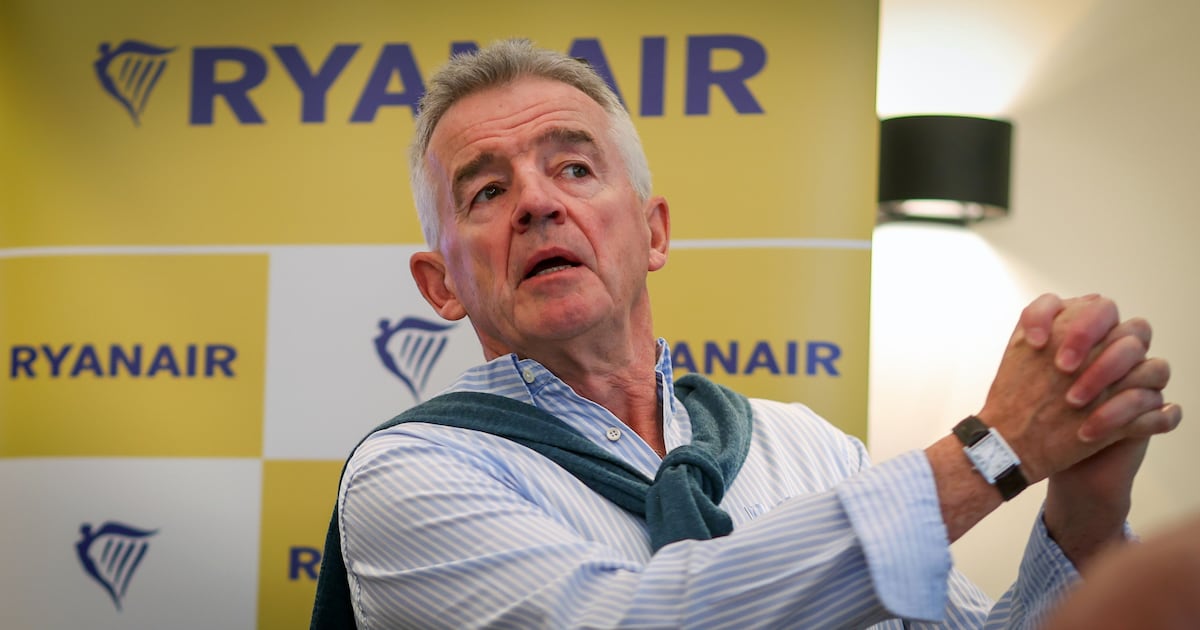
As for the rest of us here, we continue the self-defeating task of looking for empathy in unlikely places. Ryanair CEO Michael O’Leary always gave a persuasive impression of someone who sees empathy as a weakness in the bigger picture. Now we learn that the airline has redefined “immediate” family for us. A woman whose brother died in Edinburgh the day before she was due to visit him, sought a refund on her €560 ticket on the basis that he was “immediate family” – which he was, by Ryanair rules. But while her repeated requests were stonewalled, according to an article in The Irish Times by Conor Pope, a new definition of “immediate” family was slipped in to the airline’s updated terms and conditions. And her deceased brother was no longer “immediate” family.
For clarity: Ryanair’s terms and conditions no longer regard your siblings, grandparents or grandchildren as “immediate” family and you can also forget about the in-laws.
We’ve learned the hard way how “low fares” regimes work, but what a strangely cruel compact we have entered into where a €35 billion corporation leeches the humanity out of its responses to a grieving woman. When forced to concede, there was no apology for the gaslighting, for the waste of time, for the withholding of a large sum of money from a customer already in distress – only regret that “our customer service agent made an error in applying our current bereavement policy (which dates from April 2025) to this case, when the booking was dated Feb 2025, and therefore the old policy should have been applied”. The airline said it had applied a refund “last week prior to your query”.
O’Leary answers to a board that is evenly divided between men and women, who must at least be aware of such occurrences.
Thirteen years ago after one particularly egregious exchange with a grieving passenger, he accepted that the airline should “try to eliminate things that unnecessarily piss people off” and that would include encouraging staff to be more lenient on people whose bags are only “millimetres” above size regulations, he said. These days, staff are incentivised to hunt down those miscreants.
Customers can of course take out travel insurance where they have “concerns about the health of wider relatives at time of booking”, as Ryanair advises. Ryanair could also try adopting a corporate ethos which factors some degree of humanity into what increasingly feels like a hustlers’ world.
Aer Lingus still counts siblings, grandparents, grandchildren, nephews, nieces, aunts, uncles and in-laws as immediate family. So feck off to Aer Lingus, O’Leary would undoubtedly reply. When he retires, O’Leary once told Marian Finucane, he wants to hand the business over to people who will run it “in a more professional manner than I do, people who will say the right thing about the environment and customers and dogs and old people, because I’m not that kind of person . . .”
But it’s not about saying the right thing. It’s about observing the debasement of bonds, empathy and civility that keep us safe and sane and doing the right thing.