
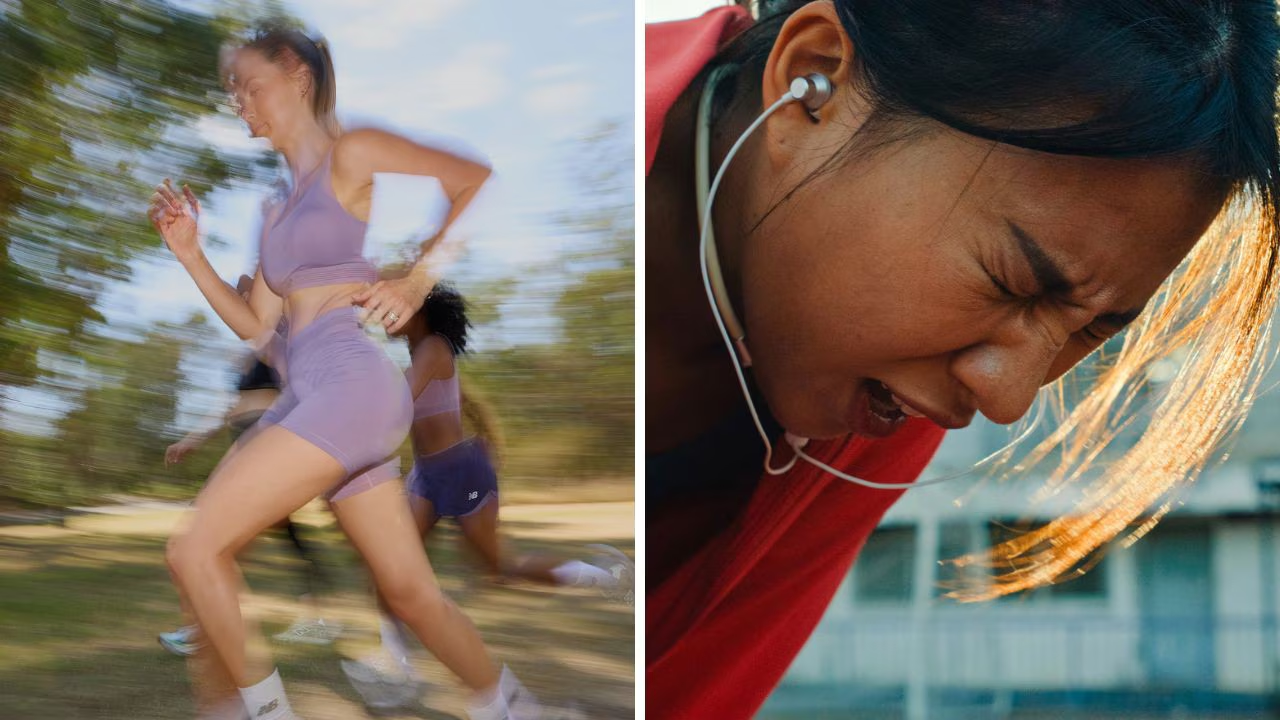
If you’ve spent the last few years feeling personally victimised by your smartwatch, you aren’t alone. We’ve become a nation obsessed with the grind, where a 5km run doesn’t count unless it’s uploaded to a leaderboard and your heart rate has hit the red zone.
But according to the women behind Australia’s biggest wellness empire, we’re officially over it.
This is where the Soft Escape comes in. It’s a movement that rejects the ‘toxic’ pressure to constantly chase PBs and instead asks a radical question: What if you just ran because it felt good?
NEED TO KNOWAfter years of “grind culture”, Australia’s biggest wellness moguls are officially rejecting the standard gym model for a radical new approach.Just 14 weeks after welcoming son Atlas, Laura Henshaw reveals why she’s ditching the “bounce-back” pressure for a strategy she calls the “Soft Escape.”While we’re told to disconnect, many women prefer not to run without a phone. There’s one specific setting Laura uses to find solitude without going off-grid.We put the “Soft Escape” to the test to see if a non-runner could actually find joy without a leaderboard or steps counted.The ‘Atlas’ effect
KIC co-founders Steph Claire Smith and Laura Henshaw are the catalysts for this pivot. For Laura, “The Soft Escape” isn’t a marketing slogan; it’s a survival strategy. Just 14 weeks ago, she welcomed her son, Atlas.
Her return to the pavement has been a raw departure from the “bounce-back” culture we usually see online, one where the goal isn’t to hit a pre-baby pace, but to simply find twenty minutes of solitude.
But for most women, the dream of “unplugging” comes with a side of realistic anxiety. We’re told to “disconnect,” yet we carry our phones for safety, music, and – in Laura’s case – to ensure a post-partum body isn’t being pushed too hard, too soon.
“This has definitely changed since becoming a mum,” Laura admits. “There were times when I would go for a run to the beach for a swim without my phone, but now my phone comes everywhere with me.”
The trick to a ‘Soft Escape’ isn’t about disappearing off the grid; it’s about being selectively available. It’s using your phone as a safety tool and a coach, while silencing the noise that makes you feel like you’re ‘on the clock’
“I’ve only just started running again this week,” Laura says. “I’m following our KICRun return to running post-partum program, so I need my phone and AirPods so I can follow the prompts on when to run, and when to slow down, so I can build up my running strength safely.”
For Laura, the mental shift happens the moment the Do Not Disturb kicks in. “For me, as long as I have my notifications muted, I find I’m usually able to switch off.”
The goal isn’t a marathon; it’s a mental reset.
“You can’t pour from an empty cup,” Laura explains. “Taking 30 minutes for yourself isn’t selfish – it’s necessary. When you take that time to recharge, you’re actually better equipped to show up for the people in your life.”
Confessions of a dabbler
To see if this soft approach could actually work for a non-runner, I decided to quit the gym for two weeks.
My running history is thin. I dabbled in a half-marathon 15 years ago and haven’t really touched the pavement or treadmill since. I’m the person who usually needs a connected scorecard and a loud HIIT timer and a lot of red heart rate zones to feel like I’ve done enough.
But it isn’t doing me any good. Don’t get me wrong, I do love it, but I also need to find balance and have enough left in the tank afterwards for everything else.
For 14 days, I’m going to follow the KIC x New Balance ‘Run for Joy’ challenge. I’m a few days in so far, I’ve ditched the watch, ignored the splits and followed Steph’s lead …
Focus on the feeling, not the digits.
“A workout can often feel like something you have to do – it’s structured, goal-oriented, and sometimes even a little intimidating,” Steph tells me.
“A ‘Soft Escape’ run focuses on mental health benefits over physical. It’s an opportunity to reconnect with running for the pure joy of it.”
The hardest part hasn’t been the running; it’s the thought of maybe having to run in silence to get the benefits of a soft escape.
Steph admits even she swaps between music and silence depending on the mental hum of the day. “When I’m feeling overstimulated, running to feel-good music … or even silence and just listening to the noises around me, helps me de-stress and regulate my emotions,” Steph says.
By Day 4, the “mental hum” of my own busy work day actually started to quieten. I stopped checking for a digital beep and started checking in with my body. As Steph advised, I looked for the markers that actually matter: Are my shoulders relaxed? Is my jaw no longer clenched?
The $240 beginner strategy: can a shoe actually help you ‘unplug’?
If you’re a beginner – or someone like me who hasn’t seriously touched the pavement in a long time – the biggest barrier to running isn’t usually how fit you worry you aren’t; it’s your feet. Or rather, your shoes.
I’ve dabbled with the idea of starting running again over the years, I’ve even started Couch to 5km a few times, but it never stuck. This time, I chose the New Balance Ellipse, $240 from newbalance.com.au specifically because they’re designed for this exact entry point.
Unlike high-performance marathon shoes that can feel aggressive and stiff, the Ellipse is an ‘anti-grind’ trainer. It’s built with something New Balance describes as “reimagined Fresh Foam X cushioning”, which gives a bouncy underfoot feeling.
In my opinion, as someone starting from zero, that extra padding does help you lose track of time.
Laura Henshaw, who is navigating her own return to movement 14 weeks post-partum, has been “living” in them for that exact reason. “I’ve been living in the New Balance Ellipse, they’re just so comfy!” she says.
For a beginner, the $240 price tag is an investment in comfort that removes the chore factor. It’s not about running fast; it’s about having a shoe that makes the ground feel soft enough that you actually forget you’re working out.
The verdict
The Soft Escape is less about cardio and more about a boundary.
“It’s so easy to get caught up in the numbers – pace, distance, calories burned – but trust me, that completely strips away the joy out of running,” Laura warns. “Your watch can’t measure the joy you feel from moving your body.”
After two weeks, I’m not faster. I haven’t climbed any leaderboards. But for the first time in 15 years, I didn’t spend my entire run wishing it was over.
And in 2026, that feels like the only metric that matters.
If you want to see how I got on over the full two weeks, check out our Instagram and TikTok.
Want more shopping news? Make sure to sign up to our weekly shopping newsletter (it’s free) to stay on top of the latest deals, trends and product roundups.