
Your support helps us to tell the story
From reproductive rights to climate change to Big Tech, The Independent is on the ground when the story is developing. Whether it’s investigating the financials of Elon Musk’s pro-Trump PAC or producing our latest documentary, ‘The A Word’, which shines a light on the American women fighting for reproductive rights, we know how important it is to parse out the facts from the messaging.
At such a critical moment in US history, we need reporters on the ground. Your donation allows us to keep sending journalists to speak to both sides of the story.
The Independent is trusted by Americans across the entire political spectrum. And unlike many other quality news outlets, we choose not to lock Americans out of our reporting and analysis with paywalls. We believe quality journalism should be available to everyone, paid for by those who can afford it.
Your support makes all the difference.Read more
Rhi Lambert has never posted a “what I eat in a day” video.
In an era where wellness influencers meticulously document their breakfast bowls and macro-balanced lunches, it feels almost subversive. But for Lambert – a nutritionist, bestselling author and clinic founder – the decision is deliberate.
“I run an eating disorder clinic,” she tells Emilie Lavinia on The Independent’s Well Enough podcast, “and I see the harmful impact that that expectation can have – not only for the people following, but for the individuals themselves.”
Scroll through social media and it’s easy to believe that health is something performative. A perfectly plated, carefully curated routine that can be replicated if only you’re disciplined enough. Lambert sees something else: comparison, competition and, increasingly, confusion.
“It’s a slippery slope,” she says. “You can see why people do it … but the reality is it’s so curated. Nobody who is working hard has the time to cook three perfectly balanced meals every single day in the way that these videos often portray.”
Her refusal to play that game sets the tone for everything that follows. Because if Lambert has a central argument, it is this: we are more distracted than ever by wellness trends, and in the process, we’ve missed what actually matters.
For years now, the conversation around health has fixated on protein. High-protein snacks, protein coffees, protein yoghurts, protein everything – all promising strength, satiety, transformation.
Lambert is unimpressed. “Protein hype has done so much damage to this country,” she says plainly.
The problem, she argues, is not protein itself – “It’s important, we need more as we age” – but the way it has crowded out everything else. Because while Britain obsesses over hitting protein targets, it is quietly failing at something far more fundamental.
“We’ve never had a problem with getting enough protein. It’s never been listed as an issue,” she says. “Whereas fibre… I mean, 4 per cent is the worst statistic I think I’ve ever heard in my nutrition career.”
That figure – that only a tiny fraction of the population is getting enough fibre – underpins her wider thesis. This is not just a nutrient gap. It is a symptom of something bigger. “We’ve grown up in a country that’s lost food culture.”
That loss, Lambert argues, is visible everywhere: in what we eat, how we eat and how little we understand about either.
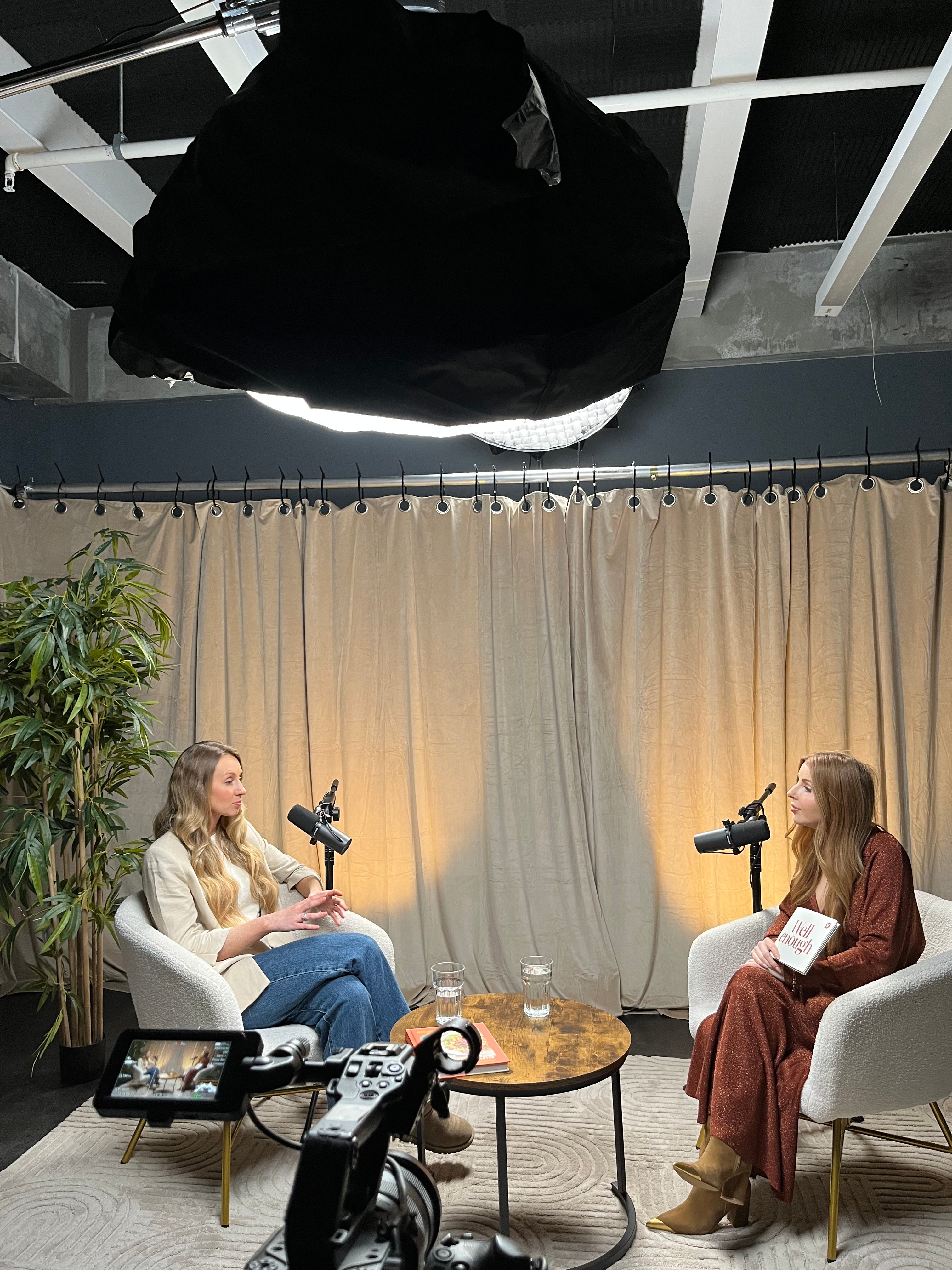 Rhiannon Lambert on the Well Enough podcast (The Independent)
Lunch, for one, has quietly collapsed into convenience. “Lunch is where most people fall short,” she says. “It’s convenience foods on the go.”
We eat at our desks. We snack instead of sitting down. We outsource meals to pre-packaged options designed for speed, not nourishment. Even the language around food has shifted – less about cooking, more about hacks.
At the same time, decades of diet culture have warped how we think about eating altogether.
“It’s always been, what can I take out?” she says. “Whereas, we’ve missed the mark.”
For Lambert, that mindset – calorie counting, carb-cutting, restriction – is not just outdated, but actively unhelpful. It strips food down to numbers and ignores what it is actually there to do. “Food isn’t numbers.”
Her own experience bears that out. Before becoming a nutritionist, Lambert trained as a classical soprano, travelling the world and, as she now reflects, under-fuelling herself. “I definitely had a form of disordered eating that was never diagnosed,” she says. “I thought products like Weight Watchers were healthy … I had no nutritional knowledge whatsoever.”
It was only after stepping away from the music industry – “my mental health was poor” – that she turned to nutrition, completing a degree and later a master’s specialising in obesity and prevention.
The through-line, she says, is simple: she knows what it feels like to get it wrong.
Part of the problem, she believes, is that fibre has been spectacularly mis-sold. “I think a survey recently [found that] 80 per cent of people thought that fibre consumption is just about your poo,” she says. “There’s so much more than that.”
It is not, in other words, glamorous. It doesn’t lend itself to transformation shots or viral before-and-afters. And in a culture driven by aesthetics, that matters.
“It’s not sexy,” she admits. “It’s so much more interesting to say high-protein… it’s associated with aesthetic and muscle and gym.”
Fibre, by contrast, has been left with the branding of prunes and punishment.
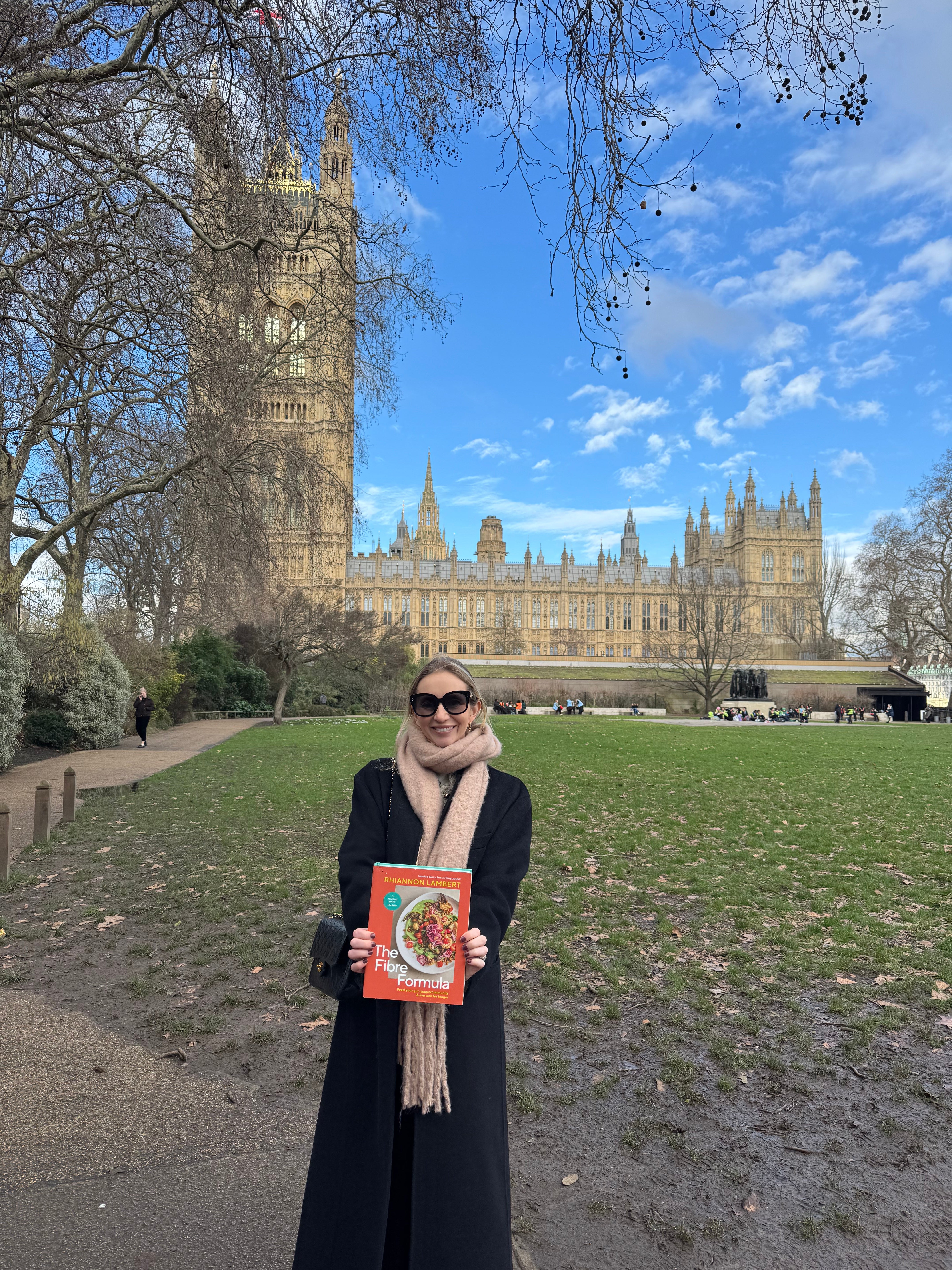 Rhiannon Lambert with her book, The Fibre Formula, at parliament (Rhiannon Lambert)
But the reality, she insists, is far broader and far more consequential. Fibre plays a role in heart health, blood sugar control and the gut microbiome; it feeds the bacteria that help regulate inflammation and immunity. It is linked to brain health, too – “We know that you can live another five years with more fibre” – and to mental wellbeing.
Then there is cancer. “Fibre can reduce cases by 50 to 60 per cent with bowel,” she says. “That’s huge.”
And yet, despite all of this, it remains overlooked in favour of whatever nutrient happens to be trending.
That trend cycle is, in part, driven by social media, and Lambert is clear-eyed about the consequences.
“People are preferring to go to social media than to their GP,” she says. “It’s more time efficient. It doesn’t cost anything. But you just don’t know if what you’re looking at is real or authentic.”
Compounding that is the fact that “the word nutritionist isn’t protected”. Anyone, she points out, can adopt the title, regardless of training.
“There are many other pathways and courses that are not five-year-long degrees like I’ve done, where people will call themselves the same qualification that I have online and have over a million followers.”
The result is a landscape where advice is abundant, but not always reliable, and where nuance is often lost.
Even well-intentioned trends can veer into the absurd. Lambert reels off a few.
“Eating sticks of butter as a snack on the go is the most absurd, awful thing,” she says. “I’ve seen babies being weaned on things like this online.”
Then there are so-called GLP-1 foods: recipes and products marketed to mimic the effects of weight-loss injections. “You just cannot compare the strength in a weight-loss injection to an item of food,” she says. “They will not work in the same way at all.”
Even fibre itself is not immune to trendification. “Fibre maxxing” may be everywhere on TikTok, but taken too literally, it misses the point. “The issue we have here is diversity,” she says. “The same supplement every single day is not going to help you long term.”
If all of this paints a bleak picture, Lambert is quick to bring things back to reality, and to what people can actually do.
At home, with two young children, perfection is not the goal. “I’m not a Michelin-star chef. I’m a cook in the house for my kids. I try my best,” she says.
That “best” looks less like elaborate meal prep and more like quiet, practical tweaks: blending butter beans into pasta sauce, adding lentils to bolognese, mixing quinoa into rice.
“It’s about getting savvy with those everyday meals,” she says. “It can still be their favourite bolognese – you’re just adding more lentils to the mixture.”
The same logic applies to snacks. “You can’t beat nuts and seeds… things like chia seeds, they’re so nutrient-dense,” she says. “Popcorn… way more fibre than a bag of crisps.”
The emphasis, always, is on addition rather than restriction. “My philosophy is, what can you add in?”
Still, Lambert is adamant that this cannot be reduced to individual responsibility alone. “There is a massive divide with cost in this country,” she says. “We know it’s twice as expensive to eat healthily.”
The food environment matters and, in her view, it is currently working against people. “Seventy per cent of children’s diets is ultra-processed in this country,” she says. “We have the highest rate in Europe.
Schools and nurseries, she adds, are part of the problem. “They’re diabolical,” she says. “Not every nursery has a nutritionist… it’s not acceptable.”
Government, too, has a role to play, though progress is slow. Lambert recently presented data in parliament on the UK’s fibre intake. “I think they listened,” she says. “Whether it’s actioned, let’s see.”
Perhaps the most striking point, though, is her observation about how we got here in the first place. “Women went into the workforce in the 1960s… they stepped out of the home cooking role,” she says. “The men didn’t step up to fill that role. Convenience food came in to fill it for everyone.”
In other words, the rise of ultra-processed food is not just about laziness or poor choices. It is structural – rooted in time, labour and inequality.
“We are expected to do it all,” she says. “And we can’t.”
In the end, Lambert’s message is not complicated. It is, if anything, the opposite. Eat more plants. Add rather than subtract. Cook when you can. Don’t chase perfection.
And, perhaps most importantly, tune out the noise.
“My one tip for feeling well enough would probably be shut out the noise,” she says. “I feel that we need to disconnect a bit more… it’s really hard to listen to what you need when you’re exposed all the time to food noise.”
Because for all the trends, products and promises, the answer is rarely found in a powder, a protocol or a perfectly curated plate.
“Just having brown pasta is an achievement,” she says.