
By Josh Davis
First published 25 March 2026
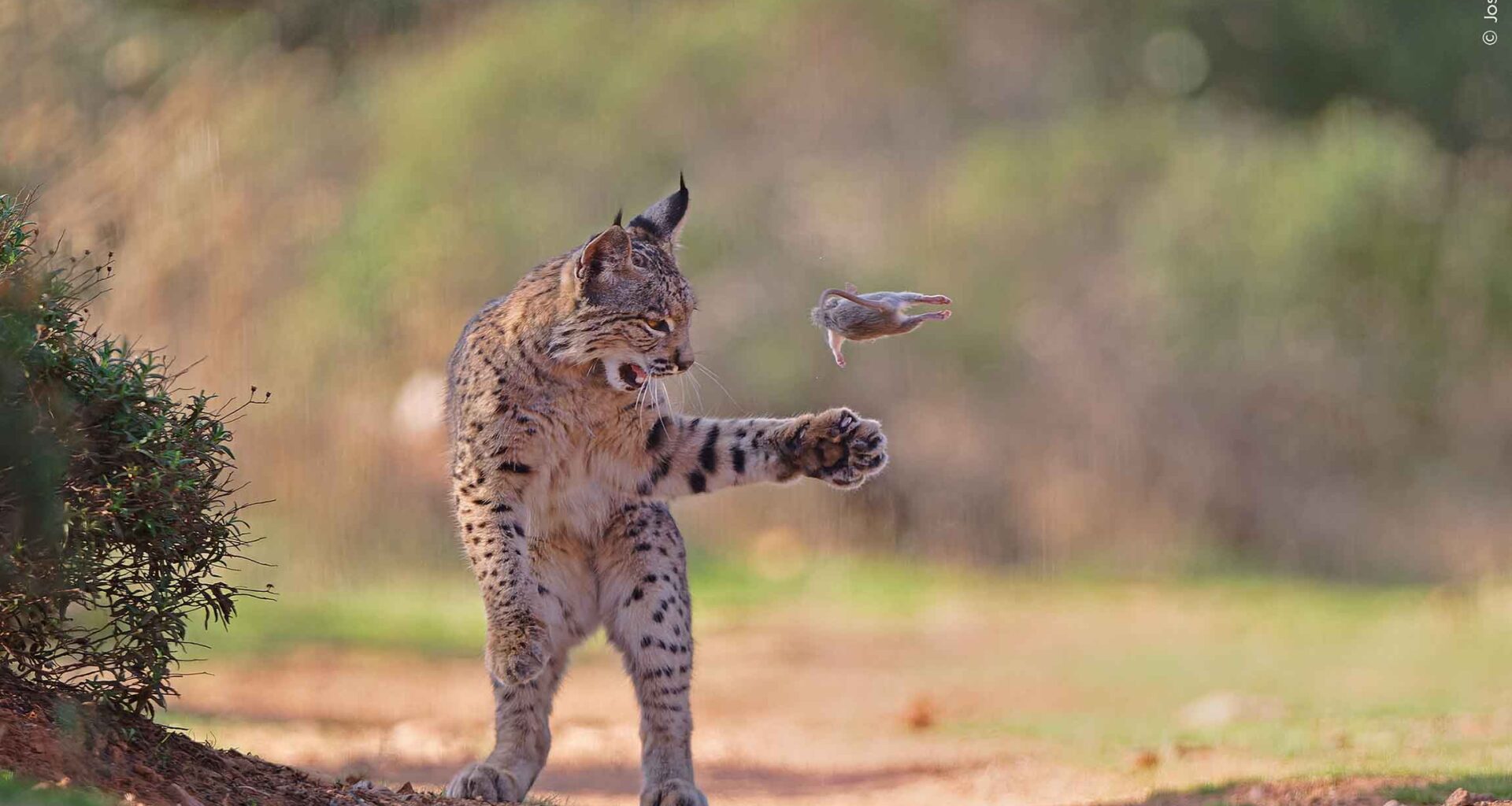
A photo of an Iberian lynx playfully throwing its prey in the air has been crowned the winner of the Nuveen People’s Choice Award 2026.
Titled Flying Rodent, the image by Josef Stefan soared to first place after more than 85,000 people across the world took part in the public vote.
Once pushed to the brink of extinction, the Iberian lynx is now seen as a conservation success story.
The cats had long been top of Josef’s list to photograph. He finally got the opportunity to do this from a hide at Torre de Juan Abad in Ciudad Real, central Spain. Josef watched the lynx toy with the rodent for about 20 minutes before it got bored and ate it. It’s common for lynx to play with their prey before killing it.
This playful but grisly scene impressed the public, who chose Josef’s photo as the winner of the Nuveen People’s Choice Award 2026.
Symbols of hope
The Iberian lynx was once one of the most endangered mammals in the world.
One of four species of lynx, they’re only found on the Iberian Peninsula in southwestern Europe. The charismatic cats are known for their spotted, reddish-brown fur and black-tufted ears. These features help them blend into the Mediterranean landscape while they hunt.
While their camouflage didn’t save them from near extinction, the cats have since become icons of hope.
“They’re an amazing conservation success story,” says one of our researchers, Dr Natalie Cooper. “In the early 2000s only around 100 individuals were left in a few small pockets of habitat in Spain. Only 62 of these were mature individuals.”
Several factors caused their steep decline. As open scrubland and oak woodland disappeared, there were fewer places for the lynx to live. Humans also persecuted them, wrongly thinking they killed livestock.
“They actually mostly feed on rabbits,” Natalie continues. This brought in a third threat: “Their populations also suffered when big outbreaks of disease decimated rabbit populations during the twentieth century.”
Conservationists had known for decades that lynx faced an uncertain future. But when the species was declared Critically Endangered in 2002, they really focused their efforts. Nature-based solutions included creating corridors between habitats, habitat restoration and protecting their rabbit prey.
Scientists also ran a highly successful captive breeding and reintroduction programme. Several cats were brought into captivity so they could start new populations. Before they could be reintroduced to the wild, the resulting kittens were trained to hunt and, crucially, avoid people.
As a result, seven new Iberian lynx populations were established across Spain and Portugal. The number of individual cats rose by 1,500% over 20 years.
“This is a remarkable achievement that required collaboration among scientists, government agencies, NGOs and local communities,” says Natalie.
“A true example of what we can do if we work together.”
Josef says that taking this winning photo was the realisation of a dream that has been with him for years.
“The Iberian lynx is a living symbol of hope, showing what can happen when we take responsibility, act consciously and focus our attention where it’s most needed,” says Josef. “Winning this award and being able to platform this message is the highlight of my 30 years as a nature photographer.”
Browse the top five photos from the competition
This year’s runners-up include a group of flamingos standing out against an industrial backdrop of power lines and a family of polar bears resting in the summer heat.
You can visit our online gallery to see these photos alongside images from previous People’s Choice competitions.