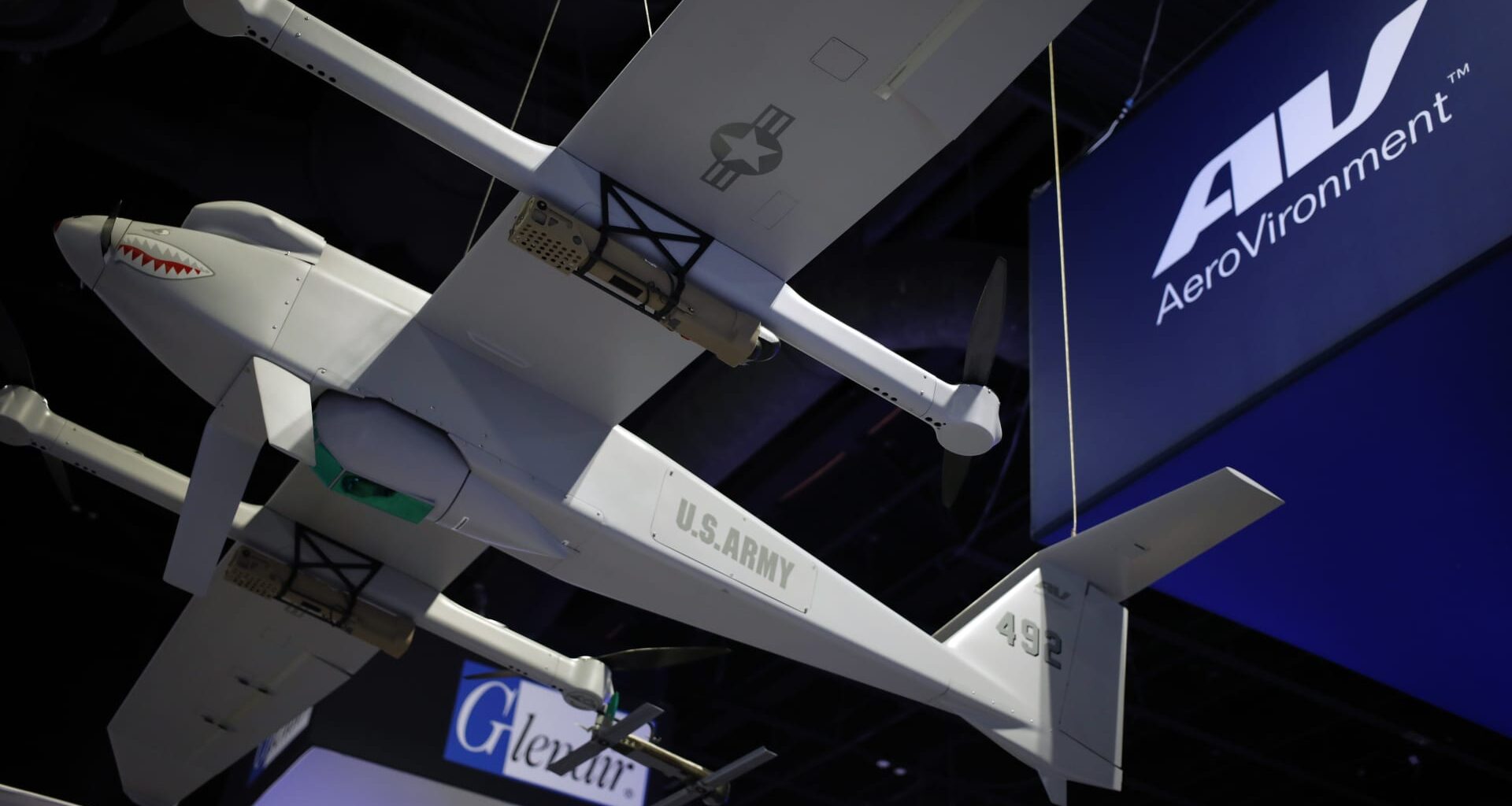
Surging global defense spending, partly driven by the Iran war, and advancements in artificial intelligence are setting up a new leg of growth for the drone market, shining a light on companies AeroVironment and Kratos Defense & Security Solutions . The global drone market is entering a new phase of rapid growth as rising geopolitical tensions boost demand. Advances in AI have further enhanced the capability of today’s drones, with Barclays analyst Zornitsa Todorova calling drones a physical embodiment of AI. “Drones are a core expression of AI in defense, relying on AI for navigation, sensing, autonomy and decision making,” she wrote in a report on Monday. “Defense use has driven up to half of the recent market growth, led by the rapid rise of low-cost, one-way swarm deployments.” Todorova said she views the growth of drones as a defense story first, and an AI story second. Driven by new artificial intelligence developments, the drone market is now entering a hyper-growth phase that could see exponential growth in drone adoption and production. “Market size has doubled from around $20bn in 2020 to over $40bn in 2025, while drone patents are up 45x since 2012,” she added. “As AI becomes even more embedded at the core, we see the market reaching $250bn by 2035, positioning drones as one of the four core growth engines of Physical AI, second only to autonomous vehicles.” Recent geopolitical tensions further strengthen the case for drones, with Todorova noting that drone production in Ukraine rose from around 800,000 units in 2023 to nearly 5 million in 2026. The current Middle Eastern conflict saw close to 2,000 recorded drone strikes in the first few weeks of the war, she said. Tactical and counter-unmanned Among defense stocks, analysts at Canaccord Genuity believe that the Iran war’s impact will likely favor makers of both tactical drones and counter-unmanned aerial systems. The U.S. and its allies are likely to accelerate build rates and stockpiling of munitions and interceptors, analyst Austin Moeller wrote. Moeller sees AeroVironment as a particular beneficiary. “AeroVironment has been working on its LOCUST laser weapon, which is deployed on some DE variants of the SHORAD Stryker’s mission equipment package (MEP) that have been sent to the Middle East,” he wrote. “In parallel, AVAV is under a $96M contract to deliver its Freedom Eagle-1 C-UAS missile to the U.S. Army under the Long-Range Kinetic Interceptor program and has begun ramping up sales of its TITAN family of electronic warfare systems to customers for drone jamming/electronic defeat applications.” Moeller also believes that AeroVironment and Kratos are the best-positioned stocks in the market for one-way attack and attritable (reusable but cheap enough they can be lost in combat) drones. Pentagon demand for tactical drones will only accelerate, he said. “Kratos’ Valkyrie Group 5 stealth drone has a range of more than 3,000 nm (5,500 km), and its Mako and Tactical Firejet/Mighty Hornet IV have ranges of 1,400 nm and 400 nm/540 nm, respectively,” he wrote, referring to nautical miles. “These systems provide the best standoff distance and operational range for conducting deep strikes inside of Iran or China from either Taiwan or across the Pacific island chains.” “Comparatively, AeroVironment’s new Red Dragon one-way attack drones have a range of 400 km, and its new Switchblade 400 variant has a range of up to 65 km,” Moeller added. Outside defense Barclays’ Todorova sees tailwinds for drone usage beyond the defense market, saying the technology could is increasingly being adopted for civilian use agriculture, logistics and delivery. Civilian applications will likely rise from 55% of the market today to about 65% by 2035, she said. In agriculture, drones are used in precision farming, improving efficiency and output. “Farmers are using them to apply fertilizers and pesticides, sow seeds, monitor crops and even transport produce,” the analyst said. “Drone spraying could cut operational costs by around 70% versus manual backpack spraying and about 50% versus tractor-mounted spraying. Spraying time falls by more than 90%, while water use declines by roughly 90%.” Leading drone manufacturer DJI estimated that around 400,000 of its agricultural drones were in active use worldwide by late 2024, up from 80,000 in 2020. That number could swell to 3.5 million by 2035, assuming the same growth rate, Todorova wrote. In logistics, Todorova sees use cases for inventory management, such as drones boosting safety and saving labor by performing daily inventory sweeps and audits. In the delivery sector, drones could outperform ground delivery on short routes, resulting in meaningful labor savings when scaled.