
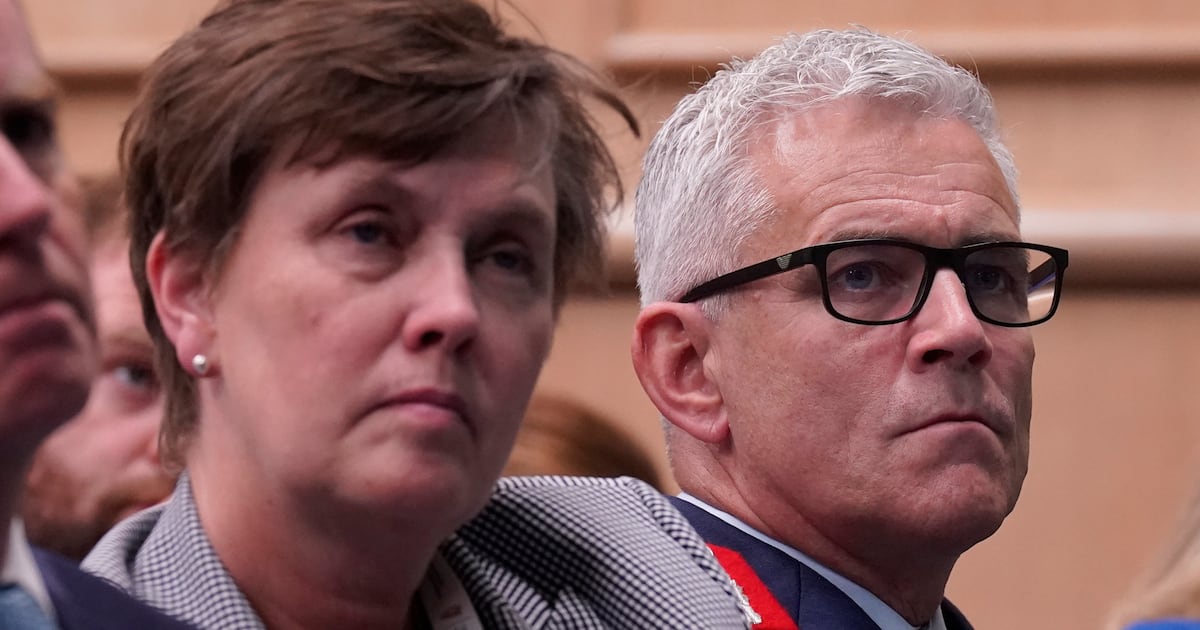
Ireland’s position of politically supporting Ukraine while remaining militarily neutral is a “difficult path” to follow, a senior Irish official has said after being challenged to explain Irish neutrality at a defence conference in France.
“It is a difficult path or line to us to follow, but that’s the line,” Department of Defence secretary general Jacqui McCrum told an audience at the Paris Defence and Strategy Forum on Wednesday.
She spoke in reply to a former British MP, Robert Walter, who asked her to “explain to me and to this audience Ireland’s modern concept of neutrality”, given the support she had expressed for Ukraine and for defence co-operation within the European Union. “I’m very cognisant of the remarks made by your current president and your former president,” Walter said.
McCrum jokingly thanked him for the “easy start” to questions and replied that she believed Ireland was shifting to take defence more seriously, noting an enlarged department and public engagement with the issue of maritime security.
“I think the debate on defence is possibly changing,” McCrum told the audience.
“There is a lot of debate in our country about this, and particularly … about co-operation with partners. It’s possibly a smaller voice that gets a lot of air time,” she continued.
“The world has changed and it is continuing to change. Sometimes people think defence is war and attacking people. I see it as an insurance policy, and we can’t abdicate out of that insurance policy.”
“We probably have to mature that discussion and debate on a national level.”
McCrum was also asked by another questioner to explain how Ireland was improving defences in response to Russian vessels in Irish waters, and the incident in which unidentified drones flew near the flight path of Ukrainian president Volodymyr Zelenskiy during his December visit.
McCrum later told The Irish Times that there were “intensive security discussions going on” on how to improve security ahead of the visits of European leaders to Ireland when the state assumes the rotating European Union presidency later this year.
“It’s challenging for our country to change. We’ve been sitting in this area in the northwest of Europe, probably isolated for many years. But as you can see, the war in Ukraine did affect us,” she said.
“I think it just takes time for people to become accustomed to that, to understand what their government is doing and to trust their government,” she continued.
“We’re dependent on partnerships both strategically and economically, and we have to play our part as being part of the gang.”