
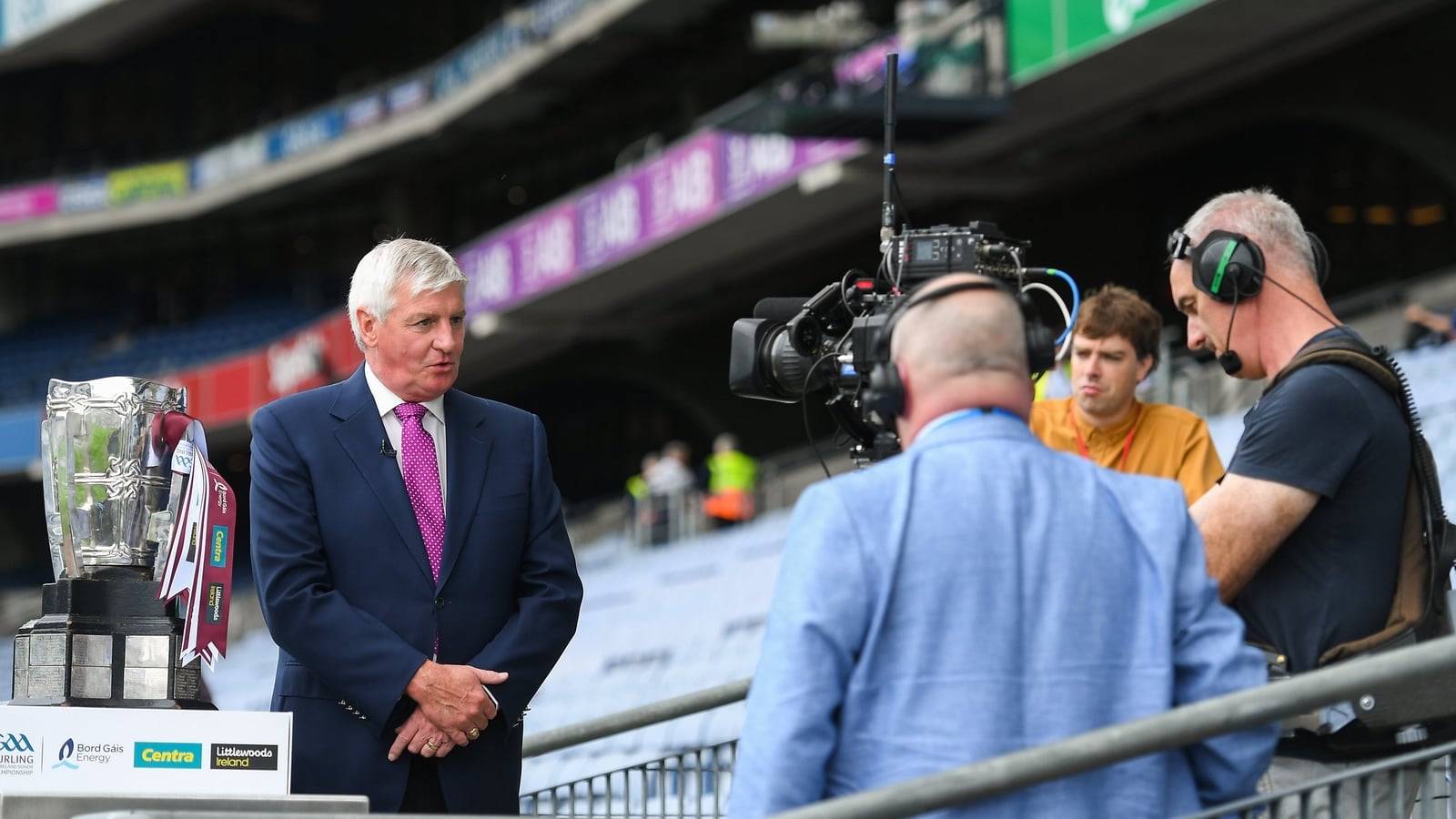
There is, of course, a poignancy when reflecting on the life of one who has just departed.
In the case of Michael Lyster it’s his close family and friends that will mourn his death the most. For the rest of the wider world, our relationship with him was either as a work colleague or seeing him through the prism of radio and television.
After a journalistic career that started with the Tuam Herald, a then 25-year-old Michael Lyster was one of the new recruits that delivered sports bulletins on the fledgling Radio 2, alongside the likes of John Saunders and Caroline Murphy.
He admitted himself over the years that locals in Tuam had expected him to arrive in Montrose as a DJ. Michael did spin the discs locally at the mobile discos and wrote a music column for the Herald.
It wasn’t long before his face appeared on television, first on RTÉ’s Grandstand and World of Sport equivalent, Sports Stadium, before in 1984 taking over the stewardship of The Sunday Game. It was the GAA’s centenary year and his first All-Ireland to cover was the hurling decider between Cork and Offaly in Semple Stadium.
‘Only One Michael Lyster’: The former presenter remembered #rtegaa #leaguesunday #sundaygame pic.twitter.com/GG6szn9g3W
— The Sunday Game (@TheSundayGame) March 22, 2026
In all he would be at the helm for 77 finals across football and hurling (seven replays in that run) before the curtain came down after Jim Gavin’s Dublin completed a Sam Maguire four-timer in 2018.
In that said year, Michael was a contributor on the RTÉ hurling documentary The Game, where he spoke about his childhood in Co Galway, those early days watching games on black and white television and recalling the time his grandmother “flung Holy Water across the television set to bless the Galway team”.
Michael’s contributions across the five-part series have now been edited together, with a whole lot more being said after he left Galway to become a household name.
Pieces of history distilled across six decades.
The impact of television in the 1960s, this after the establishment of Teilifís Eireann, was something that Lyster alluded to early on, as he referenced the fear that the “goggle box” in the corner was going to “kill the art of conversation”.
We know it didn’t, with the realisation dawning that, as he put it “we are going to have to incorporate this machine in the corner into our lives”. Of course we live in a world today, as was much the case in 2018, of many forms of media, with Lyster acknowledging that all this new media has made us “more communicative, you can’t escape the media”.
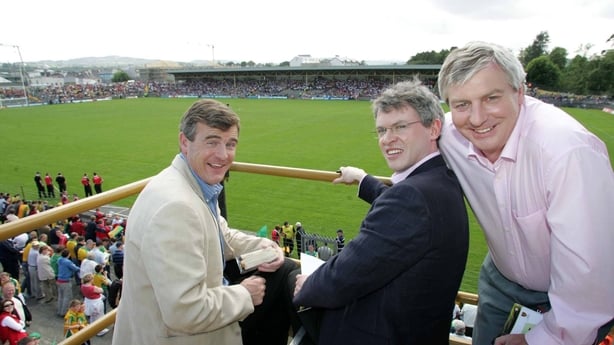
The presenter with Sunday Game analysts Colm O’Rourke and Joe Brolly in 2006
Iconic names in the world of GAA broadcasting were recalled, most notably Micheál O’Hehir, where a young Lyster was out in the field by himself kicking the ball to imaginary players (himself), describing it all in his best impression of O’Hehir. “I was wonderful every day, according to the commentator,” he quipped.
And so to The Sunday Game.
It was felt by those in control that the man from Galway was best equipped to helm the GAA flagship programme. And Lyster wanted to make his mark. Instead of wearing a suit jacket, he was going to don a jumper, to make the programme “more relevant to people like myself”. The casual look was in back then, though in time Lyster and the panel would revert to a shirt and tie. His music knowledge also led to favoured compositions being used. Bob Seger’s Comin’ Home was the sign-off to Tipperary ending their Munster famine in 1987.
The advent of more and more live games, and the fact RTÉ had to pay a form of compensation to the GAA because of that, was also highlighted. That payment, however, that was soon dispensed with as those in Croke Park would eventually see the benefits of live action. That said, going ‘live’, according to Lyster was a big jump.
As to his own broadcasting style, the importance of being “objective” was paramount. He was “the RTÉ man”, though that didn’t stop people coming up in time, saying “you are the GAA”.
As the ‘The Game’ primarily chronicled the history of hurling, Lyster pointed out how television has aided our knowledge of the code, replays making more sense of what happened in real time during such a fast-paced game.
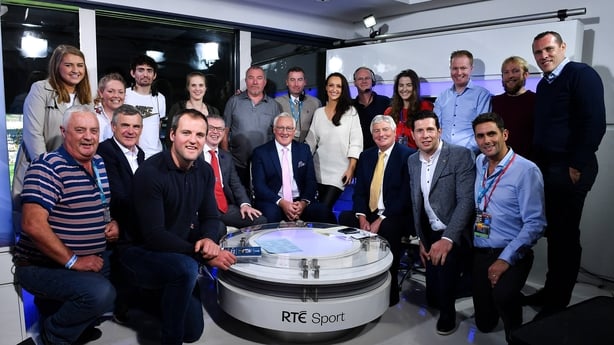
Outside broadcast staff and analysts behind the scenes on the occasion of the final Sunday Game programme to be presented by Michael Lyster in 2018
Television, and media on a broader scale, has contributed to making Gaelic Games and sport in general a greater “social occasion”, Lyster stated before a Reithian reference on the importance of what he and others in RTÉ have done over the years.
“I’m in the television business. If you were to ask me about what I thought about Gaelic games in my life, it has been a very important part of it. But really I’m a television presenter, doing this stuff and I want people to like it. We’re in the business of entertainment and I think we have better analysts today that understand what people want.”
Michael Lyster broadcasted for close to 40 years – a period of much change in the GAA and media worlds.
In 2018, he forecasted more change. And he is right. But he outlined one basic fundamental that will remain the same, when saying: “As long as they put a couple of posts down one side of the field and a couple the other side of the field, and put people out in the middle of the field to chase after something, be it a ball or a flying spaceman, it will be more or less the same.”