
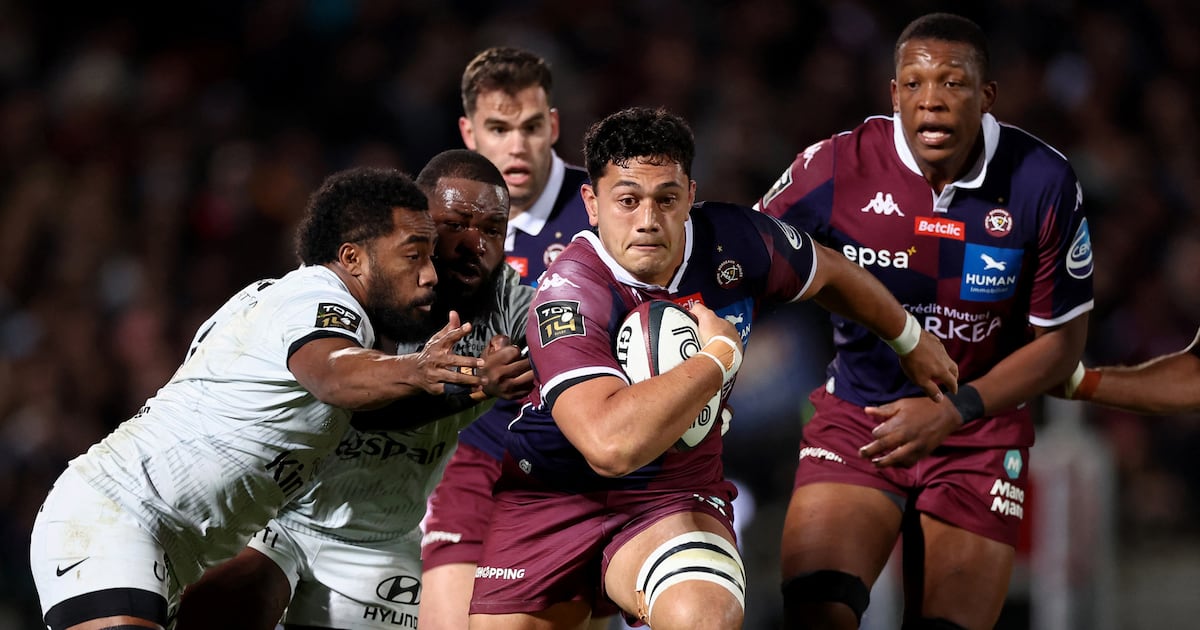
Player welfare is a clarion call of long standing for rugby’s constituents – the governing body World Rugby, unions, federations, clubs and tournament organisers. The IRFU’s model had long been the envy of its global peers, and sport’s hierarchy in several countries have followed suit to varying degrees in adopting a version of a central contracting framework.
With the Six Nations recently completed and players returning briefly to their respective domestic leagues, before European fare returns in the form of the knockout games in the Champions Cup and Challenge Cup at the end of the month, it is timely to examine club game minutes.
Where better than to study France, the Six Nations champions, and runners-up, Andy Farrell’s Ireland? The sample size is the final match of the tournament as, injuries notwithstanding, both countries chose their strongest available match day 23s.
Fabien Galthié’s side successfully chased down the title against England in Paris, while Ireland had the consolation of beating Scotland to claim second place and a Triple Crown.
There are several factors worth bearing in mind, not least injuries, which can be easily gleaned from the paucity of matches in a few cases.
There have been 19 rounds of the French Top 14 to date while that figure is at 13 when it comes to United Rugby Championship (URC) rounds. With the addition of European games, French players could have played a maximum of 23 games, Irish players 17.
Two French players, flanker Temo Matiu and prop Demba Bamba, played 19, while Tom O’Toole, Darragh Murray and Ciarán Frawley lead the way from an Irish perspective, each having 13 club appearances so far.
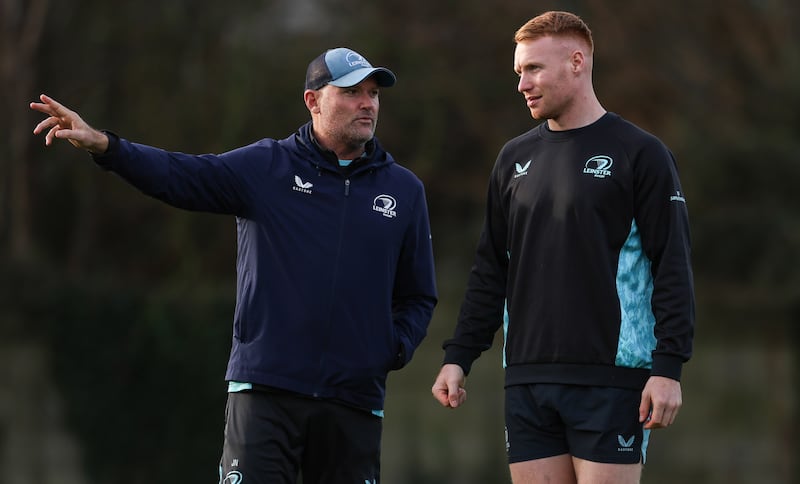 Leinster senior coach Jacques Nienaber and Leinster’s Ciarán Frawley. Photograph: Grace Halton/Inpho
Last summer’s Lions tour meant that a hefty cohort of Irish players didn’t start their season until late October. They saw very little, if any, of the first six URC rounds.
France’s match day 23 from the English match have played a combined 16,667 minutes of club rugby, compared to Ireland’s squad total of 11,205 minutes, a difference of 5,462 minutes, which, if divided by 23 players, works out at about 237 minutes, plus change. Just shy of four hours or three matches more for the French players.
Bordeaux-Bègles flanker Matiu, with 1,258 minutes across 19 matches and 15 starts, leads the way with the highest pitch time but there are two other players whose statistics stand out.
Louis Bielle-Biarrey broke his own Six Nations record when scoring nine tries in the most recent campaign but those who think he is a lightly raced thoroughbred at club level might care to note that he’s started 13 of 14 matches for Bordeaux, crossing for a staggering 16 tries.
The 22-year-old is not even the most prolific player at his club in terms of game time, with that honour falling to Mathieu Jalibert. The outhalf has started all 16 matches he has played in with an average of 71 minutes on the pitch. The benefit of regular match minutes is evident as these two players have developed from teenage phenomena into outstanding senior internationals.
That represents a primary challenge for Irish rugby in trying to ensure exposure to high-calibre matches in trying to progress the development of players. France have much greater latitude and that’s why their players get access at a much younger age.
Just four French players (Théo Attisogbe, Antoine Dupont, François Cros and Peato Mauvaka) have played less than 10 club matches this season, in marked contrast to the Ireland squad where only five (Tom O’Toole, Michael Milne, Darragh Murray, Nick Timoney and Ciarán Frawley) have reached double digits.
The additional workload in match terms didn’t prevent France from winning the Six Nations and it will be interesting to see if it compromises the chance of Toulouse or defending champions Bordeaux in claiming a Champions Cup trophy.
Or will Leinster, the last province standing in the premier European tournament, benefit from the IRFU’s player management programme? They’ll have to buck a recent trend. French clubs have won the last five Champions Cups and are back-to-back Six Nations winners in 2025 and 2026.
It is perhaps not playing more but being consistently exposed to a higher level of rugby at a young age that represents the sweet spot for success.