

Scientists have captured rare footage of a sperm whale giving birth, including the moment its relatives hoisted the newborn calf out of the water to allow it to breathe.
The mother, a whale known to researchers as Rounder, was filmed off Dominica as her calf emerged tail-first before being lifted towards the surface by members of her family group.
Newborn sperm whales are thought to be negatively buoyant, meaning they will sink if not supported, and initially they are poor swimmers. The lifting behaviour, described in the journal Scientific Reports, may be essential to avoid drowning.
Biologists have described the drone footage as “amazing”
The drone footage and underwater recordings provide one of the most detailed accounts of the birth of a big whale.
Adult sperm whales are among the largest creatures on Earth. Females can reach about 11m (36ft) in length, while males grow to 16m and weigh up to 45 tonnes. The newborn calf was about 4m long, roughly the size of a small car.
Dr David Gruber, founder of Project CETI, the research initiative behind the work, said: “It was absolutely amazing.
“I took over 2,000 photographs from our sailboat that afternoon, but the aerial drone footage gave us an entirely new top-side perspective. I must admit, I got somewhat emotional in the one instance where the baby sperm whale is uplifted almost completely out of the water.”
As Rounder went into labour, several adult females repeatedly dived beneath her, turning belly-up and positioning themselves close to her body.
Dr Shane Gero, Project CETI’s head biologist, said: “In the moment, I was blown away.
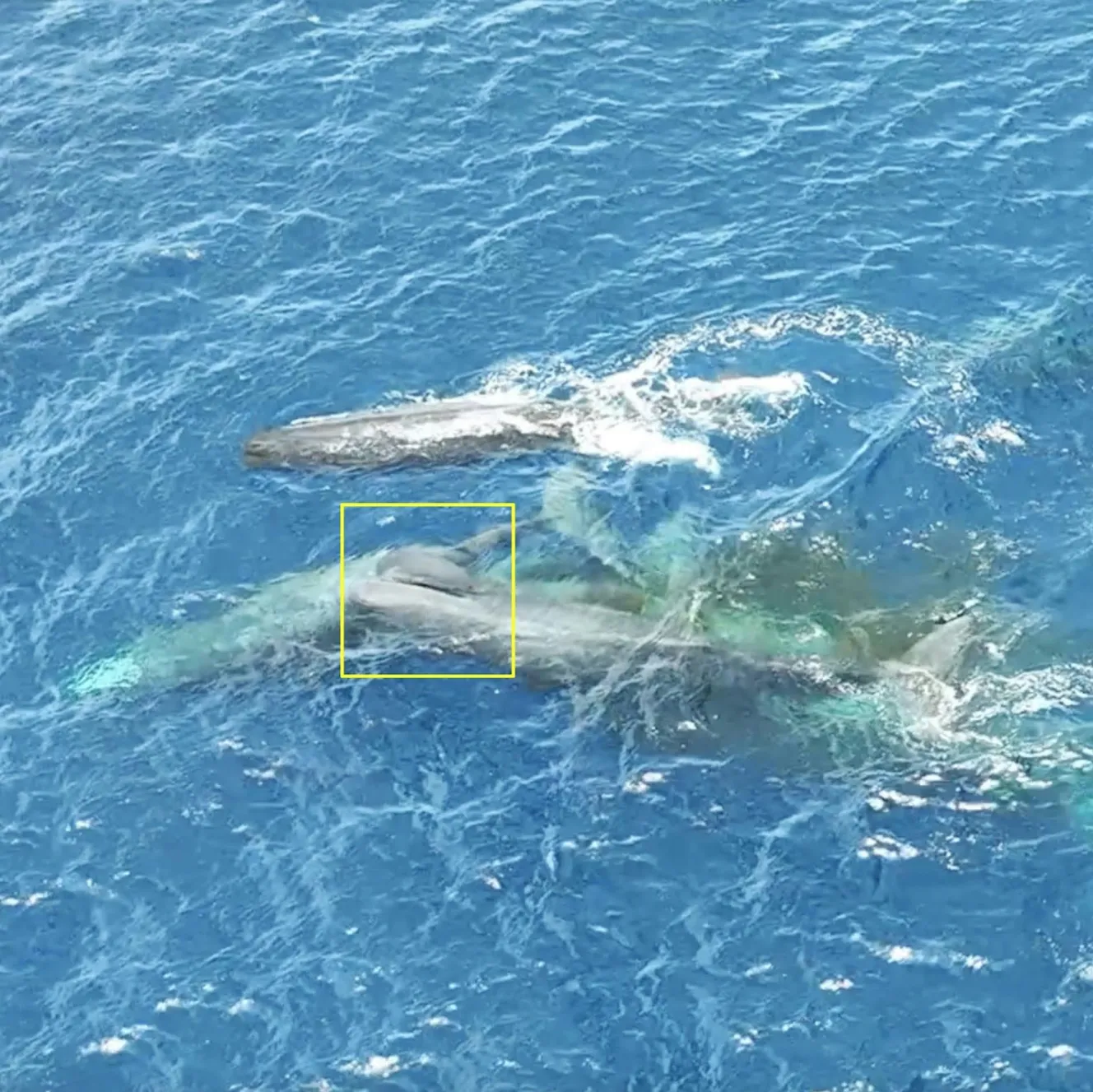 It’s rare for co-ordinated lifting by sperm whales to be seen in such detail
“I’ve followed Rounder’s life since she was a calf, so to be there when she gave birth was unimaginable. To then go back into the footage and see all the details which we were able to capture with the drones, and then analyse and interpret was thrilling.
“To see the flukes emerge from Mom, to see Lady Oracle [the calf’s grandmother] support her daughter Rounder during labour, and to see the entire unit get involved in supporting the newborn was amazing.”
Environment newsletter
The latest climate, energy and nature news and analysis, plus reasons to be hopeful.
Sign up with one click
Scientists have previously observed whales supporting newborn calves, but co-ordinated lifting by an entire social group has rarely been described in detail. The study suggests the behaviour may have ancient origins, potentially dating back more than 30 million years.
Gero said: “The big take home from this is that in co-operative societies, of whales or otherwise, we succeed by working together. In the vast darkness of the open ocean, relying on those around us is critical to survival.”