
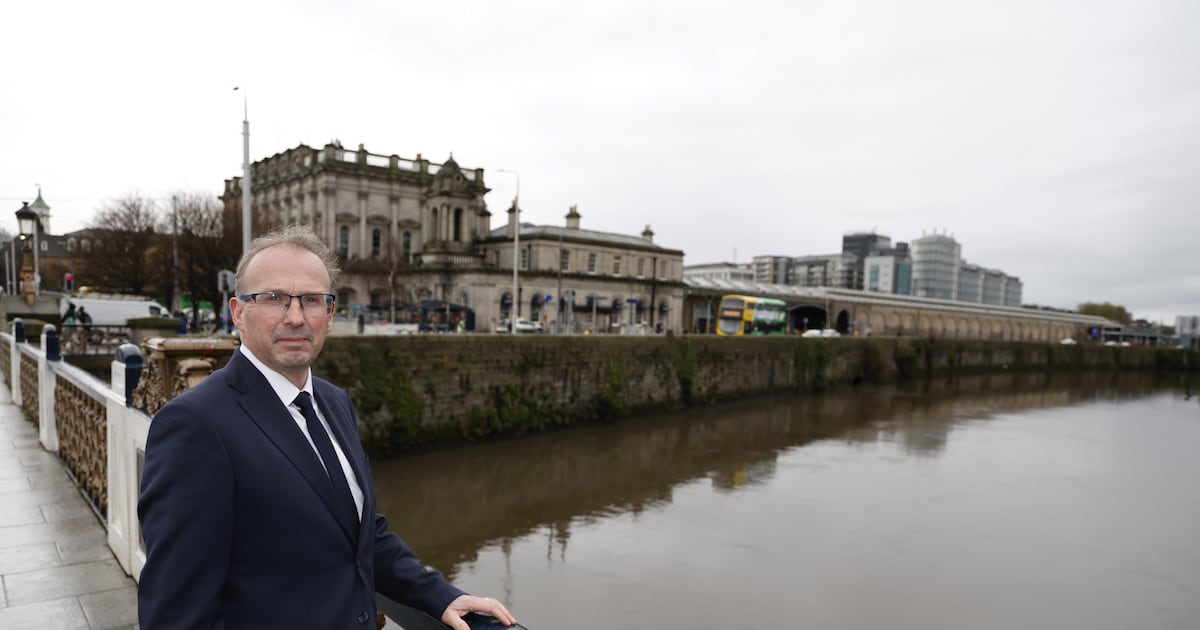
State-owned transport group CIÉ is looking at redevelopment opportunities at both Heuston and Connolly stations in Dublin that could provide for new interchange arrangements between buses and trains as well as housing.
The board of CIÉ will also decide in June on the implementation of a landmark deal agreed last summer that would see more than 6,000 retired personnel receive their first pension increases in 18 years.
In an interview with The Irish Times, CIÉ chief executive Stephen Kent said he has had conversations with the National Transport Authority (NTA) about an “intermodal opportunity” at Heuston.
“It is a fantastic historic train station with a Luas outside the door. But it is probably suboptimal in relation to buses,” he said.
According to Kent, not all buses passing by the station may have to go all the way down the quays into the city centre.
“You could have turning [facilities] and it could be a great intermodal. I know the NTA would have plans for looking at a potential bus interchange.”
Kent also said the CIÉ group would shortly present “concepts” to Minister for Transport Darragh O’Brien about developments around Connolly Station.
“The vista, both in the public realm and with the integration of buses with the trains, could be dramatically improved,” he said.
He said some buses already departed from outside the station but in some instances there were no shelters for passengers.
Kent said CIÉ was working with property developers about proposals, including on housing, and there would also have to be dialogue with Dublin City Council.
The immediate priority of CIÉ is the planned pension reforms, Kent said.
He said detailed questions had to be answered on the proposed arrangements to allow the Minister for Transport and the Minister for Public Expenditure to give their consent and for new statutory instruments to be put in place.
Under the deal agreed last May, existing defined benefit schemes would be closed to new entrants. A new defined contribution scheme would be introduced while retired staff would receive increases of up to 5 per cent.
Kent maintained that the CIÉ group had arguably the largest pension deficit – estimated at more than €360 million in 2024 – on its books of any company in the country, with liabilities increasing as hundreds of additional personnel were recruited and enrolled in the existing defined benefit arrangements.
Left unchanged, he said the group could have faced pension liabilities of €4 billion within 10 years or so.
However, retired transport workers have expressed deep frustration at the delay in implementing the promised pension increases.
[ CIÉ pensioners to march on Taoiseach’s office in protest over pension increaseOpens in new window ]
Kent said all parties were working towards a target date of the CIÉ board meeting in June to consider the formal implementation of the pension deal. He said many details on the deal had to be worked out including a procurement exercise for the planned new defined contribution scheme.
He acknowledged that it would be tight to meet a June deadline given there would have to be a 28-day consultation period if the Minister was minded to publish new statutory instruments.
“So that can get you to May. So there’s no doubt that June, at this point, is going to be tight. But everybody is wedded to that date. There’s nobody telling me that we’re not aiming for that date, and we’re trying to keep it on track for that date.”