
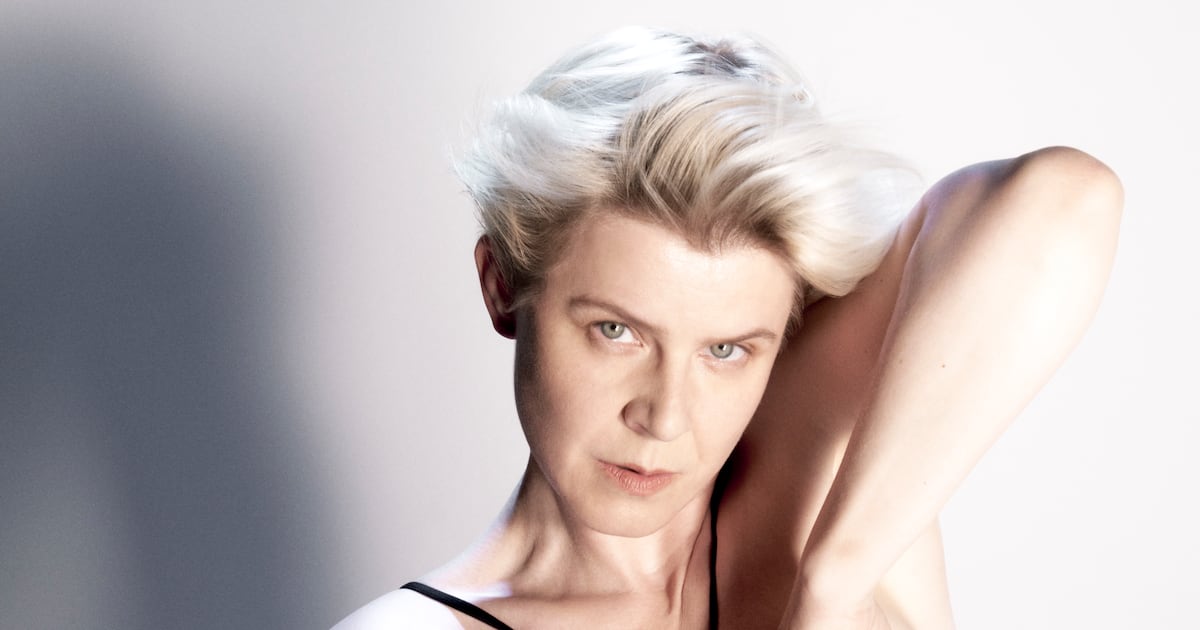
Sexistential
Artist: Robyn
Label: Konichiwa
If pop music has an equivalent of The Velvet Underground or The Smiths, then that title lies with Robin Miriam Carlsson. Robyn has never sold a huge number of records, but her influence is immense.
It’s arguably thanks to her that the Abba formula of imbuing upbeat music with bottomless sadness has carried through to the 21st century. From the mopers supreme Billie Eilish and Ariana Grande to Harry Styles’ minimalist new direction, without her there would be no modern pop.
To be critically adored but commercially overlooked is not a fate that every artist would wish for, but Robyn seems at peace with being an inspiration rather than an icon in her own right. It certainly hasn’t affected her talent for the most beautifully bittersweet pop, as she demonstrates on the breathtaking, vulnerable Sexistential, her first album since Honey, in 2018, and an LP that glimmers like a disco ball at a wake.
Robyn first came to attention in the early 2000s, not for what she did but for what she didn’t. She was, famously, a protege of the Swedish hitmaker Max Martin, who launched himself upon humanity as the writer of Britney Spears’s …Baby One More Time; last year she was midwife to Taylor Swift on her post-Eras album The Life of a Showgirl (a good record that the internet decided deserved a kicking).
Robyn was supposed to be the new Britney, but it became immediately clear to her that life as a pop puppet was not something that was going to do her any good. As she told me shortly after her cult hit With Every Heartbeat – UK number one, top 20 in Ireland – if she was going to work with a figure such as Martin, it had to be on her own terms.
“Max is a control freak, and I think he actively searched for collaborations where he could be in control of the music, because that’s what he wanted to do. Record companies like [Spears’s label] Jive provided him with those types of artists, who didn’t have their own ambitions to write, or were more like performers. So they created this concept where, you know, it was kind of ‘super pop’. For me that was very foreign. I didn’t understand it.”
She and Martin would patch up their differences, and he contributes to two songs on this uplifting downer of an album, most impressively its slow-burn closer, Into the Sun (which, in a bizarre coincidence, is also the name of the final song on the new BTS LP).
But, before we get to the end, Robyn gives us an incredible beginning with Really Real, where a Giorgio Moroder-style groove – as cool as ice, as frothy as champagne – rumbles over misanthropic lyrics about an empty love affair.
Really Real sets down a marker for an album that, despite its title, is less a celebration of sexuality than Robyn’s meditation on her relationship with her physicality and her sensuality changing as the years clip by. (She is now 46.)
That message is most explicit on the title track, where she talks about going for a quick hook-up on the celeb dating app Raya while pregnant by IVF: she sings that her “body’s a spaceship with the ovaries on hyperdrive”, a line she invests with the same weight that Morrissey brought to his complaints about not being able to get a snog under an underpass.
The record wears its influences honestly: Blow My Mind is Kraftwerk’s The Robots with extra hormones; Sucker for Love gives us cyberpunk Donna Summer. Yet across a project that brims with heartbreakingly gorgeous production, it’s Robyn’s unflinching lyrics that cut deepest. “Talk to me,” she says on the song of the same name. “Sometimes I get lonely.”
Amid the robotic otherness, it is these moments of bleak, unfiltered vulnerability that land the hardest.