
In March 2004, Australian photographer Robert Edwards asked a simple but meaningful question on Rob Galbraith’s now-defunct photography forums: “Could Adobe make a RAW format?” The answer was very much “yes,” and Adobe announced the DNG format, or Digital Negative, later that same year. Now, more than two decades later, DNG is now the official standard under the International Organization for Standardization (ISO).
As Edwards explains, this is the result of a quarter-century of work by countless people. It’s also deceptively important work with significant implications for the future of digital photography.
Nearly all cameras, and certainly all of the ones PetaPixel readers care about, capture RAW photos. In most cases, the specific format varies by brand, and sometimes a camera has multiple different RAW file formats with different compression mechanisms. For example, Sony Alpha cameras capture .ARW RAW photos, while Nikon cameras shoot .NEF, Canon’s capture .CR2, Fujifilm has .RAF, and so on. Some cameras capture .DNG RAW files, like Leica, Ricoh, and Sigma cameras.
‘Now the responsibility shifts. Camera manufacturers no longer have a valid reason to avoid supporting DNG.’
These manufacturer-specific RAW photo formats are proprietary, meaning not only are their inner workings industry secrets, but they are also supported at different speeds and to varying degrees in industry-leading photo editing applications and, in some cases, are never fully supported at all. For example, at the time of publication, the Sony a7 V RAW files are still not fully supported in any editing program outside of Sony’s Imaging Edge. Even though in many cases, a photographer’s life is not affected by the fact that their preferred camera has a proprietary RAW format — most things work most of the time — it is still a problem.
When Edwards asked if Adobe could make a RAW format in early 2004, he was really asking if a company could make an open-source RAW format that fully preserved edits and was comprehensively documented, ensuring it was archival-quality, versatile, and able to implemented across all aspects of a digital photography workflow, no matter which camera a person used or which apps they used to process and store their RAW photos.
Thomas Knoll, the famous engineer who invented Adobe Photoshop, chimed in on Edwards’ forum post — Rob Galbraith’s forums were really important at the time — and said that Edwards’ idea was possible. “Yes, it is feasible,” Knoll wrote in his straightforward response.
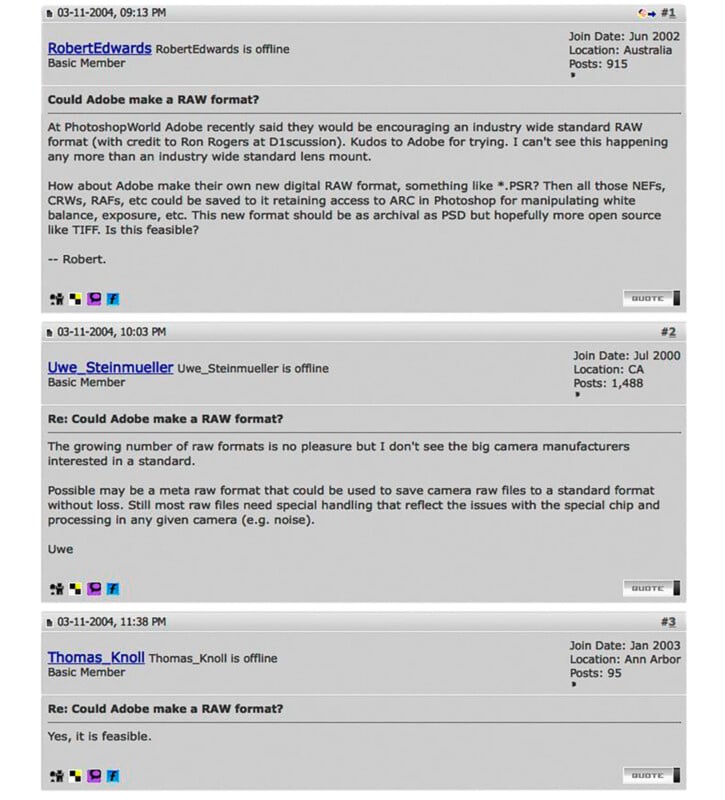 Credit: Robert Edwards
While Knoll didn’t tip his hand, DNG was already in the works. It arrived in September 2004.
DNG, an open, fully documented RAW file format with widespread support and ISO-compliant technological foundations, solves the potential problems above and more. DNG, given how it was built and documented, has compatibility and longevity that a proprietary RAW photo format can never have.
As Edwards explains, “interoperability and preservation” has “always been the goal.”
In February 2013, the Australian Institute of Professional Photography invited Edwards to an ISO meeting on photographic standards. Edwards was flanked by manufacturers, scientists, technicians, photographers, engineers, and even government representatives, all there to discuss photographic standards. Since then, and arguably even longer, Edwards has been fighting for DNG to become an ISO standard.
“This week marks a significant milestone: ISO 12234-4 has been published,” Edwards writes. “DNG is now an international standard, alongside formats such as TIFF and PDF.”
“After more than two decades of discussion, persistence, and advocacy, the goal has been achieved. What began as an idea is now a globally recognized standard.”
The complete standardization document is extremely lengthy, highly technical, and far from required reading for photographers. However, the ISO 12234-4:2026 “Digital Imaging — Image storage — Part 4: Digital negative format” document’s intro is worth considering:
Advanced and professional photographers often choose to capture and edit photos in raw format for additional flexibility and artistic control. Unlike display-referred formats (such as JPEG, PNG, and TIFF), which store images that have already been processed by the camera, raw formats store unprocessed or minimally processed data directly from the camera sensor. This enables photographers to adjust many parameters to taste, including white balance, tone mapping, noise reduction, sharpening, and so on. Photos in raw format are analogous to film negatives in a photographer’s workflow, so they are often referred to as “digital negatives.”
The purpose of this document is to define a standardized file format for storing raw photographs. This file format can be used in a wide range of hardware and software applications for generating, processing, managing, transcoding, or archiving raw photographs. Since raw photographs are closely tied to the camera sensor and other characteristics, camera manufacturers may use and support their own Vendor Raw formats to meet various design requirements.
The key point here is that this document and the work therein officially create, in perpetuity, an internationally recognized, standardized RAW image format. The document defines the DNG format, explains in painstaking detail exactly how it works, and outlines precisely how private companies can implement it in their products.
Camera makers that have resisted including DNG in their cameras, claiming that Adobe owned DNG, or that there wasn’t an easy way to implement DNG, or that the format wasn’t documented, no longer have any excuses.
Edwards thinks the arguments against incorporating DNG have long held little water — as evidenced by the numerous companies that have DNG in their cameras — but now they are officially dead. No more can companies cry foul about including DNG as an option alongside proprietary RAW or wax poetic that it’s not possible or that they don’t own the rights.
‘After more than two decades of discussion, persistence, and advocacy, the goal has been achieved. What began as an idea is now a globally recognized standard.’
“Now the responsibility shifts. Camera manufacturers no longer have a valid reason to avoid supporting DNG. Many already do. Others can follow the example of companies like Pentax, offering both a proprietary format and DNG,” Edwards writes.
He adds that photographers also wield significant power.
“Real change, however, does not come from standards alone. It comes from photographers. If you care about your images, your work, your memories, your legacy, then this matters. Ask manufacturers to support DNG. Choose tools that prioritize openness and long-term access.
“Because this has never only been about file formats. It is about making sure the photographs we create today can still be seen in the future.”
Image credits: Header photo created using an asset licensed via Depositphotos.com. DNG graphic by Adobe.