
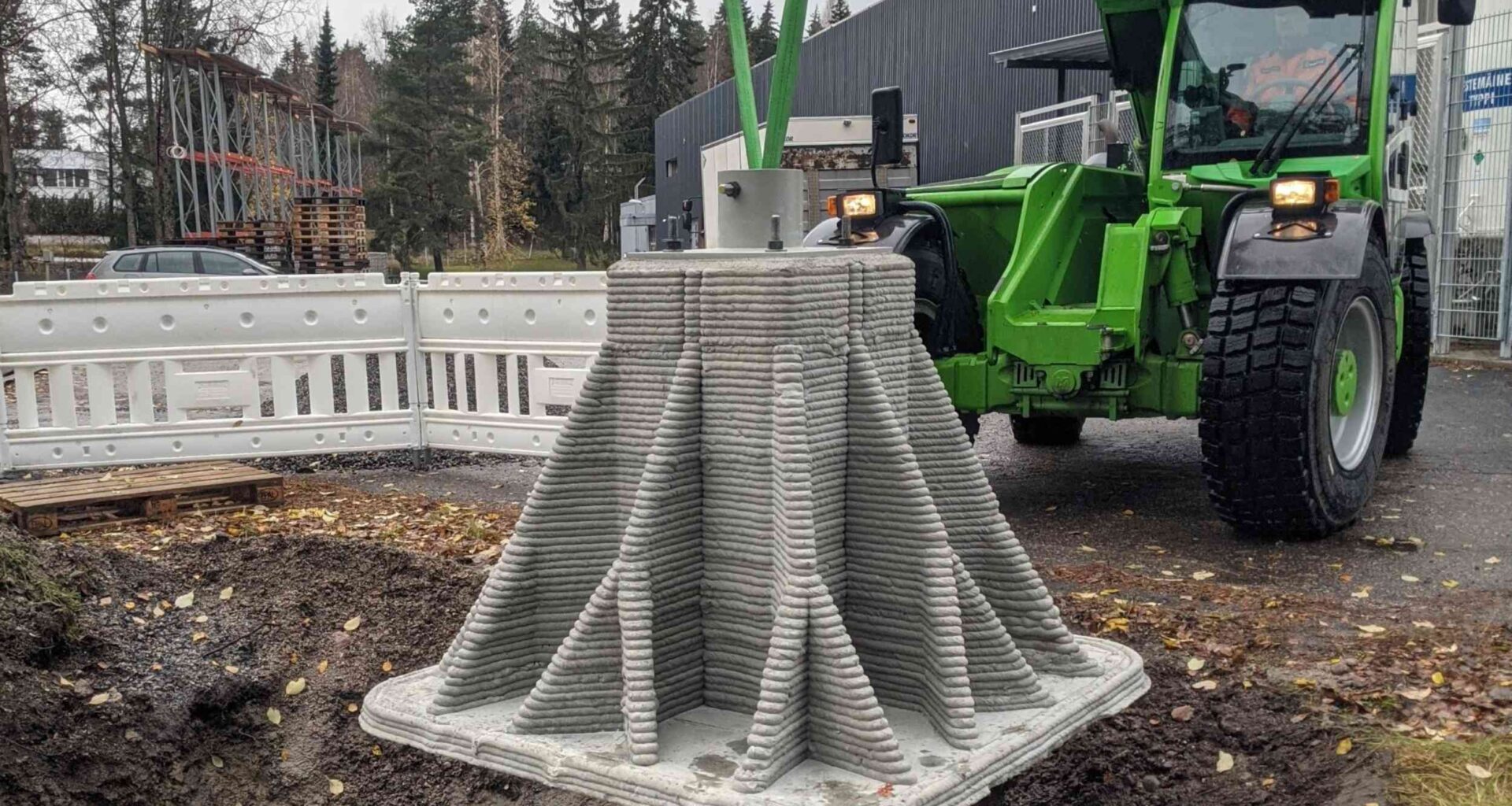
Embedding a polymer grid during printing has transformed 3D-printed concrete into a material that carries 41% greater loads and bends 552% further before failure.
That change shifts the technology from brittle demonstration pieces toward structural elements that can absorb stress without breaking apart.
Strength during printing

Under fresh concrete, the flexible mesh sat between neighboring layers rather than resting on top after printing.
Inside a modified printer at the University of South Australia (UniSA) the team made reinforcement part of the print path.
By feeding the mesh through a second nozzle just behind the concrete nozzle, the machine pressed it into place under the layer’s weight.
Printing the reinforcement in place also raised a harder tradeoff, because stronger plates could still come with weaker seams.
Why printed concrete fails
Unreinforced printed concrete breaks abruptly once a crack opens, because the layered build gives it little help across that split.
Steel can solve that in ordinary concrete, but bars are awkward inside a moving print job and can invite corrosion later.
Flexible fiber-reinforced polymer, a plastic composite strengthened with fibers, avoids rust and moves through printing equipment more easily.
Even with those advantages, reliable reinforcement has remained the part nobody solved cleanly in printed concrete.
Tailoring the concrete mix
Instead of printing one mix from bottom to top, the plates used functionally graded concrete, layers built from different mixes for different jobs.
A fiber-rich mix formed the lower layers where bending pulls hardest, while a lower-carbon slag-based mix sat above to cut emissions.
Earlier tests from the same group showed that tailoring the layers can lower carbon emissions without giving up bending performance.
Within this design, stronger reinforcement mattered more because the concrete around it was already doing a tailored job.
From manual to automatic
Earlier work with polymer grids had already shown that printed concrete plates could become much tougher under bending.
Hand placement, however, broke the promise of a fully automated build and forced the process to stop.
Printing the grid through the machine itself mattered because construction speed means less if workers must stop to insert every strip.
Closing that gap came at a price, because automation also created new damage inside the layers.
What the plates did
Once bending started, the difference showed up in how long the reinforced plates kept carrying load after cracking.
Two of the best layouts reached nearly the same performance near failure, even when one carried only half as much grid.
Several reinforced specimens even kept gaining resistance after the first crack opened, instead of dropping off immediately.
Plain plates snapped without warning, but the reinforced ones bought time, which is what structural safety needs.
Where layers turned weak
Trouble appeared where one printed layer met the next, because the grid reduced how much fresh mix actually touched fresh mix.
In splitting tests, seams with grids lost 43.6%, 33.1%, and 35.5% of their pull-apart strength across the mixes.
Delays between unlike layers also dried the surface, creating a cold joint, a weak seam from delayed bonding.
Layer-to-layer grip matters because reinforcement can only spread stress well when neighboring layers hold instead of peeling apart.
Pores steered the cracks
Scans of the printed layers found more porosity, the amount of empty space inside a material, after the grid went in.
Reinforced samples contained many more pores larger than 0.04 inch, and those voids stretched along the print direction.
Larger gaps diverted cracks upward and sideways, which helps explain the rougher fracture paths seen in the reinforced layer seams.
Once those weak zones lined up, failure followed the easiest route through them instead of spreading damage more evenly.
Bond slip ruled failure
Pull-out tests showed the grid did grip the concrete, but the bond stayed modest and the strands began to slide.
Among the tested concrete, the fiber-rich mix held best, while the blended and lower-carbon mixes let the reinforcement slip sooner.
Slip at the grid-concrete bond concentrated deformation into one main crack, because stress stopped traveling far enough to start many smaller cracks.
Wider strips performed unexpectedly well, which suggests future designs may gain more from smarter shape than from simply adding material.
Why the idea matters
Because reinforcement joined the print itself, the method points toward building parts that need fewer pauses and fewer hands.
A UniSA project backed by a $402,221 Australian Research Council grant aimed to print reinforcement from the start.
“This is the first research project in the world to see if it’s possible to simultaneously print fibro reinforced polymer along with concrete,” said Prof. Yan Zhuge, structural engineer at UniSA.
The new paper does not finish that mission, but it shows the idea now works in hardware instead of sketches.
What comes next
Reinforcing concrete while it is being printed now looks practical, and the payoff in bending resistance is clear.
Before builders can trust larger structures, researchers still need tighter layer-to-layer bonding and reinforcement that crosses layers, not just rides between them.
The study is published in Nature.
—–
Like what you read? Subscribe to our newsletter for engaging articles, exclusive content, and the latest updates.
Check us out on EarthSnap, a free app brought to you by Eric Ralls and Earth.com.
—–