
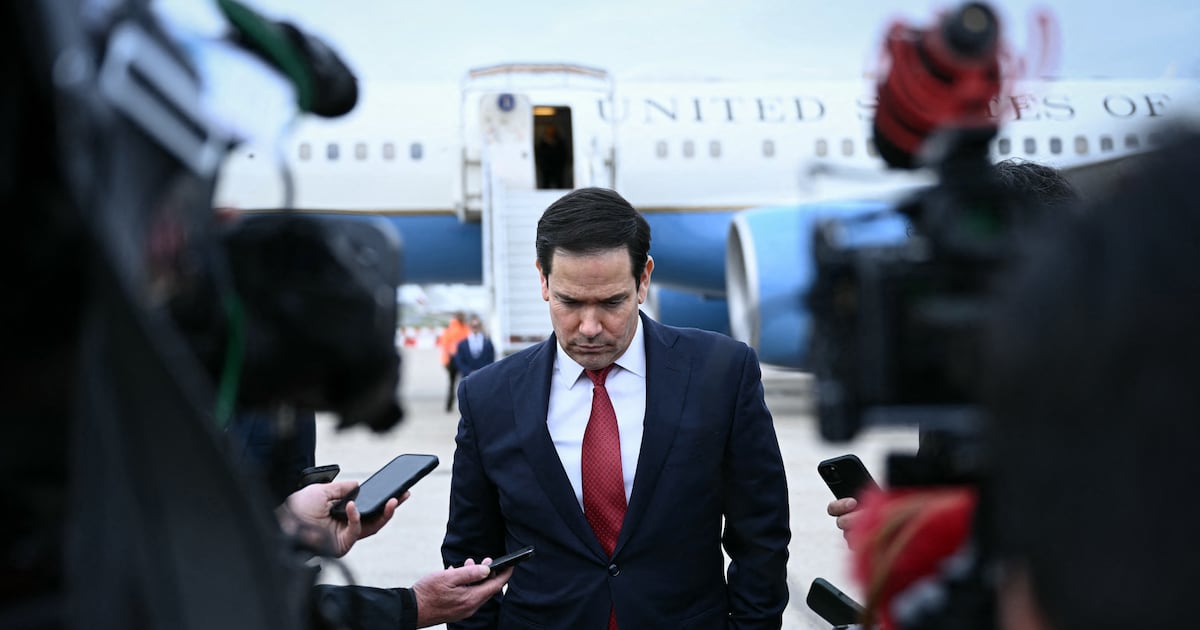
US secretary of state Marco Rubio said the US expects to finish its operations in Iran “in the next couple of weeks”.
He claimed that its objectives were being achieved “ahead of schedule”, at the end of a meeting in France of foreign ministers from the G7 group of main western economies.
However, the Middle East war enters its fifth week on Saturday with huge gaps between the sides on how to end the conflict, which continues to have a devastating impact on the world economy.
Despite US president Donald Trump’s decision to postpone until April 6th his threat to attack Iranian energy sites, substantive peace talks at this juncture appear an unrealistic prospect.
According to the Wall Street Journal, the Pentagon is weighing sending up to 10,000 additional ground troops to the Middle East, as Washington considers the option of a ground operation.
Israel’s defence minister Israel Katz declared on Friday that the Israel Defense Forces (IDF) will expand strikes in Iran in response to continuing missile launches from Tehran.
“Despite the warnings, the launches continued and therefore the IDF’s attacks on Iran will escalate and expand to additional targets and areas that assist the regime in building and operating weapons against Israeli citizens.”
Shortly after his announcement, Israeli jets struck a uranium production facility, two of Iran’s largest steel plants – which are partially owned by the Islamic Revolutionary Guard Corps (IRGC) – and a heavy water research reactor near the city of Arak. In earlier strikes, Israel hit Iran’s primary missile and naval mine production facility in the city of Yazd.
After almost a month of intense daily air strikes, Washington can only determine with certainty that it has destroyed about a third of Iran’s vast missile arsenal, according to a Reuters report, quoting five people familiar with the US intelligence. The status of around another third is less clear but bombings likely damaged, destroyed or buried those missiles in underground tunnels and bunkers.
[ How many missiles does Iran have left?Opens in new window ]
The assessment, which has not been previously reported, shows that while most of Iran’s missiles are either destroyed or inaccessible, Tehran still has a significant missile inventory and may be able to recover some buried or damaged missiles once fighting stops.
The intelligence stands in contrast to the claim by Trump on Thursday that Iran had “very few rockets left”.
The US-based Human Rights Activists News Agency (Hrana) reports that 1,492 Iranian civilians and 1,167 Iranian military personnel have been killed in the four weeks of fighting.
In a sign of strain on the Israeli military, its top general, Lt Gen Eyal Zamir, warned that the “IDF is going to collapse in on itself” as the army deals with mounting operational demands and a deepening manpower shortage.
“I am raising 10 red flags in front of you,” he told security cabinet ministers. “The IDF needs a conscription law, a reserve duty law, and a law to extend mandatory service,” he said. “Before long, the IDF will not be ready for its routine missions and the reserve system will not last.”
Opposition leader Yair Lapid issued his own warning. “The IDF is stretched to the limit and beyond,” he said. “The government is sending the army into a multi-front war without a strategy, without the necessary means, and with far too few soldiers.”
Despite the difficulties, a survey published on Friday by the Israel Democracy Institute showed that a large majority, 78 per cent, of the Jewish Israeli public supports continuing the war against Iran. However, the share of those opposed to the war has risen to 11.5 per cent.
Fighting also continues in Lebanon, where Israeli troops are operating across the border to push Iranian-backed Hizbullah fighters north of the Litani river. More than 1,072 people have been killed and more than a million have been forced to flee their homes.