
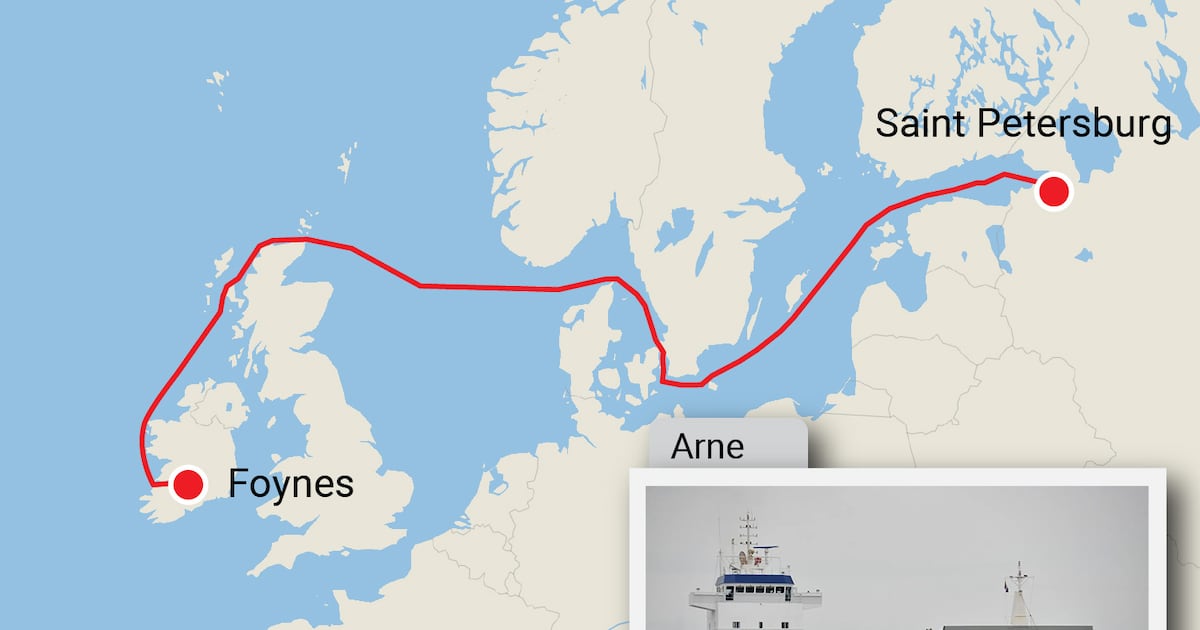
A vessel that regularly transports cargo from Aughinish Alumina, the Co Limerick industrial plant, to Russia was observed dropping its anchor near critical subsea cables off the Irish west coast last year after collecting a shipment from the plant.
A month later it was boarded by German police and found to be missing its anchor and most of its anchor cable.
The ship is one of dozens which regularly transport alumina produced at Aughinish to St Petersburg in Russia.
This week an Irish Times investigation revealed that this alumina is being turned into aluminium which is then sold to a major supplier of metals to the Russian military industry.
Aughinish is owned by the Russian metals giant Rusal which has extensive links to the Kremlin and the Russian defence sector.
Rusal and Aughinish Alumina both said they have no control over the ship aside from hiring it for the transport of alumina.
Since Russia’s invasion of Ukraine, Rusal has been shipping hundreds of thousands of tonnes of alumina from Aughinish to its smelters in Siberia. Russia now accounts for 68 per cent of alumina produced at Aughinish, up from 23 per cent in 2020.
The material is transported in large cargo vessels which dock once a day at Aughinish’s private jetty in the Shannon estuary.
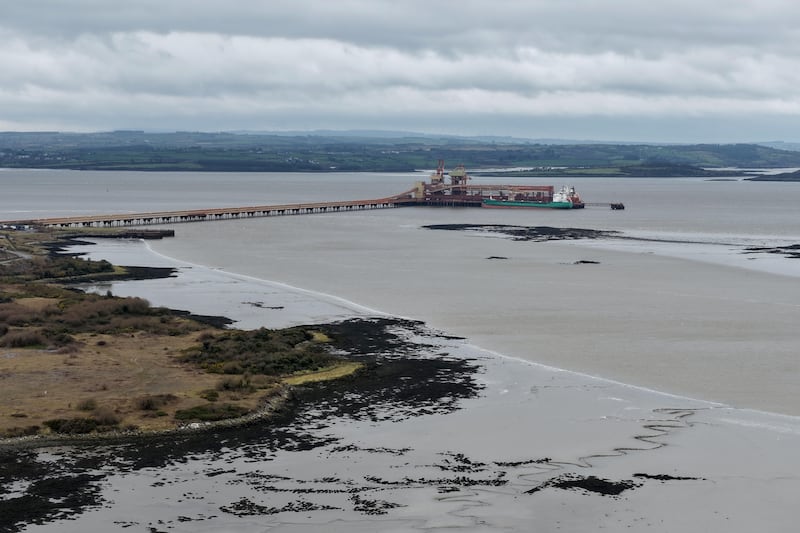 A vessel at the jetty of the Aughinish Alumina plant on the Shannon estuary. Photograph: Alan Betson
The export of alumina to Russia is not illegal and none of these vessels are sanctioned. However, some of the ships transporting alumina from the Limerick plant have drawn attention from European security agencies in recent years.
This includes the Arne, a 134m cargo vessel registered under the flag of Antigua and Barbuda. The ship docked at Aughinish on January 25th last year after departing from St Petersburg on New Year’s Day.
It then set sail again and travelled up the west coast. By this stage it was under surveillance by the Defence Forces and the Coast Guard. An Air Corps C295 maritime patrol aircraft was deployed to shadow the vessel.
According to security sources, as the Arne sailed off the coast of Co Mayo on January 28th, Air Corps personnel observed it towing its anchor while it was under way. The ship was in roughly 90m of water and its anchor cable was around 120m in length.
The incident occurred in the vicinity of the AEC-1 data cable which connects Ireland and the United States carrying important transatlantic data communications.
The ship left Irish waters and sailed back to St Petersburg, arriving on February 3rd.
It departed Russia again on February 19th, bound for Spain. On February 22nd, as it prepared to enter the Kiel Canal which links the Baltic and North Seas, it was intercepted by two patrol vessels from the German Federal Police and one Danish military ship.
The Arne was escorted to the Bay of Kiel in Germany where it was inspected. Authorities found it was missing its port side anchor and much of its anchor cable, European security sources said.
Photographs taken of ship while in the German port show it is missing its anchor.
The Irish Times confirmed the ship’s routes in January and February using open source software which tracked signals from the ship’s automatic identification system.
The route was then confirmed by satellite data provided by Starboard Maritime Intelligence.
Conor Gallagher looks at what happens to alumina made in Aughinish, Co Limerick after it is exported to Russia. Video: Enda O’Dowd
German authorities detained the ship on foot of information provided by other EU countries, including information from Ireland on the Arne’s activity a month previously.
In the days before the Arne’s interception, it was observed travelling unusually slowly in the vicinity of the C-Lion subsea cable which links Germany and Finland.
The cable suffered minor damage around this time. However, German authorities were unable to link the Arne to this incident and it was permitted to continue its journey following the inspection.
Finnish authorities later suggested the C-Lion was damaged by another ship towing its anchor.
A law firm for Alpha Shipping, the ship’s EU registered operator based in Riga, Latvia, said it experienced severe weather conditions off Ireland after leaving Aughinish in January 2025.
The ship was struck by high waves “which resulted in the port-side bow anchor being released into the water”, it said in a statement.
The ship’s operators immediately contacted the flag registry for temporary permission to operate with just a starboard anchor, it said.
The following month, the ship had to wait for 2½ hours while waiting for German police to inspect the vessel, after which it was free to go, it said.
“These steps are entirely typical in the ordinary course of international shipping, and the German authorities identified no irregularities whatsoever.”
A spokesperson for Rusal said the ship’s operator fully co-operated with German authorities “who concluded that the Arne’s crew bore no intent in relation to the incident”.
“All claims against the shipowner have since been withdrawn,” the spokesperson said.
A spokesperson for Limerick Alumina Refinery, Aughinish’s parent company, said the Arne was thoroughly vetted and provided an example of a vetting document.
The company said Rusal has been using the services of Alpha Shipping for many years.
The Arne returned to Aughinish a month later on March 24th before departing again for St Petersburg with another consignment of alumina.
During this time, it was again subject to surveillance by the Air Corps and Naval Service. It has not returned to Irish controlled waters since, though it has docked in Belfast.
A security source said the ship remained under ongoing surveillance by EU security services while in European waters.