
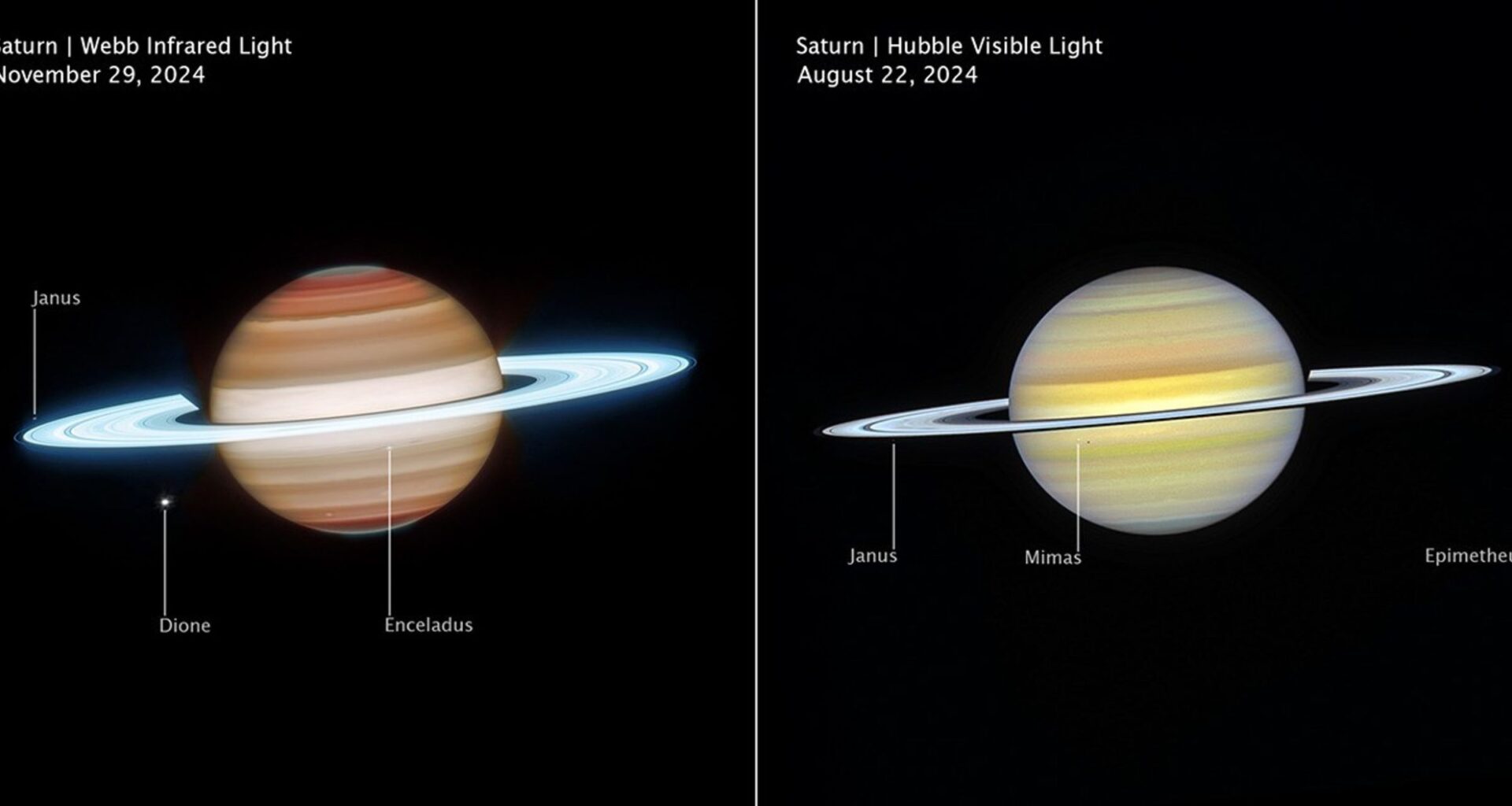
NASA’s Hubble Space Telescope and the James Webb Space Telescope have teamed up again to enlighten our space sensitivities. This time, to gift us a kaleidoscopic view of Saturn, king of rings.
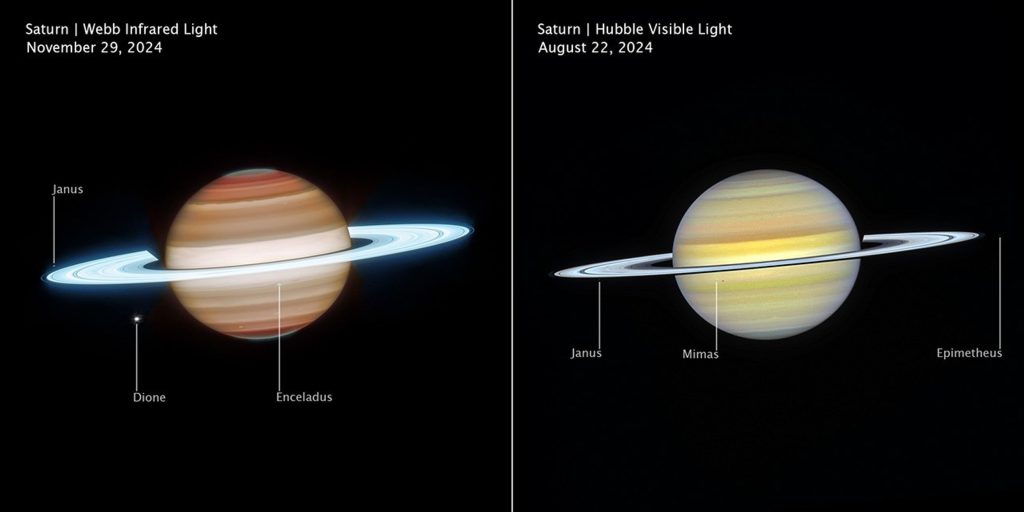 Credit: NASA, ESA, CSA, STScI; Image Processing: Joseph DePasquale (STScI).
In this side-by-side, Hubble provides a view in visible light to make Saturn relatable, while Webb investigates in infrared light to reveal chemical action among clouds at different depths.
As a result, astronomers can see through Saturn’s atmosphere as if peeling back the layers of an onion, to observe from the upper atmosphere down to its deeper, roiling secrets.
A Team-Up More Than Thirty Years In The Making
The veteran Hubble and the upstart Webb captured these newly released images on August 22, 2024, and November 29, 2024, respectively, as Saturn transitioned from its northern summer toward its 2025 equinox.
Both images show a small glimpse of Saturn’s curiously iconic feature, the hexagon-shaped storm at its north pole. The storm has persisted for decades, at least. But we probably won’t see it so clearly again until the 2040s, because Saturn’s North Pole is entering its seasonal winter darkness.
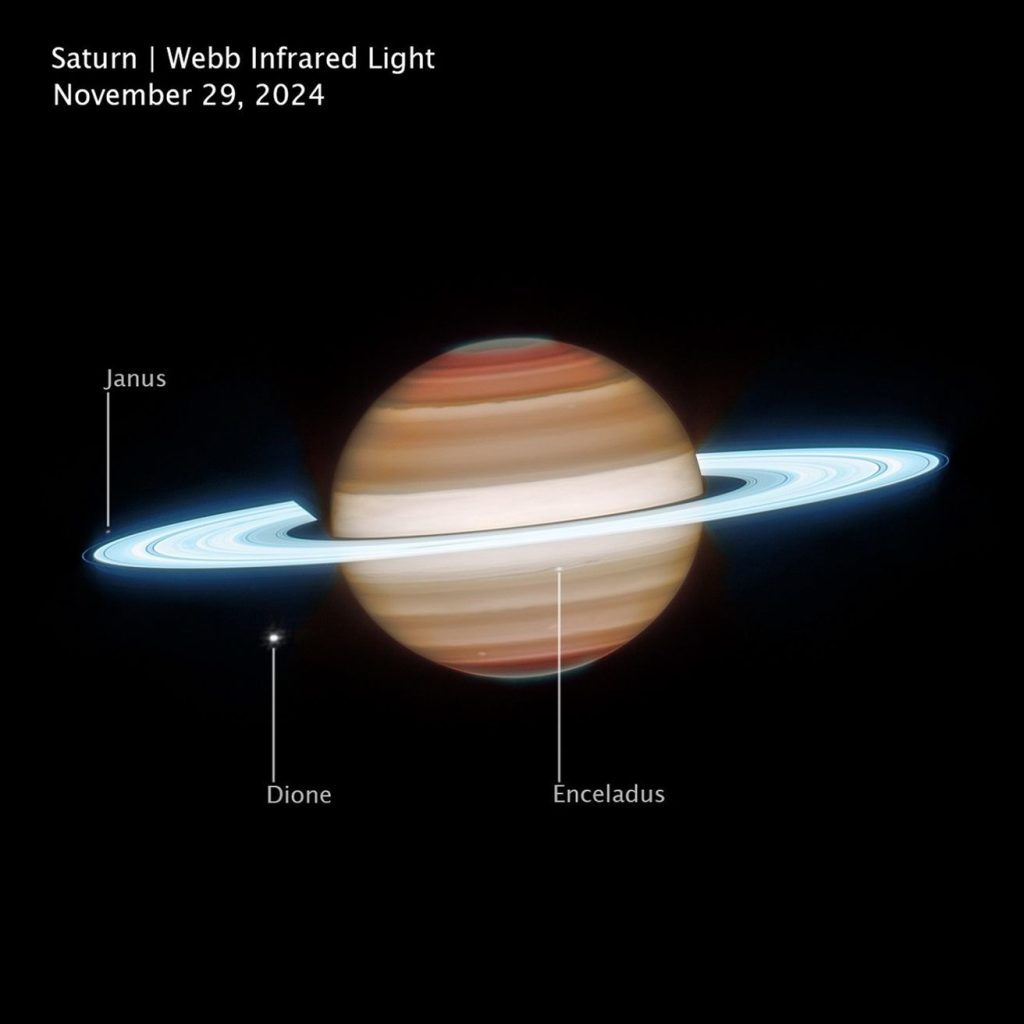
Webb’s infrared view also shows a gray-green tint at Saturn’s poles. This may be due to the way aerosols scatter light at those altitudes. Or it may be caused by Saturn’s awe-inspiring auroras, generated by charged particles interacting with its magnetic field.
 Credit: NASA, ESA, CSA, STScI; Image Processing: Joseph DePasquale (STScI).
Farther out, Saturn’s sunlit rings shine brightly because they are made of reflective water ice. Webb’s image better shows the thin crispness of outermost F ring, seen as a slight glow in the Hubble version.
Hubble: A Most Loyal Eye On The Sky
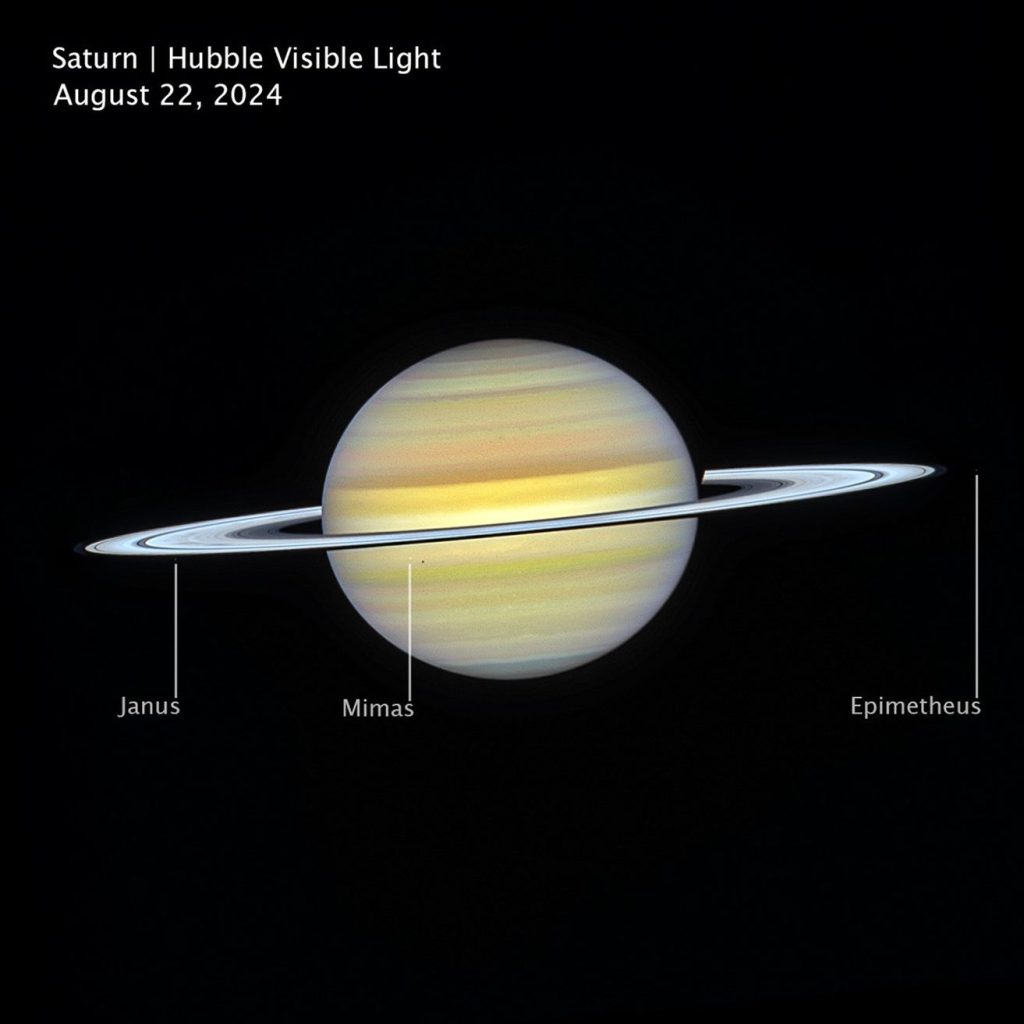
Hubble’s observation shows sets of orderly, softly colored bands shaped by the winds and waves below the clouds. The mellow yellow hues “are, in part, a product of the sunlight-reflecting ammonia crystals and hydrocarbons such as methane in its atmosphere.”
 Credit:
 This image is part of the Outer Planets Atmospheres Legacy (OPAL) program, an effort to monitor long-term atmospheric evolution on the giant planets. Fortunately, Saturn is a “natural laboratory for studying fluid dynamics under extreme conditions.”
To better understand it, astronomers employ numerous facilities to view different aspects of the Saturnian system, including past surveys by NASA’s Cassini orbiter, conducted from 1997 to 2017, before it ended its mission with an extravagant Grand Finale as it plunged into Saturn’s atmosphere. Luckily, Hubble and Webb won’t share the same fate.