
TrojansProject Arts Centre, Dublin★★★★☆
In Luail’s production of Trojans, the barrier between audience and performer disappears, making poignant themes of community, displacement and migration. Rather than more literally recounting Virgil’s Aeneid, upon which the choreographer Philip Connaughton based the dance, Trojans suggests connection, separation, joy and sadness, all superbly brought to life by Luail’s dancers. They excel at working as a cohesive unit.
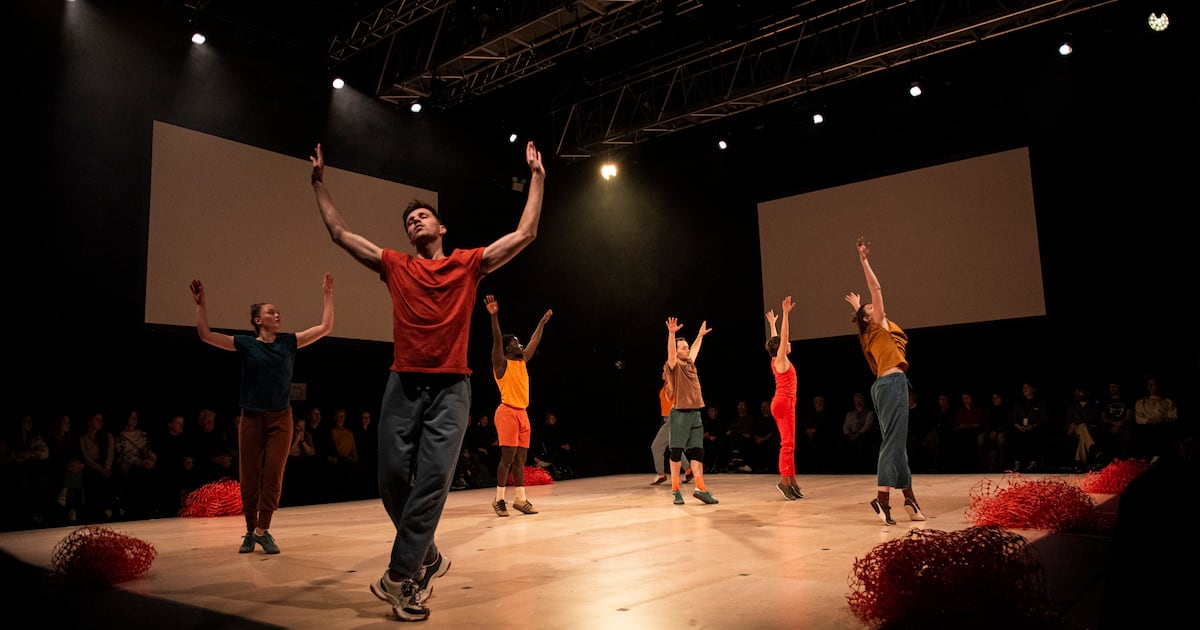
Chairs that are at first covered with orange plastic netting line the perimeter of the stage, which sits in the middle of the space. Giant video screens fill each of the four walls, prompting audience members to take actions that range from walking across the floor to making eye contact with the dancers to taking a seat once the netting has been removed.
Such intimate connections with the cast feel unusual, and they work; we not only become invested in what happens to them but are also part of the story.
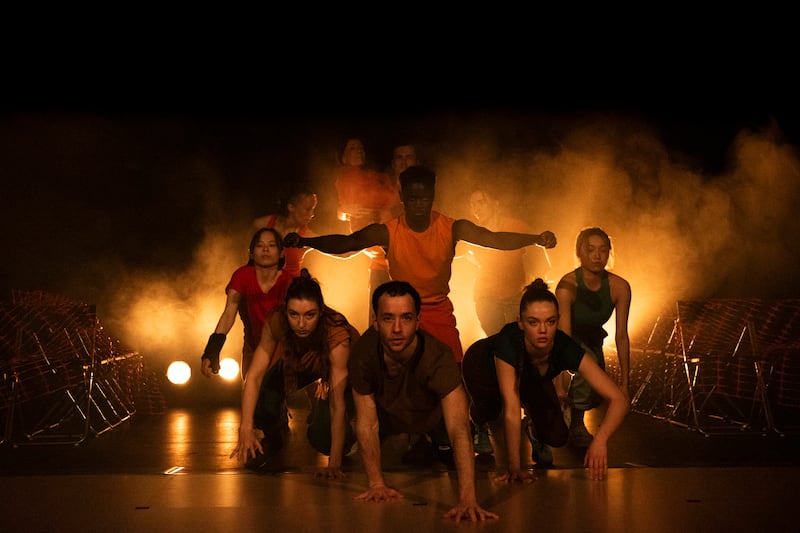
When Oberman Knocks’s soundscape kicks in, the dancers move into shapes that evoke giant sculptures coming alive. Part of Luail’s beauty and strength lies in how each performer expresses their individuality yet still remains so closely linked to the other members of the group. They become like one with their gloriously crisp, clear movements, emitting a single hum of energy.
A regal Joanna Banks represents Juno, who in the Aeneid causes great destruction. The same holds true here. At the beginning of Trojans, Banks sends dancers reeling and writhing on the floor with a single word to each of them: die.
Throughout, she sets in motion chains of events with great repercussions that reverberate through the performers’ movements and also on the screens. At one juncture she sits on top of a formation of them, who have created a kind of moving table top upon which she can balance.
 Luail: Trojans, choreographed by Philip Connaughton. Photograph: Luca Truffarelli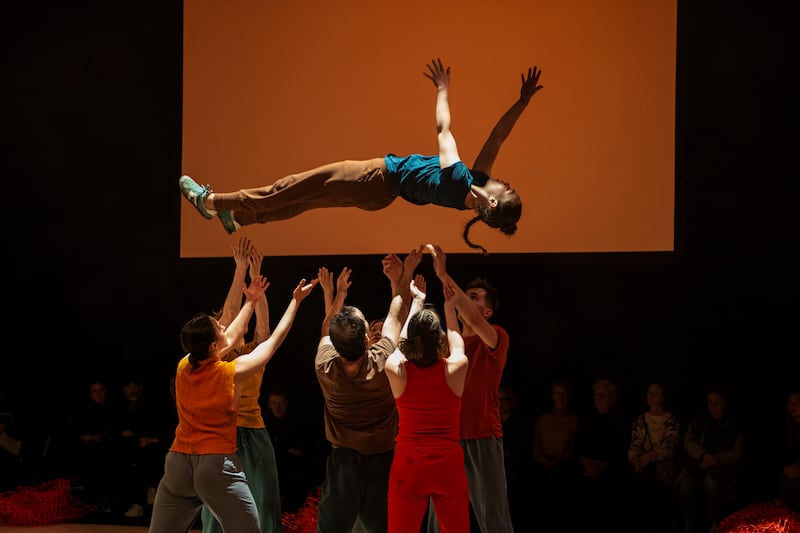
Luca Truffarelli’s video shows calm ocean waves lapping on shore and at sea. Suddenly Banks shifts as if casting a spell. As she makes contact with those underneath her, the four walls of video screens erupt with fire and destruction. Once the smoke clears, hollowed-out buildings and rubble fill the screens, and immediately the tone of the dance shifts.
While the dancers still remain loosely connected, their vibrancy has dimmed. It feels as though the previous joy and connection had been unknowingly taken for granted. Like a gut punch, a sense of closeness and community is gone. Some of the interactions that follow suggest an attempt at rebuilding, yet the images that appear onscreen look like specks in the universe or else black holes, suggesting a certain amount of futility.
However, personal connections with the Luail dancers – Robyn Byrne, Jou-Hsin Chu, Clara Kerr, Sean Lammer, Tom O’Gorman, Hamza Pirimo, Rosie Stebbing, Meghan Stevens and Chi Liu – keep a flicker of hope alive. They embody the human condition with enviable strength and grace.
When the final message on the video screen asks, ‘Would you be willing to die for the greater good?’ audience members make their choice. The result is a proud testament to this dance company’s impact.
Trojans, staged by Luail, is at Project Arts Centre, Dublin, until Saturday, April 4th; at Black Box, Galway, on Friday, April 10th, and Saturday, April 11th; and at Island Hall, Lagan Valley Island, Lisburn, on Wednesday, April 29th, and Thursday, April 30th