
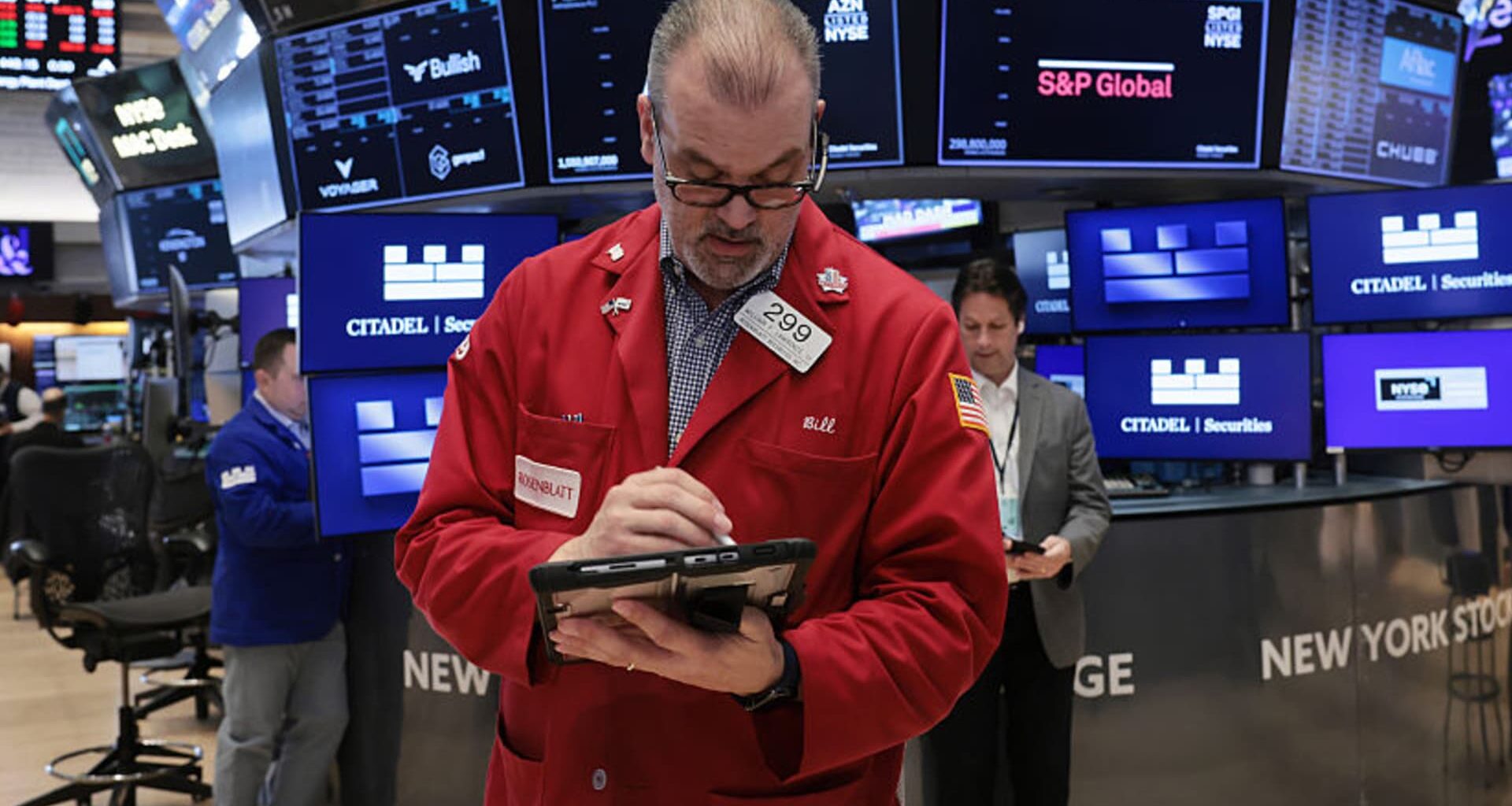
Traders work on the floor of the New York Stock Exchange on March 27, 2026.
Spencer Platt | Getty Images
The Dow Jones Industrial Average tumbled on Friday and fell into correction territory, while Brent topped $110 after incidents in the Strait of Hormuz exacerbated investors’ energy supply concerns and President Donald Trump‘s latest comments failed to encourage traders to scoop up shares.
The 30-stock Dow fell 793.47 points, or 1.73%, to close at 45,166.64. The S&P 500 lost 1.67% and ended the session at a seven-month low of 6,368.85. The Nasdaq Composite dropped 2.15% and settled at 20,948.36.
The broad market index notched its fifth straight weekly decline, dropping 2.1% in the period. The tech-heavy Nasdaq slid 3.2% week to date, while the blue-chip Dow retreated 0.9% for the week.
Friday’s slip comes a day after the Nasdaq fell into a correction, now almost 13% below its record set in October. The Dow tumbled into correction territory Friday on an intraday basis and ended the session down 10% from its closing high. The S&P 500 is down 8.7% from its closing record.
Stock Chart IconStock chart icon
Dow Jones Industrial Average, year-to-date
International Brent crude futures rose 4.22% to settle at $112.57 per barrel. U.S. West Texas Intermediate futures settled 5.46% higher to end at $99.64 a barrel. It was the highest close since July 2022 for both benchmarks.
President Donald Trump extended a deadline to attack Iran’s energy infrastructure to April 6, a little over a week after the original target date that was set for Friday.
“As per Iranian Government request, please let this statement serve to represent that I am pausing the period of Energy Plant destruction,” Trump said in a Truth Social post. “Talks are ongoing and, despite erroneous statements to the contrary by the Fake News Media, and others, they are going very well. Thank you for your attention to this matter!”
The announcement is the latest signal the Trump administration is seeking an end to the Iran war, a conflict that has resulted in surging oil prices that’s already hurting voters at the pump and could cost Republicans their seats in the midterm elections.
Uncertainty remains for investors, however, after Iran’s foreign minister reportedly told state media this week that Tehran has no intention of holding talks with the U.S., even if its leaders are reviewing an American proposal to end the war. On top of that, The Wall Street Journal reported, citing people familiar with the matter, that the Pentagon was considering sending another 10,000 troops to the Middle East.
The Strait of Hormuz is closed, Iran’s Revolutionary Guard has said to the country’s state media, adding that movement through the key waterway will face a harsh response. Two Chinese ships were turned away from crossing the Strait early Friday, and a Thai-flagged cargo ship that had been hit in the waterway has run aground, Iran state media said.
Even with Trump’s deadline extension, investors are at the point where they want to see a resolution to the conflict actually come to fruition as opposed to hearing there’s “just maybe” a resolution, said Jay Hatfield, founder and CEO at Infrastructure Capital Advisors.
A resolution would be a boon for the stock market, which has tumbled since the U.S. and Israel attacked Iran’s energy infrastructure on Feb. 28. The three major averages have each fallen more than 7% month to date.
“The longer the Strait is closed, the worse the oil market is going to get,” Hatfield said. “The price will go down a lot, but there’s still going to be an inventory issue when the Strait reopens, so if it takes another month to reopen the Strait, oil might stay at like $80 for a while until we can rebuild stocks.”
“It’s bad if there’s no resolution, even if there is a path to resolution,” he continued.