
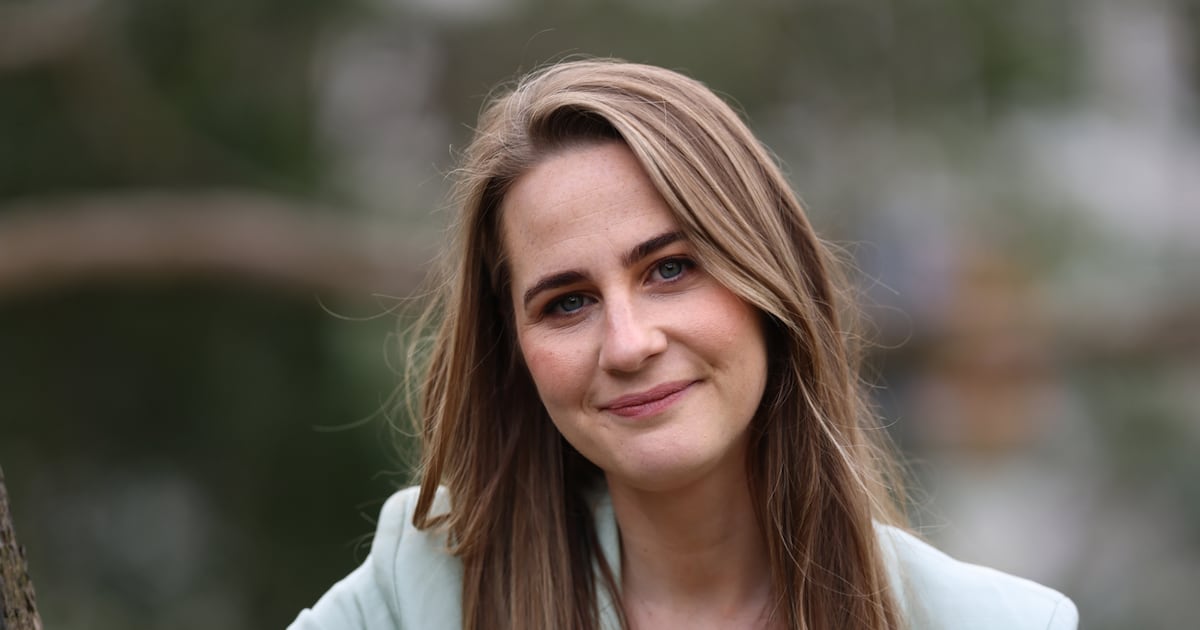
There are moments in anyone’s life that deliver a kind of internal fist-pump. For Louise Nealon, that sense of validation came in 2023 when she was asked to take part in an alumni chat in Trinity College Dublin. “I got to park on campus,” she says. “The guy at the gate was like, ‘You can’t park here’. Then he looked at his list and gave me the parking permit. I put Fontaines DC on and the barrier lifted.”
For someone who had felt for much of her college life like she did not belong, it illustrated how far she had come. When Nealon started in Trinity in 2009, she had been the country girl, raised on a dairy farm in north Kildare, who’d had to ask a guard where the college was on her first day. She’d fibbed to a student counsellor at 18 that she had friends because it was easier than admitting she wandered around campus alone. She’d go on to quit college because of anxiety and depression, returning after a year to complete her degree in English literature in 2014.
Many people can relate to the outsider feelings she experienced. But Nealon translated those eddying emotions – the heart-pounding anxiety and dislocation – into complex, original fiction. Snowflake, her 2021 debut novel, told of Debbie, a student who commutes from her dairy farm to Trinity College Dublin. Insecure, individual and book-smart, Debbie has an eccentric mother who spends her days recording her dreams, and an uncle, Billy, who sleeps in a caravan in the garden. The language of the novel was fresh and spiky, the narrative path idiosyncratic and unexpected.
The book became a bestseller. In 2024, it was picked as the One Dublin One Book choice, with all the city encouraged to read it. The book was optioned for a period by Element Pictures, the company that made Normal People. Nealon appeared on television, wrote bracingly honest personal columns, and became a celebrated name in the new guard of Irish literature, mentioned in the same breath as Sally Rooney, Naoise Dolan and Megan Nolan.
Today Nealon is in a Dublin hotel, looking younger than her 34 years and ready to give her first interview in a while, because her second novel, the startlingly good Everything That Is Beautiful, is about to be published.
Friendly and unassuming, if a little nervous, she orders a tea, takes off her jacket and then pulls on a cream jumper, mentioning that her mother told her to bring it. Nealon is the third of four children, but is always mistaken for being the youngest. “It’s because I haven’t hit the milestones of – you know – marriage, house, steady job, and especially with having a weird job, but I’ve learned to be okay with it.”
She looks back now on the woman who wrote Snowflake as being quite different from the person she is today.
“I wrote it for my 18-year-old self,” she says. “Who felt lost. I sank down into that feeling. It’s a feeling that makes a lot of people uncomfortable, especially in rural Ireland, like ‘Snap out of it’. There’s still a lot of old terminology, like, ‘Her nerves are at her’.”
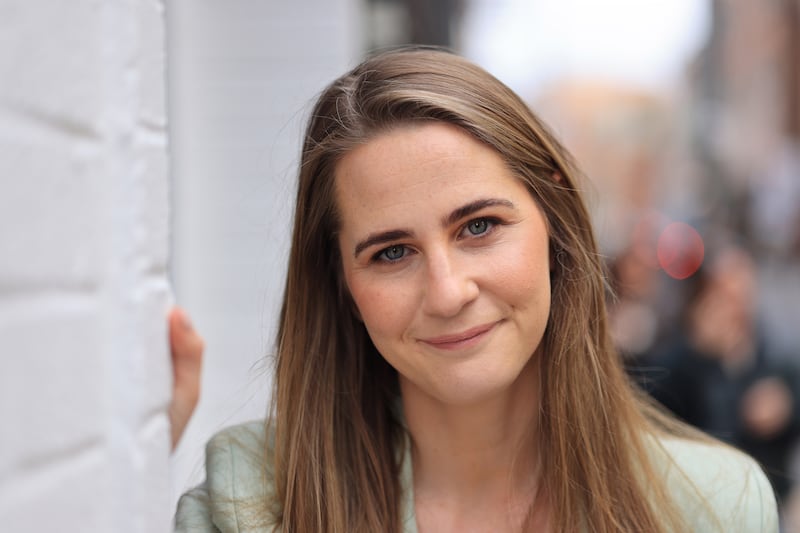 Louise Nealon: ‘My trouble started in Trinity because I didn’t have the identity as the smart kid in the class any more.’
Photograph: Dara Mac Dónaill/The Irish Times
Nealon knew how to hide her insecurities, which fuelled the internal pressure. Looking back, she says, “My trouble started in Trinity because I didn’t have the identity as the smart kid in the class any more. I didn’t quite know how to behave or be in this anonymous city.”
The success of Snowflake came with its own problems. Readers confused the character of Debbie for her. They possibly even confused Debbie’s mother for her mother. “God love my poor mother,” she says. Some moments were more awkward than others. “I was on national radio and the host was calling me Debbie,” she says. “I had to correct him.” Who? “Ray D’Arcy. Lovely man. We made it into a joke. It’s not that deep, but…” But it is unfortunate.
Nealon might have had aspects of the emotional life of Debbie, but part of her is a “show-pony”, as she puts it. She’s the kid who sang in the local choir: “I loved it. I’d take the mic and sing the psalm, and that was like an X Factor moment.” She’s in an improv group in her adopted home of Belfast. Her writing group – with Elaine Garvey, Olivia Fitzsimons and Sheila Armstrong – is called “Chekhov or F**k off”.
She’s a rigorous thinker and a very funny conversationalist. In our interview, she holds forth on cows, camogie, the GAA, the Church (“I wrote my first ever fan letter to a priest when I was nine”), and Leonard Cohen, as well as the more expected topics of writing and mental health. On mental health, she says: “I have a problem with the term mental health; it’s just your health.”
Nealon’s two-book, substantial six-figure book deal off the back of Snowflake, netted when she was 27, was what allowed her to take charge. From being broke and living at home on the farm in Kildare to save on rent, she could move to an apartment in Belfast (she’d done her masters in creative writing at Queen’s University Belfast in 2016), and pay for a therapist.
She likes, she has said in the past, choice therapy. What is that? “A psychologist called William Glasser came up with this theory where we can’t control the things that happen to us, but we can control how we react. So there’s five basic needs: love, belonging, power, freedom and fun. Everyone has these needs in different, varying levels. I would say that I have more of a need for power and fun than most people, and it’s part of the reason I became a writer.”
[ Louise Nealon: ‘There is an overwhelming silence and shame in Irish culture’Opens in new window ]
Writing allowed Nealon to become her own boss. “I am in control of my everyday life.” As for fun, Glasser says that in addition to what we might think of as traditional fun or play, there’s also the joyful type we have in learning something new; in discovery. Discovery is an important part of how Nealon sits down to a page. She doesn’t plot. Like Zadie Smith and Sally Rooney, she’s a “pantser” (as in, a seat-of-the-pantser) rather than a plotter who creates outlines.
What I am interested in is communication between genders. I have such admiration for men in my life, and the deepest respect I can pay to them is to communicate
She compares her process to the fairytale of Rumpelstiltskin: the miller’s daughter whose dad brags she can spin gold from straw, and this bargain must be kept. “You tell everyone that you’re writing and then you go into a room by yourself, and you’re like, I can’t f**kin’ do anything.”
In writing, one of her challenges is to instil herself with confidence. When she writes, she keeps a sign on her desk from an old camogie coach: “Keep the faith.” She doesn’t care about people’s opinions, except for one person’s: her own. She was self-lacerating as a younger person, looking for perfection, to the point where, she says, she was “self-aware to a fault; it froze me into a kind of immaturity”.
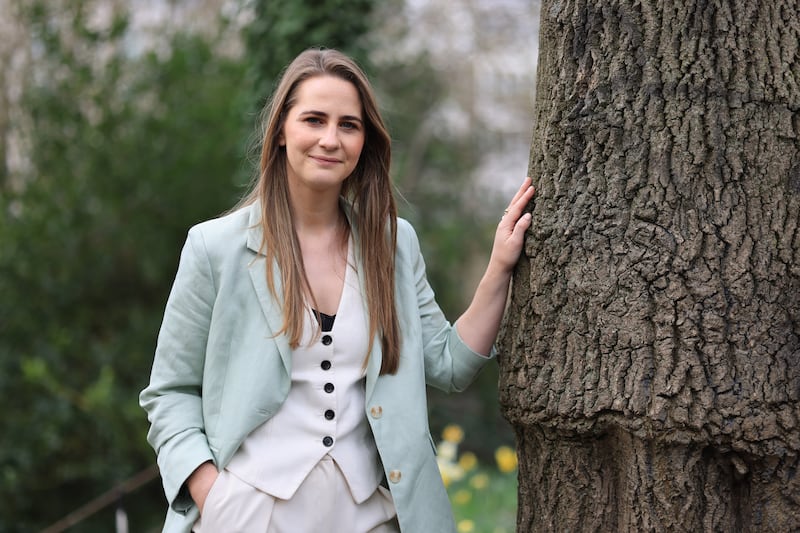 ‘Writing is managing your emotions when the sentence doesn’t fit with what’s inside your head.’ Photograph: Dara Mac Dónaill/The Irish Times
She learned to sit with the sentences she didn’t like, with emotions she didn’t like. “Writing is managing your emotions when the sentence doesn’t fit with what’s inside your head.” The rejection that came in her early days of sending out short stories, before she won the 2017 Sean Ó Faoláin short story competition and signed with top agent Marianne Gunn O’Connor, taught her that “Your shadow self is the good stuff”. Discomfort is what she’s looking for – the moment when drama occurs.
It’s evident in her remarkable new novel, which is not dedicated to anyone, but instead shares an epigraph from Muriel Rukeyser: “What would happen if one woman told the truth about her life? The world would split open.” It’s the story of the Foley family and of Niamh Ryan, a neighbour who lacks a supportive family, and so finds herself cleaving to the Foleys, who are famous through the land because of their patriarch Liam, a hurl maker, former player, and coach.
[ The Possibility of Snow, a short story by Louise NealonOpens in new window ]
The novel is reminiscent, at various points, of Claire Keegan and John McGahern: it’s wise, brutal and razor-sharp in its portraits; there’s gentle Niamh, but also Helen Foley, the taken-for-granted grandmother, and Kate Foley, the daughter who has seen too much.
Some of the subjects tackled, without giving the story away, include disordered eating, sexual assault, self-repression, bereavement and disability, knitted together in a tapestry that conjures up an adroit sense of rural Ireland as a whole. (For the depiction of Helen alone, the novel would make an amazing book club choice.)
A line from Leonard Cohen’s poem Better gives the novel its title. If you read the full poem, which reflects on human choices, it’s not the rosy vision the phrase “Everything that is beautiful” may at first portend; and in that, it echoes the profound darkness of Nealon’s novel.
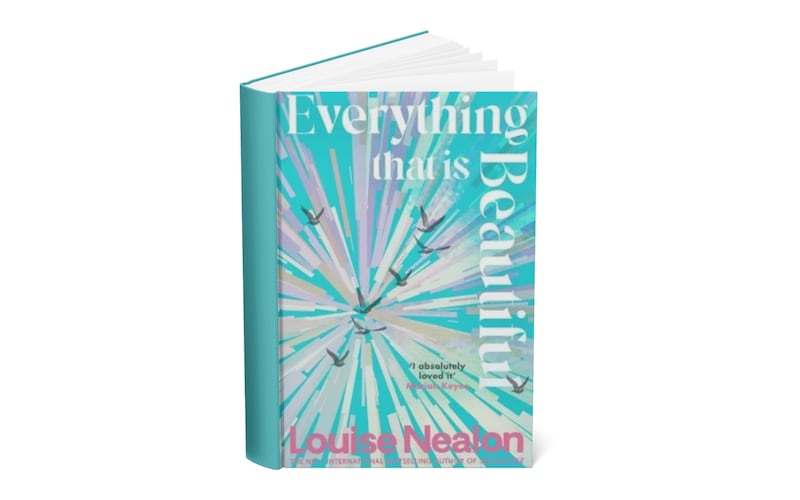 Louise Nealon’s new novel, Everything that is Beautiful.
“The last thing I’m trying to do is cancel Leonard Cohen,” she says. “But I found it disappointing how he treated certain women in his life. I find questioning people you admire, without cancelling them, without erasing them from your life, necessary.”
I mention that great artists sometimes get away with bad behaviour. “I’m exploring an energy of misogyny that we all participate in,” she says. “Sometimes bad behaviour is permissible because people are just too uncomfortable to look at it.
“The amount of shit part-time jobs I was in that were pure misogyny. I worked in a bookshop and a man came in every day. There was always one of us sorting out the magazines, and he’d say, ‘You’re on your knees again for me today’.
“We made a joke of it. To bring it to management or make a big scene would be too much, yeah?”
When I grew up, I thought the sky was blue, the grass was green, men’s sports deserved to be televised, and women’s didn’t
— Louise Nealon
Change comes gradually and then sometimes suddenly, but only if people talk to each other and address societal ills. The novel focuses intensely on hurling and the joy that can come from sport, a joy Nealon knows from her days playing camogie.
She points to the positive transformations that have happened in the GAA and elsewhere in recent years. “When I grew up, I thought the sky was blue, the grass was green, men’s sports deserved to be televised, and women’s didn’t. And now I live in a world where women’s soccer is on TV all the time.” She’s grateful her little nieces and nephews bear witness to a different reality than the one she did.
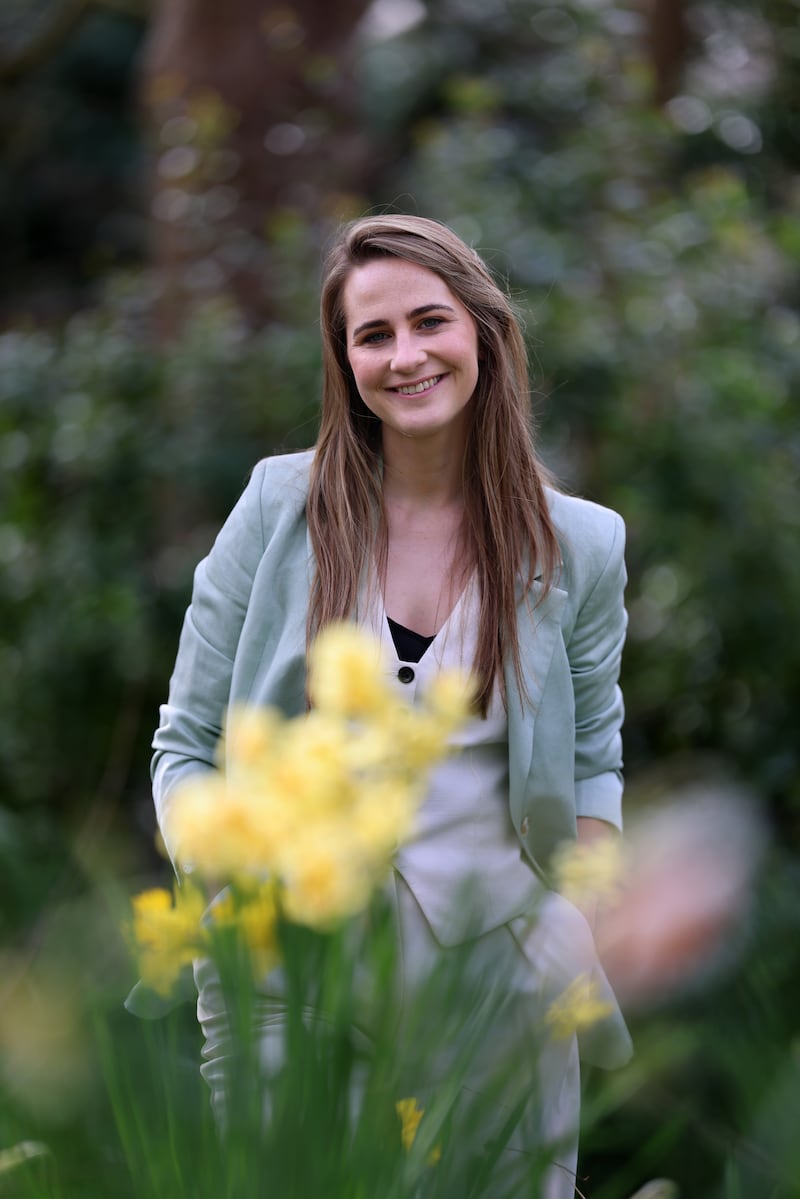 Nealon’s new novel focuses intensely on hurling and the joy that can come from sport. Photograph: Dara Mac Dónaill/The Irish Times
It’s tempting for writers to write off certain subjects in their fiction. To ditch religion. To ditch the manosphere. To write fiction that sets its context way back in time or focuses on enduring subjects such as love – because, frankly, it may be easier. Nealon takes a different slant: she engages, even if it’s uncomfortable, even if the reading of her novels makes you wince.
“What I am interested in is communication between genders. I have such admiration for men in my life, and the deepest respect I can pay to them is to communicate,” she says. “It will only become more important for future generations to break down the barriers of the gender divide.”
Everything That is Beautiful by Louise Nealon is published by Manilla Press on April 2nd