
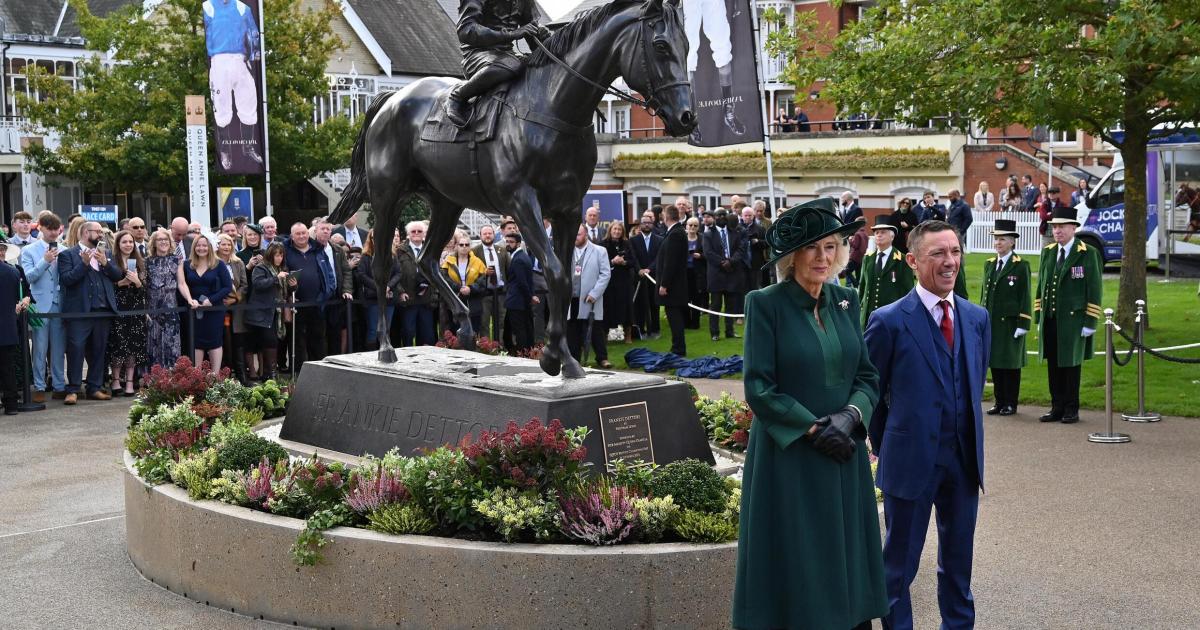
Working from his studio in picturesque Uley, Tristram is best known publicly for his bronze statue of Frankie Dettori mounted on multiple Ascot Gold Cup winner Stradivarius at Ascot Racecourse. Installed on the Grandstand Lawn, it was unveiled by Queen Camilla in October 2023 on QIPCO British Champions Day, Frankie’s professional farewell to the UK. Having secured a double triumph on King Of Steel and Trawlerman during raceday, Dettori had cause for celebration, however photographs of the presentation reveal evident enthusiasm for his immortalisation in art.
Tristram Lewis alongside his Frankie Dettori sculpture at the Italian foundry which cast it (Image: Laura Vattovaz)
Tristram Lewis working on waxes for the Frankie Dettori sculpture at the Italian foundry which cast it (Image: Laura Vattovaz)
‘Some artists sculpt people and some sculpt horses,’ says Tristram. ‘I think my niche is putting people on horses.’
Growing up in a creative household and inspired by the horse paintings of George Stubbs and Alfred Munnings from a young age, Tristram discovered Munnings’ sculptures, of which there are only two in the prolific artist’s oeuvre. The works made a profound impact on Tristram, who made a pilgrimage to Mells in Somerset aged 18 to see Munnings’ mounted statue of Edward Horner while he was greatly taken by the Jockey Club-commissioned Munnings sculpture of Cheltenham Champion Hurdle-winner Brown Jack.
‘That, to me, is the finest representation of a thoroughbred horse anyone has produced,’ Tristram eulogises. ‘It’s heartbreakingly good; it’s astonishing.’
Study for the Duke of Edinburgh, Colonel of the Grenadier Guards, presented to HRH King Charles III as a coronation gift, 2023 (Image: Tristram Lewis)
An enduring admiration for Munnings would prove light relief during the five years he spent trading commodities in London before taking up art full-time in 2014, aged 50. The pivot followed a colourful and adventurous career based largely at sea sport fishing (he cites time spent in Puerto Banús coinciding with the release of Jaws during his impressionable teenage years as an influence), commercial fishing and fish trading and also spanning estate agency and house building.
‘Whenever I got the chance, I would go into the galleries around St James’s or to Tate Britain,’ Tristram remembers of his London days. He could also be found in the libraries of the Royal Academy of Arts (of which Munnings was an outspoken president) and V&A consuming research on Munnings, with the original intention of writing a biography of the artist (a hark back to earlier art history A-Level studies) rather than becoming one himself. ‘It will happen at some point,’ Tristram divulges, hinting at a developing publishing deal.
Having quit the rat race and initially spending time painting at his Gloucestershire home near Westonbirt, Tristram’s children’s plasticine (he now uses Plastoline) would provide the route to 3D art, while memories of Munnings’ sculptures lurked in his mind’s eye. ‘I owe a mention to Philip Blacker here,’ admits Tristram, who used the jockey-turned-sculptor’s book The Making of Red Rum as a how-to-guide to construct his first wireframe and maquette before investigating the casting process with Castle Fine Arts Foundry in nearby Nailsworth.
Thoroughbred Study II, patination inspired by Herbert Haseltine Photo Tristram Lewis (Image: Tristram Lewis)
Thanks to an encounter with retired racehorse Denman near Snowshill in 2017, nearly a decade after his 2008 Cheltenham Gold Cup win over bookies’ favourite Kauto Star, Tristram felt emboldened to make a sculpture of ‘The Tank’ as his first major foray into professional sculpting.
Securing the blessing of owner Paul Barber to create a 1:4 scale bronze sculpture for The Sir Peter O’Sullevan Charitable Trust annual auction lunch, it sold for five figures.
‘A few people held up their glass to me around the room,’ notes Tristram – not immodestly – and a further private commission of a life-size horse for not far short of six figures ensued.
This coup, via sporting and equestrian art specialists Osborne Studio Gallery in London (with whom Tristram had established a link through successful sales of editions of a previous sculpture based on Tristram’s own horses) would add momentum to his artistic journey. Further smaller-scale versions of the private commission sculpture were also snapped up. By the time the pandemic hit, the Dettori project was already in flow with Tristram having secured the support of the Jockey Club and a number of prestigious backers including Lady Bamford, founder of Daylesford.
Tristram Lewis with Denman (Image: Robin Wilson)
‘There’s a lot of admin behind all these things,’ discloses Tristram, though his business acumen, networking skills and being unfazed by celebrity made him more than qualified for the task. The project also involved a donation towards the conservation of the last remaining rubbing house (buildings created for the removal of sweat, dirt and dust from racehorses, captured on canvas by Stubbs) in Newmarket. Fittingly, it was used by Munnings as a studio as he was coming to the end of his career. Ahead of the Dettori showcase, Tristram had finished a sculpture of the late Duke of Edinburgh on horseback, a gift from the Grenadier Guards originally designed for Queen Elizabeth II, presenting it in person to HM King Charles III in June 2023 to mark his coronation.
Although referencing the Dettori project fondly as ‘a great moment’ and, candidly, ‘a fabulous advert’, Tristram had his sights on another high-profile composition.
‘I like to have a big project to get my teeth into,’ he reflects. This would prove to be an endeavour carrying huge potential and prestige; a plan to depict a post-war Winston Churchill in the saddle.
Portrait bust of Churchill (Image: Tristram Lewis)
Based on a series of 1948 photographs showing the great statesman at leisure riding a hireling horse, Geronimo, near his home Chartwell in Surrey, the sculpture would be the first of Churchill mounted. ‘Churchill is a real passion for me,’ affirms Tristram, who inherited a respect for the wartime Prime Minister as the youngest child of parents involved in Bomber Command (his father was a Lancaster crew member, while his mother was employed at Bletchley Park). The original model head for Oscar Nemon’s statue of Churchill in the House of Commons sits on another of Tristram’s windowsill.
At the time of writing, the final destination for Tristram’s sculpture, which will be of monumental proportions, was still being agreed, however with the tacit support of Churchill’s family, it can be expected it will be in a prominent location with direct links to the man himself. Tristram has produced a detailed portrait bust so far and is looking forward to tackling Geronimo. ‘The Churchill project could run and run,’ he asserts. In the meantime, artworks in flow include a piece for the World Horse Welfare centenary and of a notable racehorse (now at stud) while early discussions are taking place for a mounted racing project linked to Cheltenham Festival. ‘Racing has been an important theme, a fulcrum,’ Tristram effuses. ‘I feel I’m a very, very fortunate man,’ he acknowledges. ‘Becoming an artist, genuinely, is the best thing, bar my family, I ever did. If I won the lottery, I’d still be doing this.’ Unlike his oft subject thoroughbreds, Tristram, who turns 62 this year, doesn’t feel the need to retire. ‘I’m one of those lucky people who wake up every day and get to do what they love.’.
Tristram’s work will be at Osborne Studio Gallery in London for its 40th anniversary exhibition in April.
tristramlewis.com
@tristramlewis
Macdermott, who won the 2024 Scottish Grand National (Image: Tristram Lewis)