
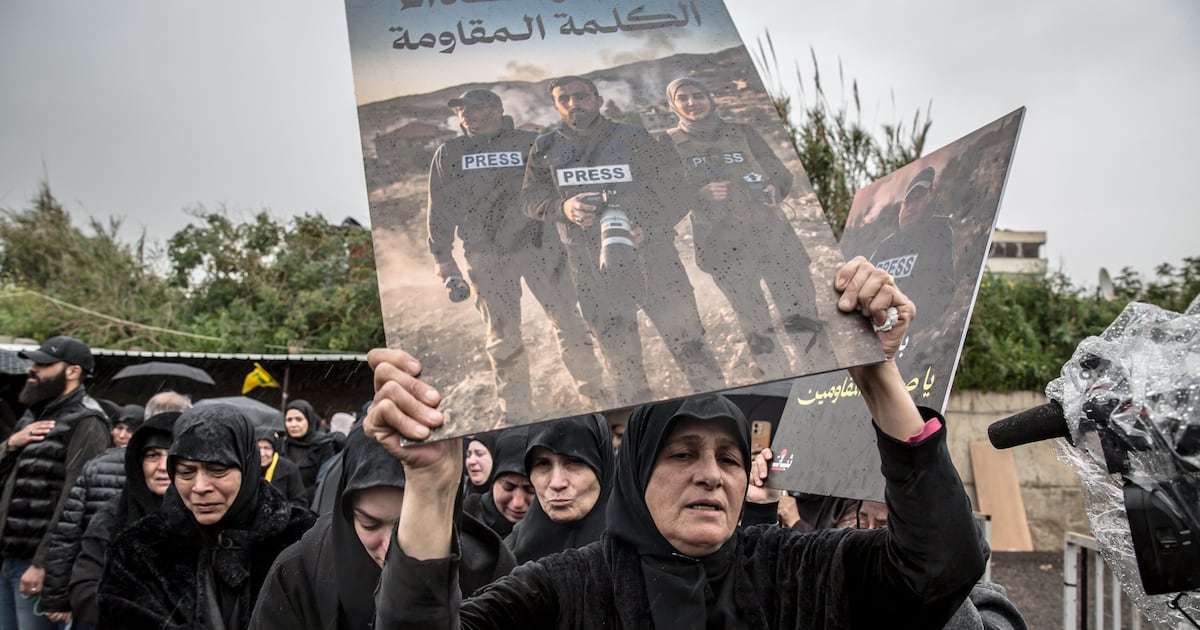
Hundreds of people turned out on Sunday to attend the funerals of three journalists who were targeted and killed by Israeli air strikes while driving in southern Lebanon the previous day.
Rain poured as their bodies – draped with flags bearing the names of their news outlets – were carried through the cemetery, in Choueifat, south of Beirut, alongside pictures of them reporting and wearing their press vests.
The targeted killings have provoked an outcry across Lebanon, where people of many different beliefs and backgrounds have come together to say that this is unacceptable and contrary to international law.
Those killed were correspondent Fatima Ftouni and her brother, cameraman Mohammad Ftouni – both with pro-Hizbullah television station Al Mayadeen, and Ali Shuaib, who worked with Al-Manar, which is Hizbullah owned.
The Israeli military said Shuaib was “a terrorist operative” in the intelligence unit of Hizbullah’s Radwan Force, accusing him of “systematically reveal[ing] the locations of IDF [Israel Defense Forces] forces operating in southern Lebanon and along the border, and maintain[ing] constant contact with other terrorist operatives”.
Other journalists working in Lebanon were quick to point out that reporting on Israeli military positions and communicating with different parties to a conflict are part of the basic work of a journalist.
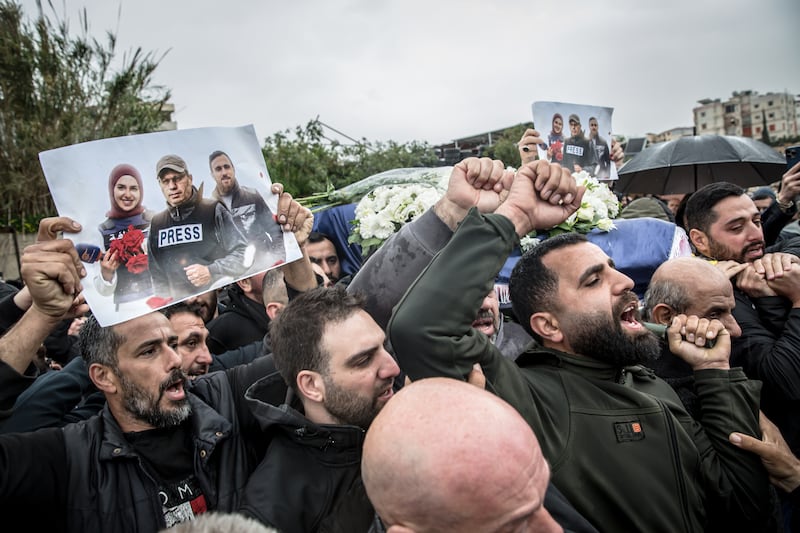 Mourners hold photos of the journalist killed by Israeli air strikes at the funeral procession on Sunday. Photograph: Sally Hayden
The IDF also accused Shuaib of “incit[ing] violence against IDF forces and Israeli citizens, using his platform to disseminate Hizbullah propaganda”.
Israeli military spokesman Avichay Adraee called him “a key pillar in Hizbullah’s terrorist propaganda apparatus, to the point that senior leaders of the organisation described him as the ‘second axis’ of the disinformation and propaganda unit.”
Under international law, journalists are protected regardless of their affiliation, unless they are directly participating in hostilities. The Israeli military did not provide justification for killing the other journalists with Shuaib.
Fatima Ftouni survived a previous attack in October 2024, when direct Israeli strikes on a compound which journalists were sleeping in killed three others. “It is the silence of the international community that let this happen,” she told the Guardian afterwards.
[ On the front line of Lebanon’s war, medics count their dead and keep goingOpens in new window ]
In the hours after Saturday’s killings, Lebanese information minister Dr Paul Morcos held an emergency press conference in Beirut.
“It is time to remember, recall, and hold on to international laws,” he said, referencing the Geneva conventions, including the 1977 additional protocol I article 79, which specifies that journalists should be considered civilians.
This means “absolute protection for the journalists, regardless of their political affiliations or their beliefs,” he said, adding that the government is working to file complaints to various international authorities including the UN Security Council, the UN Human Rights Council, and the International Committee of the Red Cross.
Reporting on his statement was Abbas Sabagh, another Al Mayadeen journalist. He said he knew Shuaib for 22 years and Fatima Ftouni since 2017. “They weren’t carrying weapons. They were carrying microphones and cameras,” he said.
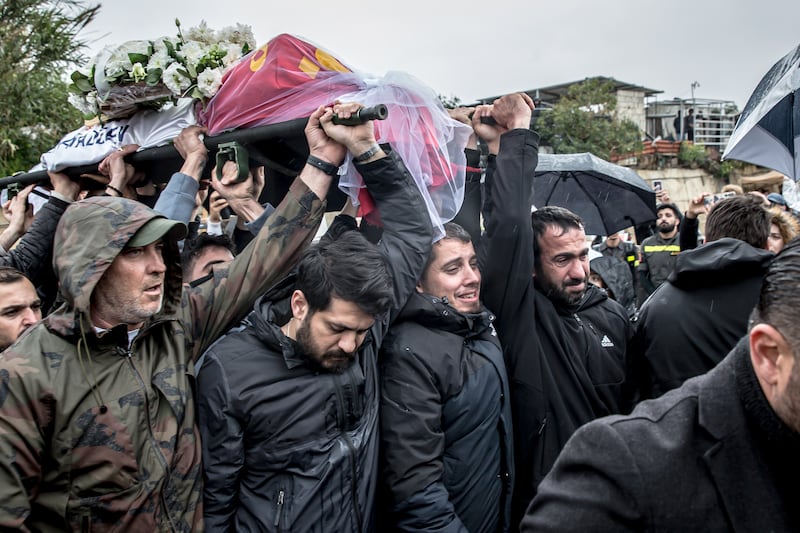 A coffin is carried through a cemetery in Choueifat on Sunday. Photograph: Sally Hayden
At dusk on Saturday, dozens of journalists from many backgrounds gathered in the central Martyrs’ Square. Some held candles and signs that said: “targeting journalists is silencing the truth.”
Elsy Moufarrej, the head of the Union of Journalists in Lebanon, said this is a war crime which “Israel is not hiding this time. They are saying it clearly.”
She said there are firm steps that should be taken now by the Lebanese state, including issuing new war crimes regulations, as well as asking the UN Human Rights Council and the International Criminal Court to investigate.
The Israeli military maintains that it abides by international law and does not target civilians. But human rights organisations and other monitors say extreme violations are being carried over from Gaza – where Israel is widely accused of carrying out a genocide – and are taking place in an environment of impunity.
Last December, Nasser Abu Bakr, Chairman of the Palestinian Journalists’ Syndicate, said more than 255 journalists had been killed in Gaza since October 2023. More than 500 were wounded while more than 200 were arrested and subjected to extreme torture in prison, he said. Journalists’ relatives were also killed or targeted.
In February, the Committee to Protect Journalists said journalist killings have reached an all-time high globally “primarily due to the actions of one government.” In 2025, it said Israel was responsible for two-thirds of all journalist and media worker killings, driving the total number killed worldwide to a record 129 – the highest number the organisation has recorded in its three decades.
At least 1,238 people have been killed in Lebanon by Israeli attacks since March 2nd, including 51 healthcare workers and 124 children, Lebanon’s ministry of health said on Sunday.
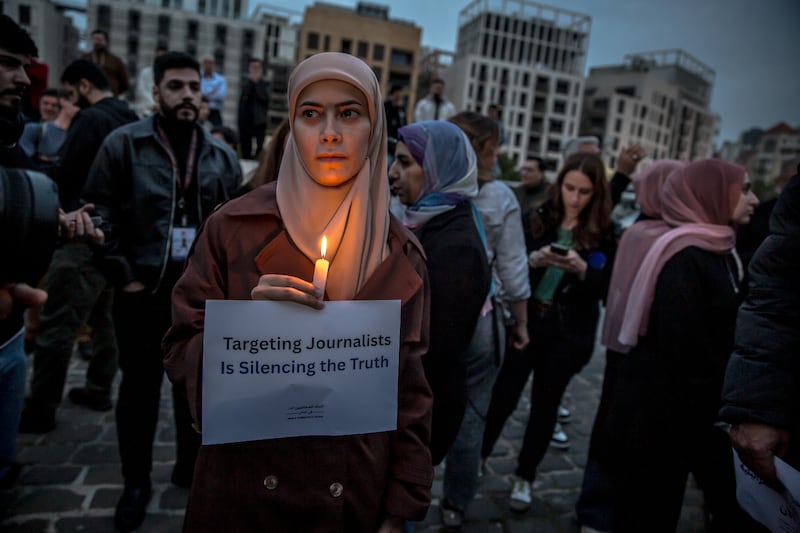 A woman holds up a poster saying ‘targeting journalists is silencing the truth’ during a protest in Martyrs’ Square, Beirut, hours after the three journalists were targeted and killed in southern Lebanon. Photograph: Sally Hayden
The same day the three journalists were killed, the World Health Organisation said Israeli strikes killed nine paramedics and wounded seven across five attacks. The Irish Times recently investigated Israeli killings of healthcare workers, which lawyers say are violating international law.
At least 25 journalists and media workers have been killed by Israeli attacks in Lebanon since October 2023, according to a tally by Beirut-based media outlet the Public Source.
They include 37-year-old Reuters correspondent Issam Abdallah, who was killed during a double tap strike in southern Lebanon on October 13, 2023, which wounded six other journalists.
Multiple investigations proved the journalists were directly targeted by Israeli forces, which are supported by the US. “The grief doesn’t fade. There is still no justice and no accountability,” Abdallah’s sister, Abeer Abdallah, told Reporters Without Borders (RSF) last year.
In December, American journalist Dylan Collins – who works with the news agency Agence France Presse (AFP) and was injured in the attack – held a press conference with US members of Congress in Washington DC.
“As an American, I thought I’d find support,” he said. “I thought my government would fight for me … I certainly expected more than nothing.”