
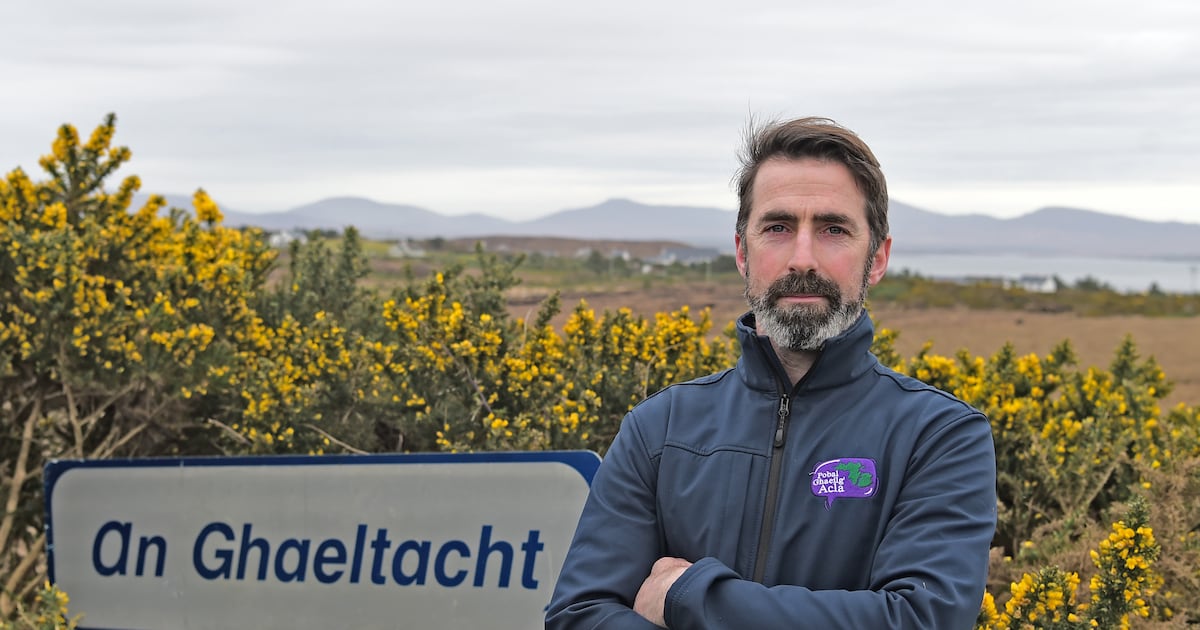
There are hundreds of crumbling and derelict houses dotted across the landscape of the Gaeltachtaí from Kerry to Donegal.
These homes once belonged to people who have long since emigrated and may have been passed on to family members. This makes tackling the issue of affordable housing a “complicated and sensitive issue” due to strong emotional links to these empty properties, according to the new country’s first vacant homes co-ordinator for the Gaeltachtaí.
The problem is exacerbated in some cases by demand for holiday homes and rentals.
A new project, funded by Údarás na Gaeltachta in partnership with Mayo County Council, is spearheaded by Achill man Colm MacEachmharcaigh.
A primary aim of the project is a national campaign, to be initiated in April, to raise awareness about the high number of empty houses in these areas and “to create a sea-change in attitudes” by their owners.
“Our main aim is to reduce the number of vacant homes and make them available for Irish speakers in the Gaeltacht. We have found that a lot of the owners of these vacant or derelict homes are people who have emigrated a long time ago, mostly to England or the US,” says MacEachmharcaigh.
“In many cases, these houses now belong to the children of emigrants, which makes it a very complicated and sensitive issue due to strong emotional links. It is understandable that it is hard to let go, even if they only visit once in a while.”
He says he plans “to engage with these people and show them how serious the situation is unless we can create housing options for Irish speakers”.
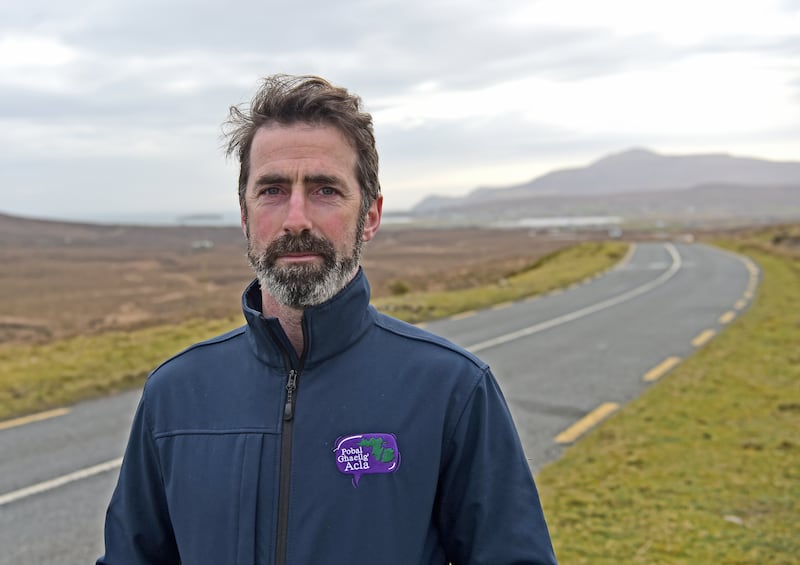 Colm MacEachmharcaigh on Achill Island. Photograph: Conor McKeown
“We need to convince them that they can give back to their ancestral home place by activating that empty home. I think for a lot of people in this position it could be cathartic and could strengthen their link to home,” says MacEachmharcaigh.
With the 2022 census recording an average rate of 11 per cent of empty properties in these areas – 3 per cent higher than the national average – the challenges are complex.
The figures also revealed that there are 9,609 holiday homes in the Gaeltachtaí.
In Mayo alone, there are 817 vacant homes (13 per cent) and 1,304 holiday homes (21 per cent) in the Gaeltacht areas. The greatest challenge is in Donegal, where there are 2,140 vacant homes (12 per cent) and 4,484 holiday homes (27 per cent), representing 7.7 per cent of all houses in the county.
“Take Achill, where I’m from: it is a popular tourism destination and there is a demand to own holiday homes as well as a demand for short-term lets. If there was availability, there are lot of people, emigrant gaeilgeoirí living in cities, for example, who would buy a house here and retire or work from here.
“This demand is one of the things where we need a sea-change in attitudes and to foster a culture where people don’t want to just sell their house to the highest bidder but ensure they put a family of Irish speakers into it who contribute to this community,” he says.
Expanding on the changes in Achill during his lifetime, MacEachmharcaigh observes that “there has been a huge surge of properties built here specifically as holiday homes, and in that same time, there has been a big reduction in the number of tourism providers.
“Three hotels have closed. There is a fraction of the family-run B&Bs that traditionally created jobs. Even from a healthy tourism point of view, there is much less interaction with locals when people come to stay. When they stayed in B&Bs, they would get to know the kids and might get to know the neighbours. We’ve lost something valuable there as well,” he continues.
Like in the other Gaeltachtaí, the demographic health of these areas can easily be measured by school numbers.
“When I was in primary school, there were 13 schools with a total school population of 450 pupils. Thirty-two years later, there are six schools and 220 pupils. However, the positive development is that a lot of parents of these children can work from home now and don’t need to emigrate, as was the case in the past. The bottleneck now is the lack of affordable housing, even though there are hundreds of vacant properties here,” he continues.
He adds that a long-term goal is to work alongside approved housing bodies that would develop houses in the Gaeltacht for Irish speakers at affordable rents.
“Language enurement policies have been applied in some Gaeltachtaí areas but only on larger housing developments and not at a level required to maintain a living language,” he adds.
He stresses that there is “a balance to be struck with many of these communities to ensure the continuation of a thriving tourism sector”.
“It doesn’t have to be one or the other. It is about getting that balance right and I think to do that you need a well-organised community that is able to be honest with each other about what is the best thing for them,” he says.
MacEachmharcaigh’s role as vacant homes co-ordinator for the Gaeltachtaí means he will work with Donegal, Mayo, Galway, Kerry, Cork, Waterford and Meath local authorities.