
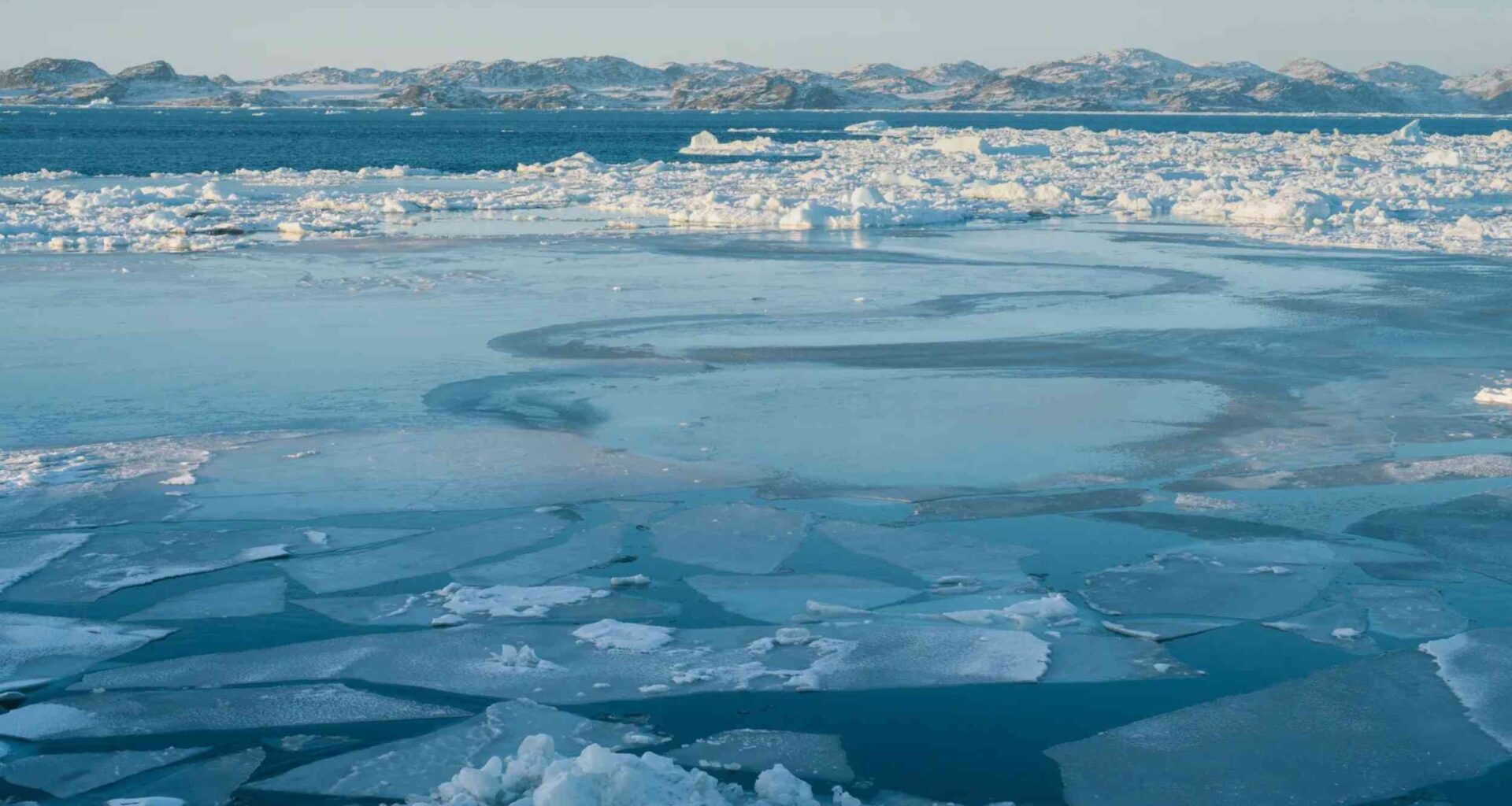
Researchers have found that buried rock-rich bands deep inside Greenland’s ice record the sheet regrowing after a major collapse more than 120,000 years ago.
The record reframes the ice sheet’s past as one of deep retreat followed by uneven recovery, rather than continuous survival.
Clues in the ice layers

Deep beneath northern Greenland, distorted bands cut through the ice where smooth internal layers are usually preserved.
Analyzing those structures in detail, Nicholas Holschuh of Amherst College demonstrated they contain debris lifted from the ice sheet’s base.
The debris-filled layers sit thousands of feet above the bed, showing the ice once moved in ways that carried material far upward during regrowth.
Their presence places a clear limit on simpler explanations and sets up the need to understand how such extreme internal movement occurred.
Rock that was carried upward
Some of those bands carry rock and grit more than 3,280 feet above the bottom of the ice sheet.
The authors call them debris trains, stacked streaks of ice and rock hauled upward during intense motion.
Nearby layers bend sharply and lose their neat shape, showing that the rocky bands changed how the surrounding ice deformed.
Any model that treats the interior as uniform misses those weak spots and can misjudge where future motion will concentrate.
Results of radar scans
Earlier radar flights saw the distorted shapes, but they could not tell whether the deep structures were folded ice or something else.
The new scans measured backscattering – the energy that bounces toward the instrument – and the returning signal spread unusually wide.
Clean internal layers usually send radar back from one tight angle, while these buried bands returned signals from many directions.
That broad return is the fingerprint that pushed the old debate over the structures’ origin toward a very different answer.
Warmth before regrowth
Only a much smaller Greenland can explain these buried bands during the last interglacial, a warm span between ice ages.
Sea level then stood about 4 to 17 feet higher than today, consistent with major polar ice loss.
Greenland also saw its warmest summer conditions of the last 600,000 years during that interval.
Once cooling returned, fresh snow and colder edge ice could trap old debris in rising bands as the sheet rebuilt.
Connecting a broader story
Other clues had already hinted that large parts of Greenland were not always covered by thick, stable ice.
Rock collected near the center of the ice sheet suggested it was almost gone at one point within the past 1.1 million years, a finding that reshaped earlier views.
Sediment from a Cold War-era U.S. research site in northwest Greenland pointed to another ice-free period about 400,000 years ago during a naturally warm phase.
The new radar result connects those scattered clues into a broader story, showing the changes were not limited to a single location.
Unusual signature in Greenland
Northern Greenland preserved these layered bands, while southern Greenland and Antarctica largely lost them – and that difference holds an important clue.
In the north, slower ice turnover let ancient rocky layers stay buried, while faster snowfall and flow farther south likely flushed them out.
Antarctica also lacks the same widespread inland setting where a retreating land-based sheet could regrow over cold margins.
Greenland’s pattern looks less like universal ice behavior and more like the signature of one unusual recovery.
Motion during regrowth
Buried bands also hint that Greenland did not simply creep back after the warm period ended.
These bands fit a picture of surging, brief bursts of unusually fast glacier flow, as new ice pushed into colder margins.
That kind of motion can shove rock-rich basal ice upward along weak zones instead of leaving it pinned to the bottom.
If Greenland really regrew in bursts, some of its oldest climate archive may still sit trapped above and below the bands.
Limitations of simplified models
Those rockier layers did more than record history because they probably changed how the ice moved afterward.
Rocky ice can alter fluidity, how easily ice deforms under stress, and the radar images show that change concentrated strain nearby.
Many forecast models still simplify the interior into cleaner, more even material, which can hide motion happening inside the ice.
Such simplified models can make the sheet look too sensitive to changing forces, even when part of motion comes from internal deformation.
What drilling could reveal
Drilling offers the clearest way to test this buried story inside the bands and nearby ice.
Samples could reveal whether the layers hold pushed-up ancient ice or refrozen water, two possibilities with very different histories.
A positive identification either way would sharpen the map of where Greenland kept old climate records and where it truly disappeared.
Direct sampling could turn a striking radar discovery into a firmer guide for future sea-level planning.
Buried rock bands, earlier sediment clues, and ice-flow physics now point to a Greenland that once shrank hard, then rebuilt unevenly.
The picture is still incomplete, but it already warns that Greenland’s future may depend on hidden weaknesses deep inside the sheet.
The study is published in the journal Nature Geoscience.
—–
Like what you read? Subscribe to our newsletter for engaging articles, exclusive content, and the latest updates.
Check us out on EarthSnap, a free app brought to you by Eric Ralls and Earth.com.
—–