
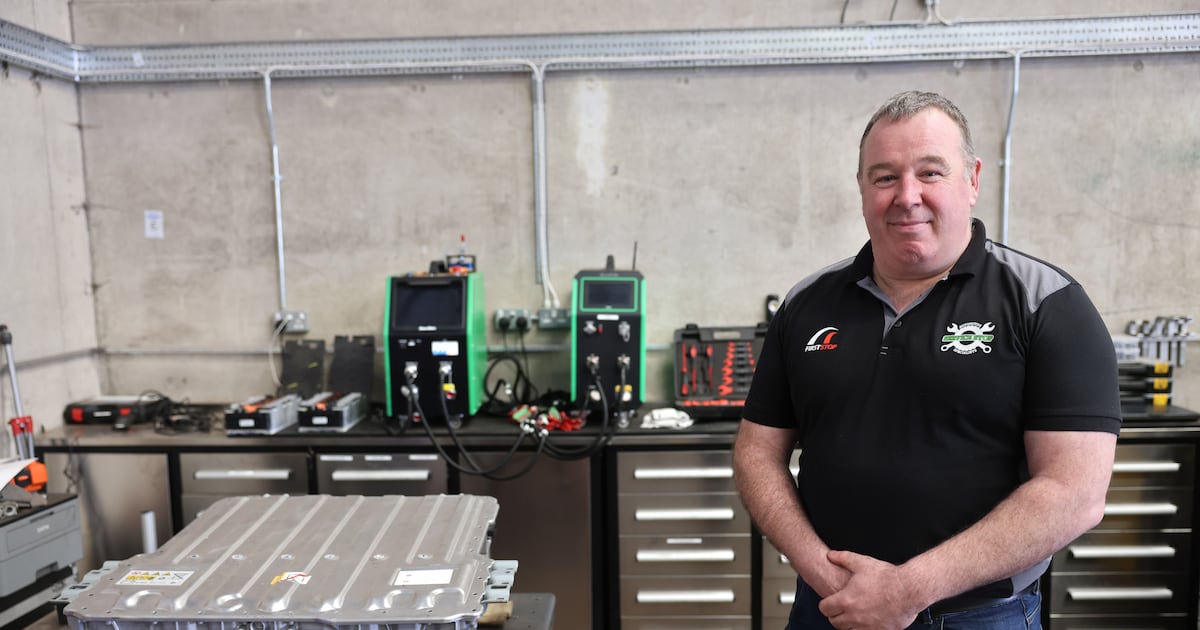
David Corbally may not have fixed the entire electric car market, but he might just have fixed how we think about it.
The owner of Service Stop, an independent garage in Oldtown, Co Dublin, has made a name for himself online as a repairer – and frequent critic – of electric cars.
He sees EVs in a way their makers never wanted anyone to: literally stripped bare, often damaged and broken, seeking either resurrection or reclamation.
It would be easy to dismiss Corbally as another voice in the online chorus insisting they’ll “stick with a diesel Avensis”. That would be a mistake.
His criticism of EVs is not ideological; it’s practical and grounded in what he sees on the workshop floor.
“EVs are supposed to be better for the environment,” he says. “If you want a car to be better for the environment, it has to last for 20 years and cover about half a million kilometres. And that means it has to be repairable within those 20 years at a cost that’s reasonable to the consumer.”
He argues that current policies are too heavily weighted towards new car sales.
“If the grants for EVs are all focused on selling new cars, well then that’s just incentivising car makers to only think about new cars, and that means they’ll push up the price of the second-hand parts, because then they get the benefit of another €5,000 grant and the sale of another new car.
His alternative seems disarmingly simple.
“If, instead, the grant was that after a certain number of years, you could go and spend €5,000 or €10,000 refurbishing the car, well that would change the whole market.
[ Concerns over electric car chargers and the risk of over-paymentOpens in new window ]
“Now, you’re not afraid to go and buy a second-hand EV, because you know that if you meet the criteria, you can get a grant to spend on it if something goes wrong. So yes, I think the reward system is wrong, and if we don’t reward the right things, we’re going to get the wrong outcome.”
His idea is to shift the focus of attention from purchase to lifespan, from sales to sustainability.
“I’ve nothing against EVs,” Corbally says. “We have seen on the ground that there are problems, problems with batteries, chargers, heaters and so on. I think a lot of the pushback comes from the fact that, to me, EVs have been sold as vehicles that need no maintenance, that don’t give problems.”
Corbally has a point – although no car maker has yet been daft enough to proclaim its electric models don’t need servicing, there has been a great deal of talk that EVs need less servicing, and less often, than a diesel or petrol car.
Although that is true, up to a point, it’s also possibly the worst thing any advertisement or salesperson could say to an Irish car buyer.
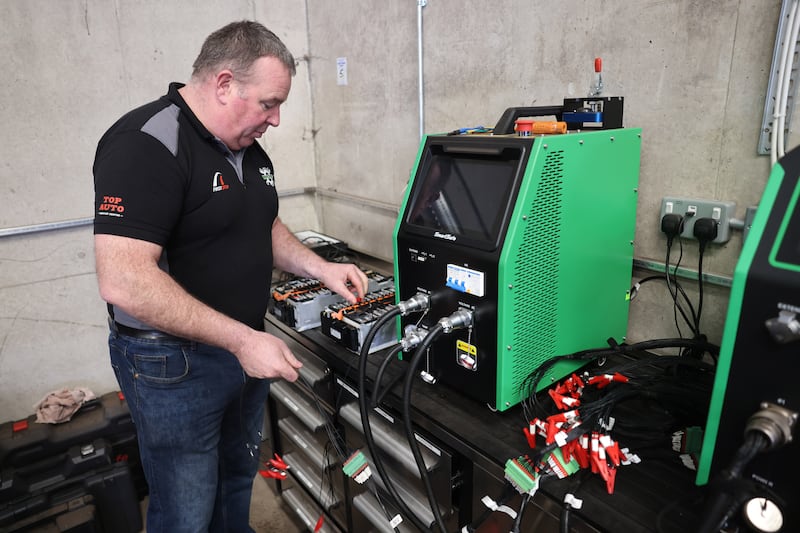 Service Stop’s David Corbally with some of the EV battery repair equipment in the garage in Westpalstown, Oldtown, Co Dublin. Photograph: Dara Mac Dónaill
We have an unlovely yet justified reputation as a nation that does not take proper care of our cars. Ask any car dealer in the country to compare the quality of imported second-hand cars with cars originally registered in Ireland, and even a hint that electric cars need less care is less of a red flag to a bull, and more of a white flag of surrender.
“It’s not only with EVs, it’s with all modern vehicles,” says Corbally. “The tolerances are so fine in a modern car that there’s no room for complacency. If someone drives their car with a warning light on, they’re just adding to their eventual cost with every kilometre.
“But the EV has been sold in Ireland like a vehicle that doesn’t need maintenance. And what happens is people believe that, but it’s only a different drivetrain. All the other parts of the car are still there, and software is really important now on EV updates and making sure that they’re kept up to date.”
Corbally says he regularly sees the problems with all aspects of electric cars, from the batteries and the charging systems, to the heating that warms up both the cabin and the battery. “It’s like the element of your kettle, essentially. The more times you heat it up and cool it down, the more chance there is of a failure.”
Other issues, surprisingly, involve oil. Many people are surprised to hear electric cars need oil, but, as pointed out, there are still metal parts meeting other metal parts – in the steering, the suspension, even the air conditioning system – and all of that must be carefully lubricated. Where you have oil, you will eventually have leaks.
“It’s wear and tear,” says Corbally. “If you leave oil in something long enough, eventually it will accumulate little fragments of metal, and eventually it just becomes a grinding paste.”
However, it is batteries that most concern people when it comes to EV worries.
In general, we should be confident in electric car batteries, as independent research has consistently shown they’re far more reliable than we thought. They’re becoming better all the time when it comes to longevity.
However, like any component on any car, they can fail, and if that happens outside a warranty, it can still lead to significant expense.
Yet haven’t we been told that battery prices on the global wholesale market are dropping like a rock and that replacing battery modules, or even an entire battery, should now be much cheaper?
“I haven’t seen the price of anything coming down in the past few years,” says Corbally. “What we find with EVs is that, yes, they’re lower in maintenance, and they have a lower cost of maintenance, but when you do have a failure, it’s three times the price to get something fixed.
“We have a BMW 330e plug-in hybrid in at the moment that needs a new battery module, and just that one module is €1,400. Last October, we priced a full replacement battery for a Tesla Model 3, and that was €15,000.”
Corbally also points out that there’s an unhelpful tension between the strength of consumer law and the price of getting a car fixed. “The consumer has a lot of power, and if we fix something – as opposed to replacing it – and it goes wrong again in two years’ time, well, you could bring that to court, and the court could find against the garage.
“So it’s better from our perspective to go and buy a new part, and yes that’s maybe €5,000, but then we’re happy that it’s going to last. A repaired part could fail again, and we’d be on the hook for it.”
So the system tends to lean garages towards replacement rather than repair, which seems contrary to what the circular economy would demand.
This is where Corbally’s idea of incentives towards refurbishment could change the face of the used car market. It’s not a rejection of the drive towards electric, it’s reframing the model.
So, would Corbally recommend a friend to buy an EV?
“I always say it doesn’t matter what car you buy – you have to like it or it just won’t work for you,” says Corbally. “I like the Teslas, they’re a good product. Not without their problems, but then all brands have their problems. I also like the Volkswagen Group stuff, especially Skodas. They’re very good, and very fixable. Mercedes, too.”
Finally, has Corbally’s online commentary brought him any grief from the big car brands?
Surprisingly, the answer is no: “I speak facts and numbers. I don’t hammer something that’s not true, that’s not the kind of content I put out.”
Although the case for turning incentives towards the repair market is clearly in the interests of repair shops, Corbally makes a strong case that it’s not just better batteries we need to make the EV transition a success – it’s better policy.
[ Ireland needs to get serious on EV charging infrastructureOpens in new window ]