
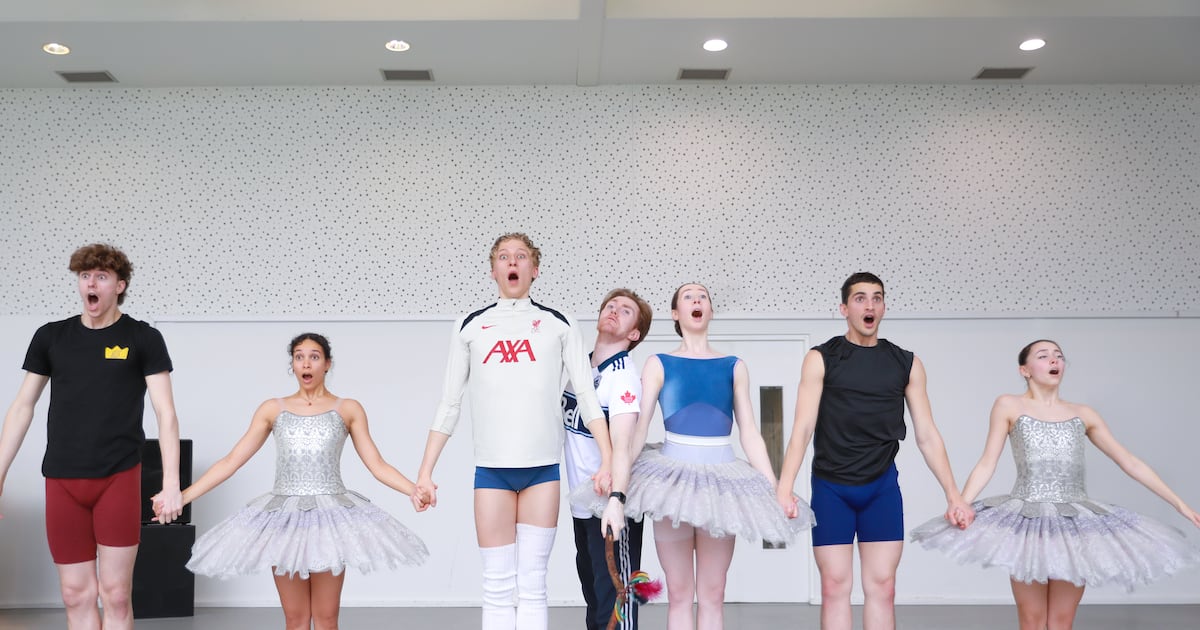
Ballet Ireland’s Bold Moves is back. The triple-bill programme, created as a way to bring international choreographers and modern ballet to Irish audiences, returns, after a brief hiatus, with two world premieres and an Irish premiere.
The line-up features Linear Flux, by the Irish choreographer Ruaidhrí Maguire, A Dream within a Midsummer Night’s Dream, by Arthur Pita, and Storm Scene, a premiere by Pita loosely based on the story of King Lear.
“It’s always so exciting to be doing new work, because obviously we’re not an institution that is here to preserve the old. We’re not like the Royal Ballet that has a repertoire going back a long way,” says Ballet Ireland’s artistic director, Anne Maher. “So for us it’s all about progression and doing new and exciting things for the audiences and for the artists in the company. And it’s great to be able to deliver things of varying genres.”
Developing a repertoire in ballet is more complicated than in other artforms. If a theatre company or an orchestra wants to perform a work by an international playwright or composer they just need the musical score or the script. In dance the choreographer needs to remount the work, move by move, in the studio over a few weeks.
Although common, it is an expensive process where a company pays for the rights to perform a dance for a certain period of time. It gives a choreographer oversight over who performs what, and because of the quality of the choreography and demand to see it, licensing can cost thousands of euro.
Past Bold Moves have included works by choreographers that required this kind of licensing. This year Ballet Ireland has commissioned new works, which it says fits its mission of supporting burgeoning choreographic talent while allowing the company to expand its repertoire.
Creating a dance from its beginning can often be more financially feasible; it also allows dancers the chance to be part of the creative process.
Martin Lindinger, Ballet Ireland’s general manager, says programmes such as Bold Moves are more digestible for newer audiences. “The reason companies do triple bills is to attract 20- and 30-somethings to the audience and dispel notions of what ballet is or what it can be. In the past, there were some great works of art Irish audiences were missing out on.”
Lindinger helped spearhead previous Bold Moves programmes, which included choreographic luminaries such as Christopher Bruce (Rooster, in 2022), the Israeli choreographer Ohad Naharin (his hugely popular Minus 16, in 2019) and the Canadian choreographer Aszure Barton, (Happy Little Things, in 2023).
Having built an audience with an interest in contemporary ballet, Ballet Ireland took last year to regroup. It had dedicated the previous year to an exhaustive tendering process to become the national dance company of Ireland, a bid that went to what is now the dance company Luail.
Maher and Lindinger hope this year’s premieres by Pita and Maguire will pick up the momentum gathered by the previous successive years of Bold Moves.
Pita spent part of his career with Matthew Bourne’s company, New Adventures, performing in ensemble and lead roles while soaking up the sense of theatricality so central to that group. As a choreographer he created ballets for Paris Opera Ballet and San Francisco Ballet.
He originally created A Dream within a Midsummer Night’s Dream for Ballet Black, a London-based company that promotes diversity in ballet. Pita’s interpretation of the Shakespeare comedy includes unexpected twists, mayhem and a soundtrack with songs by Eartha Kitt and Barbra Streisand, among others. It was nominated for an Olivier Award.
“A Dream within a Midsummer Night’s Dream is a straightforward structure, which I hope makes very clear to the audience what’s going on,” Pita says.
Shakespeare’s play tells of four young Athenians who run away into the woods and encounter Puck the fairy, who wreaks havoc with their romances; Pita takes these characters to a more contemporary dreamworld. Through Puck’s tricks and magic, two boys fall in love with the same girl, only to have everything reconciled in the end.
 Resonating with audiences today presents constant challenges for ballet companies
“Once Puck enters the space, you know there’s something that’s going to shift and change and that it is going to be interesting and fun,” Pita says. “I tried to find dreamy songs that really fit the characters. Bewitched, Bothered and Bewildered really works for Titania and the donkey. It’s just kind of perfect for someone who’s under a spell. And it’s Barbra Streisand’s version from when she was very young.
“And then we have Jeff Buckley singing Lilac Wine, which is another beautiful song, when Oberon is under his spell. It works in a lovely way because the poetry is there, but it’s different and accessible. Everybody knows exactly what’s going on.”
When he was creating Storm Scene for Ballet Ireland, Pita took inspiration from the 1983 film The Dresser, starring Albert Finney. That movie tells the story of an ageing dresser to a Shakespearean actor who, despite his failing memory, delivers his finest performance of King Lear during the onset of an air raid.
Pita uses a thunder sheet, a very thin piece of metal, a metre or two square, that you shake or strike with a mallet, to create the sound of a storm. It was used extensively before the existence of sound-effect recordings.
A storm is “such a beautiful structure”, he says. “You have the quiet before the storm, and then you have the rumbling of the thunder, and then you have the full thunder and lightning and rain. Then it’s sort of like the sun breaks through. It’s a lovely cathartic journey.
“So when I thought of this I immediately remembered the film and said to Anne, ‘It could be nice to do another Shakespearean ballet, so we have two Shakespeare-bookended pieces.’
“Storm Scene is interesting because it’s more psychological than storytelling,” Pita says. “The story is more dissected and broken up. Essentially what connects both pieces is the force of nature and the sounds of nature, like the birds, the trees, the wind and the storms, which are often in Shakespeare’s work. Maybe that’s what resonates with the period.”
Resonating with audiences today presents constant challenges for ballet companies, which is why commissioning new works is so important to Ballet Ireland. Maguire’s Linear Flux similarly involves less of a storyline and instead more abstract dancing to a contemporary score by Peter Gregson. Maguire, who previously danced with Ballet Ireland, began choreographing in 2019.
Because of social media and audience access to so many forms of entertainment, Maher and Lindinger feel the urgency of keeping ballet in the public eye. The actor Timothée Chalamet only added to an uproar about ballet’s relevance when he offhandedly commented recently that “no one cares about ballet and opera any more” during an interview with Variety magazine and CNN.
Maher points to the numbers of students enrolling in ballet schools worldwide, including Ireland, as a more realistic indicator. “One of the things I was talking about recently with a group of directors was the connections between schools and companies, and the remarkable thing was hearing about how many students there are hammering down the doors of schools and companies. Schools are bursting at the seams with young people who want to dance.”
She’s a member of a group called Positioning Ballet, established by Dutch National Ballet’s artistic director, Ted Brandsen, and including directors of other companies, such as Royal Ballet and American Ballet Theatre. They regularly meet virtually to discuss issues in the industry.
“If I’m being honest, I must receive maybe 10 emails a week from people wanting to audition,” Maher says. “There are many more young people in Ireland now who are going into professional training. Standards keep rising. I wish I were in a position to employ them all, especially on a long-term basis. I think the industry is in a healthy place. I really do.
“Yet we do need to be mindful that we keep things relevant, that we bring young people with us all the time. Ballet has evolved from the minuets and dances of the French court many, many years ago, and developed and expanded and changed and modernised. We just need to keep progressing the art form.”
Bold Moves: Dare to Dream, staged by Ballet Ireland, is at the O’Reilly Theatre, Dublin, from Friday, April 10th, until Saturday, April 18th