
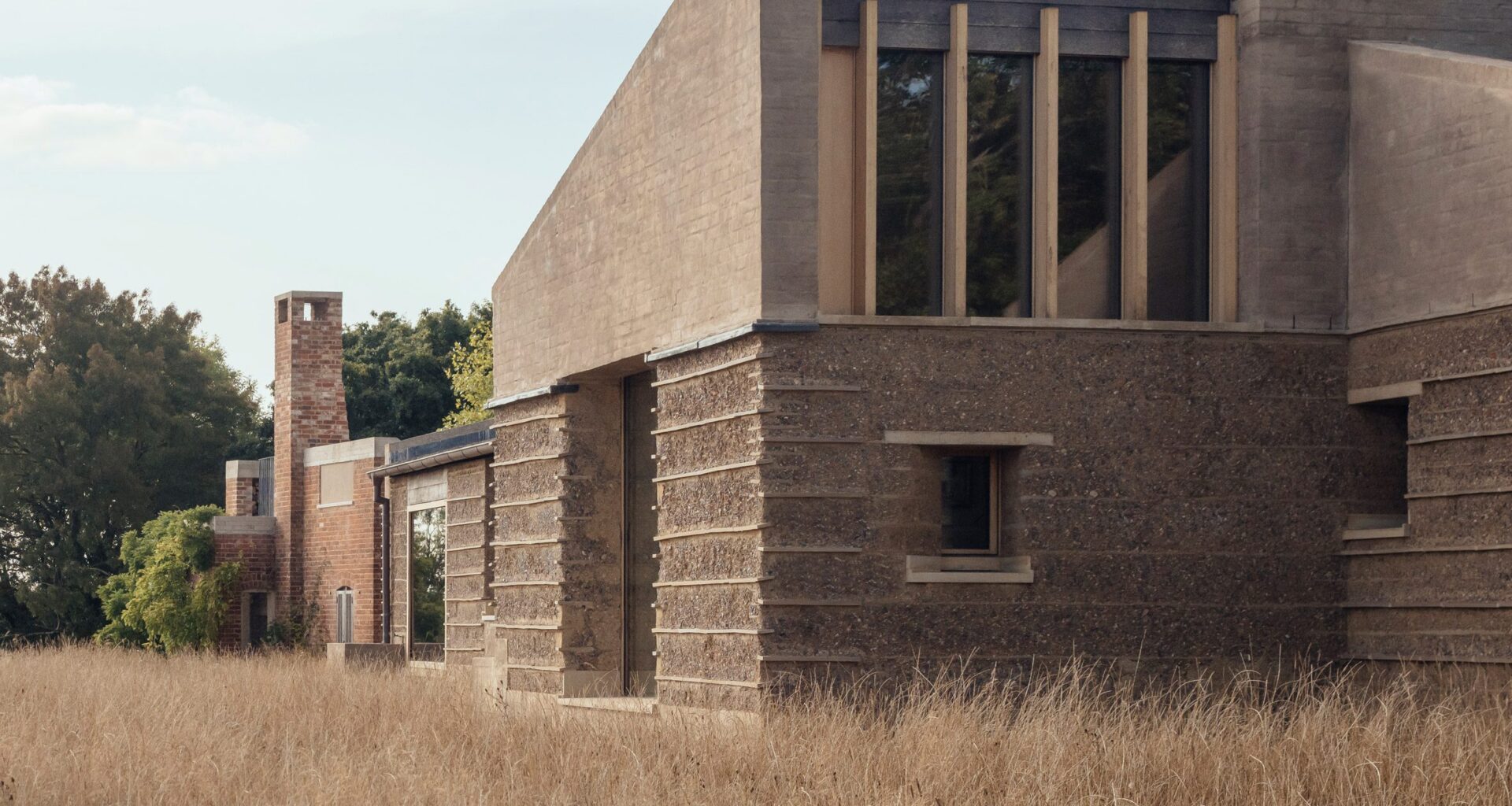
Unstabilised rammed earth forms the walls of a country house designed by Tuckey Design Studio in Wiltshire, England, revealed here in an exclusive video by photographer Jim Stephenson.
Built on the site of a former brickworks, Rammed Earth House was constructed from both the clay underfoot and an aggregate made from crushed demolition waste.
The build drew on the expertise of Martin Rauch, founder of Austria-based studio Lehm ton Erde, an expert in rammed earth structures that can endure wet and windy climates without roof overhangs or the addition of cement.
Tuckey Design Studio employed a range of these techniques to design a structure that protects itself against erosion.
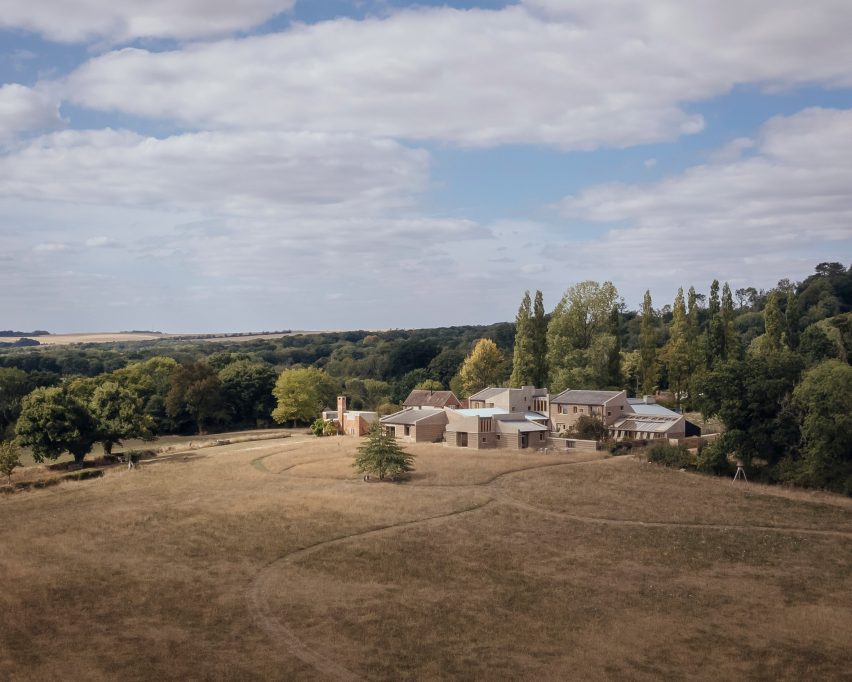 It is located in the countryside in Wiltshire
The project allowed the studio, together with contractor Stonewood Builders, to explore a form of earth construction that is largely untested in the UK, and certainly not at this scale.
“No one had built a rammed-earth building of this scale in the country that we could find,” said studio founder Jonathan Tuckey during a tour of the house.
“The project is a testament to the determination of both Stonewood and the Austrian team to just test, test, test.”
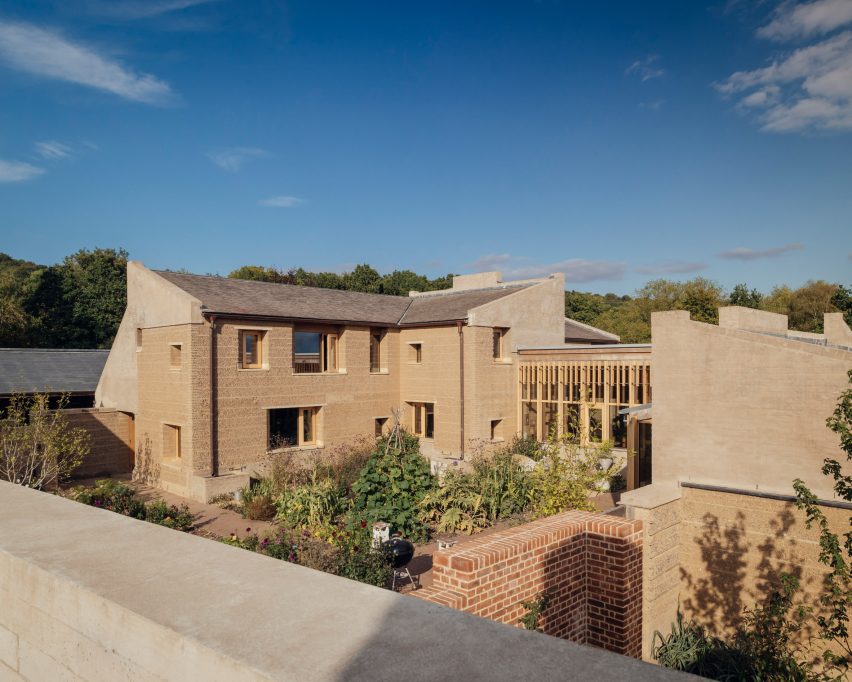 The house is organised around two walled garden courtyards
As revealed in the video, the build process involved turning the site into a quarry.
When clients Sophie and David bought the property, it contained various brick and concrete buildings. Some were retained, but the rest were demolished.
Dezeen’s guide to traditional earthen building materials
This construction waste was combined with equal parts clay, limestone gravel and water to form the mixture for the walls, significantly reducing the need for materials to be delivered to the site.
Layers of lime mortar create strata within the earth walls, forming “speed bumps” to stop rainwater from washing the material away. The more exposed walls also integrate locally quarried limestone tiles.
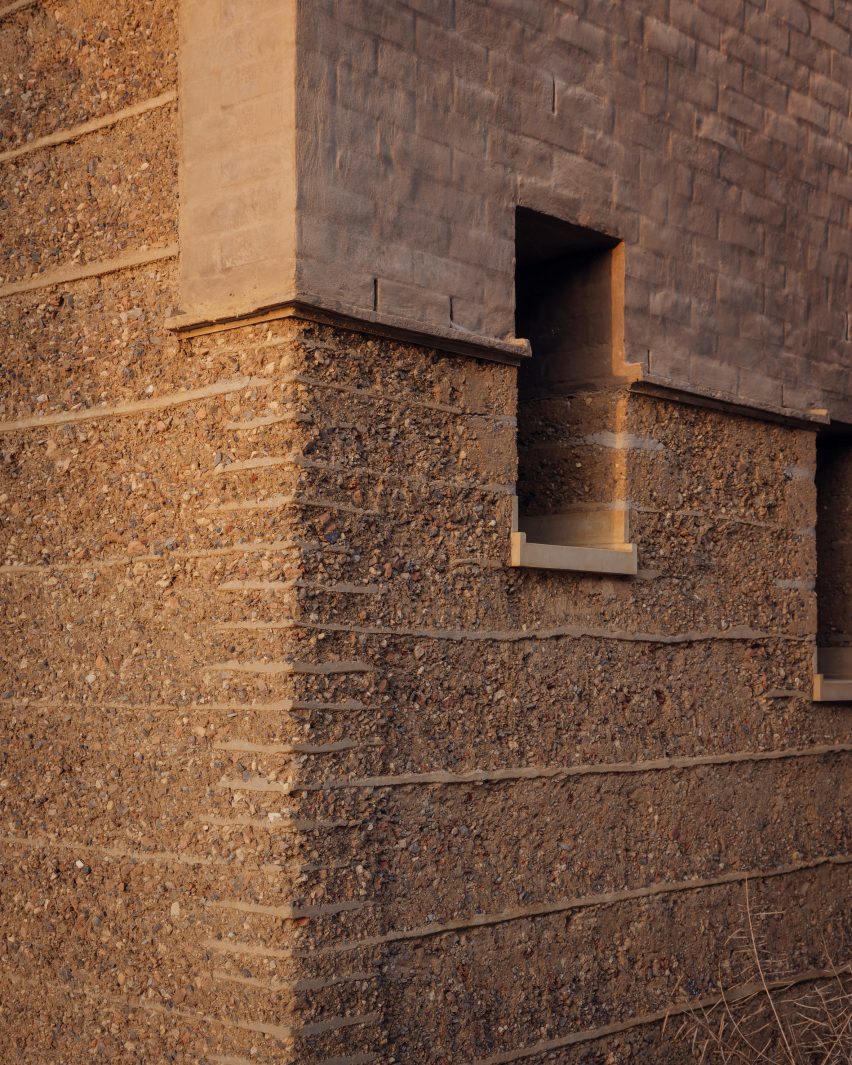 Lime mortar “speed bumps” protect the earth walls from erosion
“The walls are 400 millimetres thick, but we’ve actually designed them on the basis that they’re only 350 millimetres,” explained John Gerrard of Webb Yates, the structural engineer for the project.
“This allows some surface erosion to take place without compromising the structural integrity of the wall,” he said.
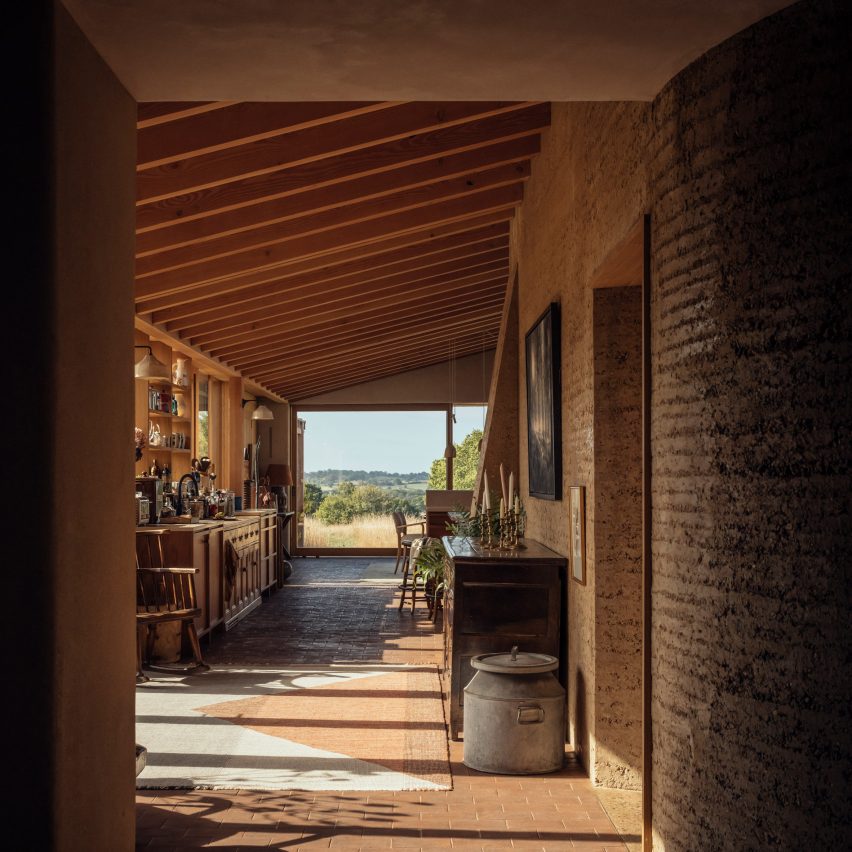 A timber and glass kitchen is the heart of the home
The rammed-earth buildings provide two wings for the 810-square-metre house, linked by a generous timber and glass structure housing a double-height kitchen.
Together with the retained brick cottages, these blocks frame a pair of walled garden courtyards, one facing east and the other west.
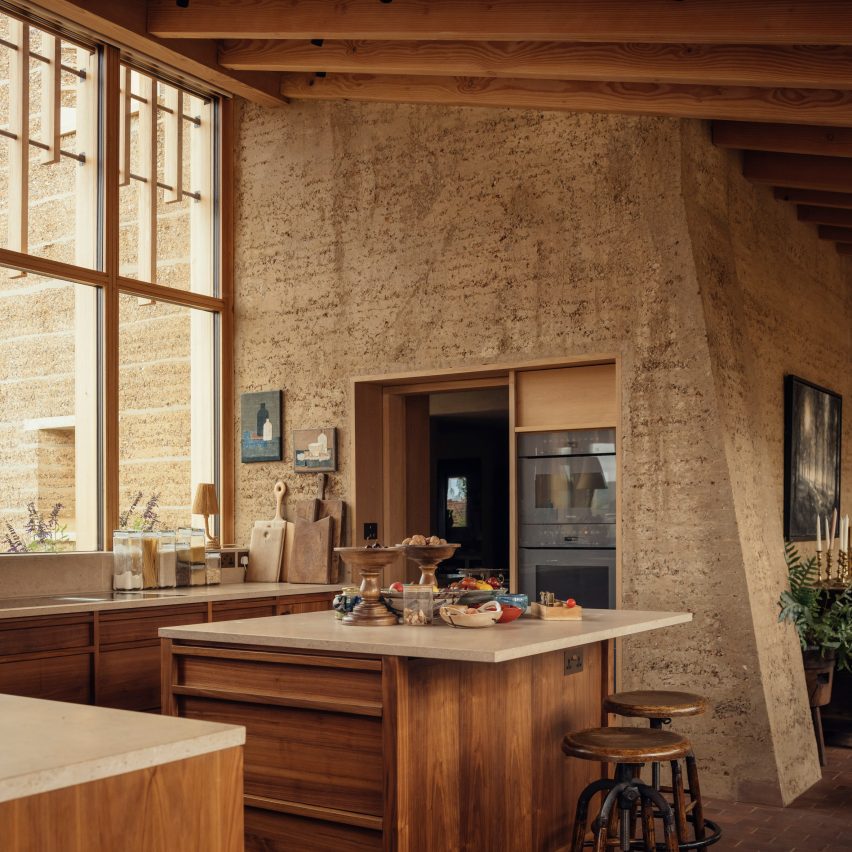 Inside, the earth walls are sealed with a layer of casein
The arrangement echoes the layout of old English farmsteads, giving the owners plenty of space to grow flowers, herbs and vegetables.
“Wiltshire has got lots of these low, agricultural courtyard buildings,” said Tuckey. “They have a humility and an embedded nature that we felt was quite suited.”
The thickness of the earth walls is revealed by deep window reveals, as well as by benches integrated into the facade.
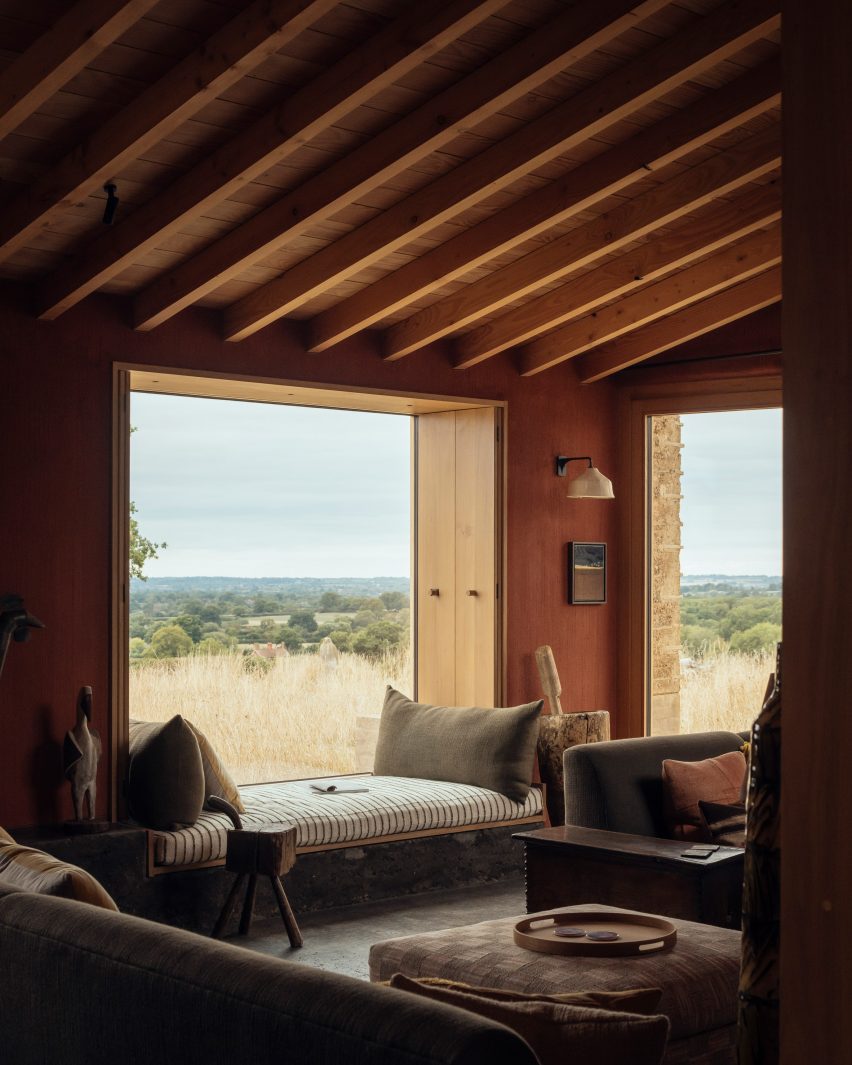 The living room looks out over the landscape
The earth surfaces are also celebrated in the tile-floored kitchen, where they are left exposed but coated in casein, a clear coating that protects from dust and gives a natural shine.
Clay plaster coats the walls in other rooms, offering a more robust finish while allowing the material to breathe.
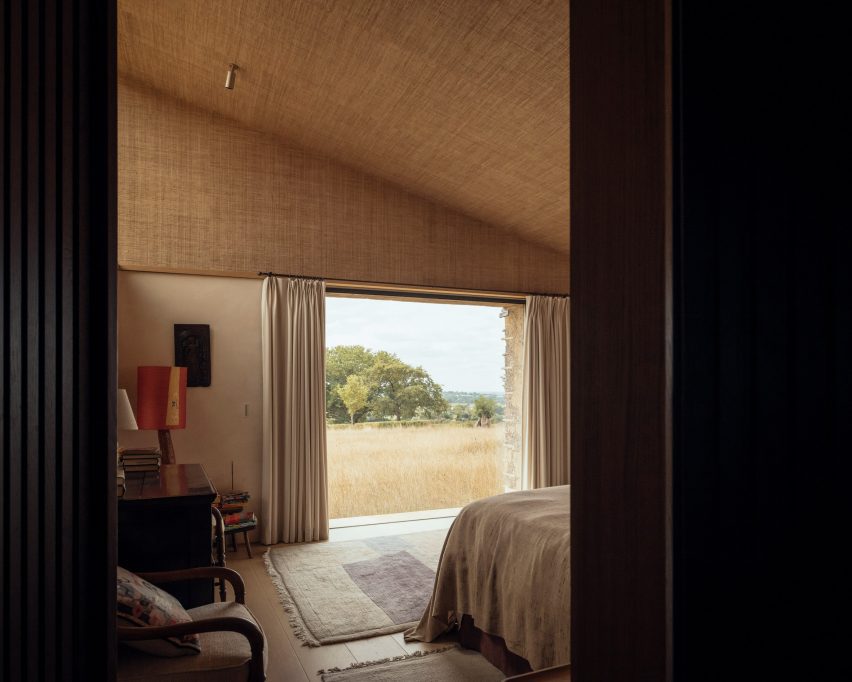 The primary bedroom has its own suite
The room layout allows the house to adapt to varying numbers of occupants, with wings that can be effectively closed up when only Sophie and David are there.
The primary bedroom suite and the main living room are positioned along the southwest elevation, benefitting from the best views.
The two-storey northeast wing provides four additional bedrooms and a snug, while an annex contains staff accommodation.
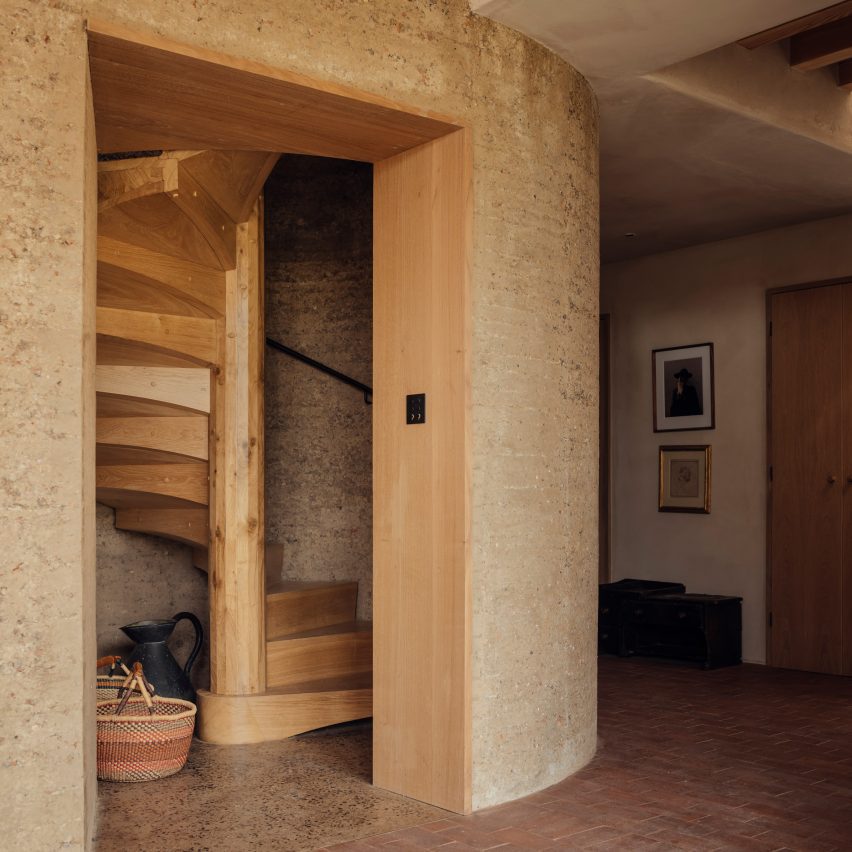 The spiral staircase is a self-supporting piece of joinery
The sense of craft extends throughout, with various other elements made bespoke. Among the most striking is the spiral staircase, a self-supporting piece of joinery that rises up through a curved rammed-earth cylinder.
The project is the latest in a series of recent building projects by Tuckey Design Studio, including a converted chapel in Devon and a villa on Lake Como in Italy.
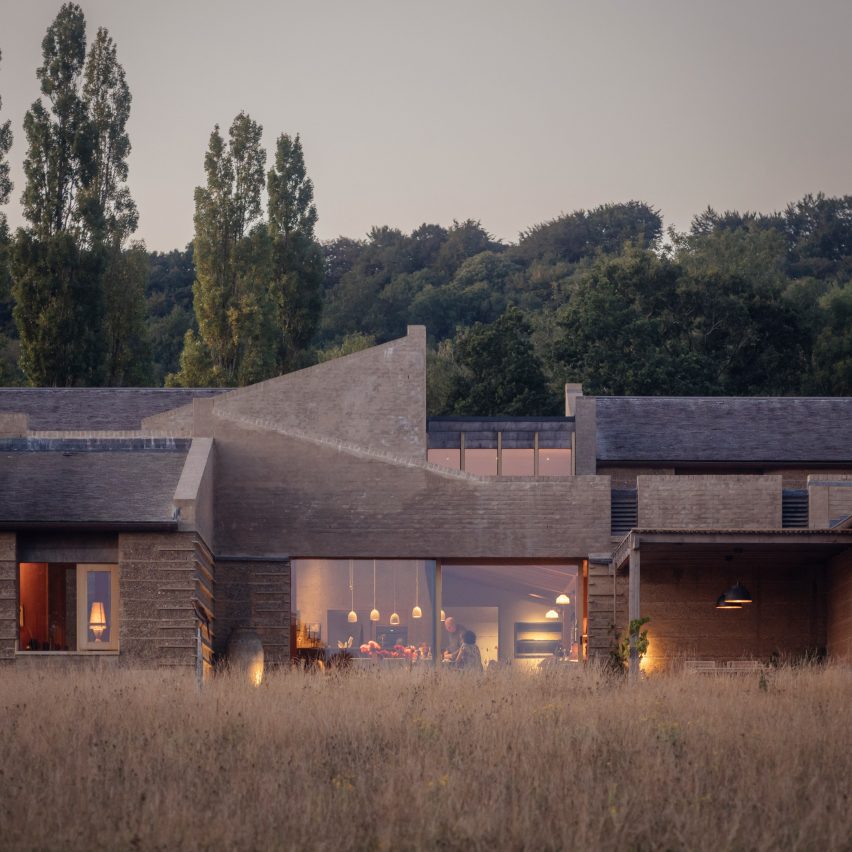 The house was designed to resemble an old English farmstead
It allowed Tuckey to realise a long-held ambition to build in rammed earth, having long been an admirer of the work of Rauch and Rowland Keable, another rammed earth expert who works in the UK.
The project draws further attention to an issue flagged by Dezeen back in 2024, that many so-called rammed-earth buildings are “essentially concrete” due to the amount of cement used as a stabiliser.
The film and photography are by Jim Stephenson.
Project credits:
Architectural design: Tuckey Design Studio
Project leader: Emaad Damda, James Moore
Design team: Emma Carroll, Emaad Damda, Ross Langtree, James Moore, Karolina Szlauer, Jonathan Tuckey, Molly Wheeler
Interior design: Todhunter Earle Interiors
Structural engineer: Webb Yates Engineers
Quantity surveyor: Dadson & Butler
Contractor: Stonewood Builders
Services engineer: SGA Consulting
Landscape architect: Pip Morrison
Lighting consultant: John Cullen Lighting
Sustainability consultant: The Healthy Home
Rammed Earth consultant: Lehm Ton Erde
Ecological consultant: Peach Ecology
Timber framers: Timber Frame Company
Stair joinery: Robert Lynch
Joinery: Somer, Willow & White, Oakwrights Monk, Edward Collinson, Penchard, William Garvey, Orwells Furniture
AV specialists: Edison Projects
Planning consultant: Brimble, Lea & Partners
Kitchen joinery: Orwells Furniture