
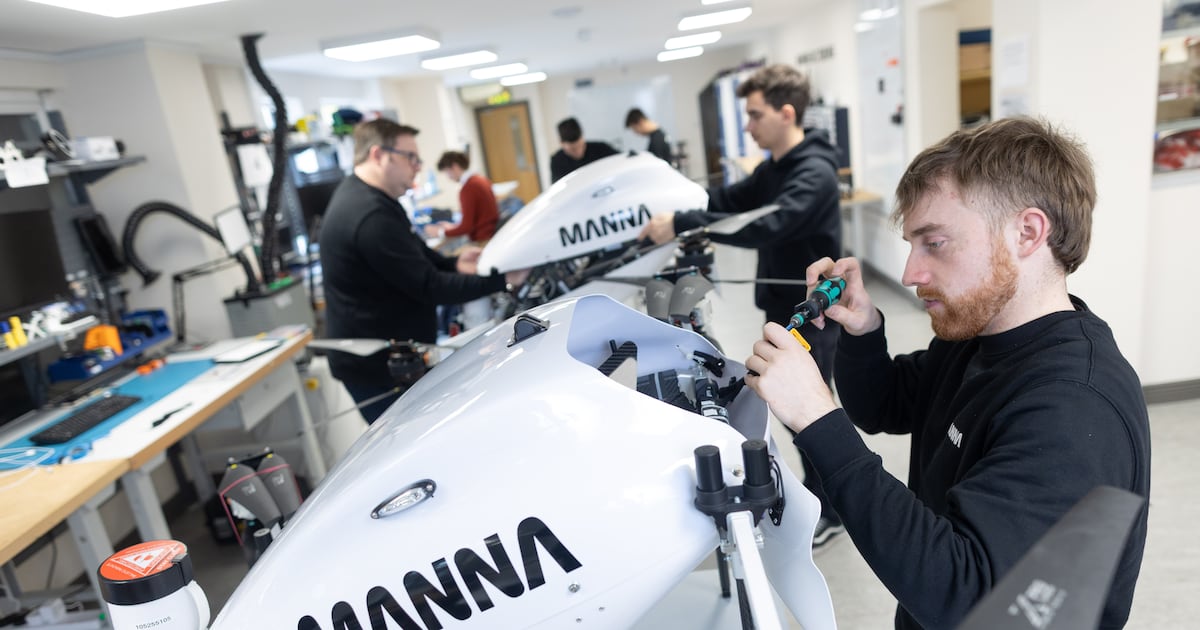
Drone delivery company Manna is set to create 400 jobs at its business following a $50 million (€43 million) funding round that will drive growth at the company.
The new jobs, which will be split between Ireland and the US, will be in robotics, software engineering, aviation and operations. Once the new jobs are filled, Manna’s total headcount will be more than 570.
Chief executive Bobby Healy said the number of jobs located in Ireland would depend on a few factors. The company has sought to expand to new sites in Dublin, including in Tallaght and Dundrum. However, it has encountered significant opposition locally.
“It will very much depend on our ability to grow in Ireland, how many of those jobs will be in Ireland,” said Healy. “For now, we’re targeting two million deliveries annually by the end of the year. We have announced a plan to run all over Ireland, in a number of cities, but there are challenges there.”
Healy noted the implementation of the drone framework, which will give local authorities and companies in the drone delivery market more certainty by establishing a national structure for drone operations.
“The national drone framework that the government came out with is set up to exactly address those questions on how local councils can treat this,” he said.
[ Irish drone delivery company Manna reported to land $50m funding roundOpens in new window ]
“In the meantime, we have been attacked left, right and centre by some irresponsible local councillors. That creates question marks over our ability to scale around Ireland, and that will, in turn, affect how many jobs involved in manufacturing and operations we create here.”
Manna manufactures drones in Ireland. It also designs the drones and develops its software here. Healy said it plans to keep manufacturing locally for the Irish, European and Middle East market, but in the future, drones for the US market would be manufactured there.
 Are Government’s fuel measures betting on a quick resolution to the conflict in Iran?
“As we grow in the United States and scale there, we will have manufacturing there one way or the other,” Healy said.
“There’s probably 500-600 jobs as our ambition in the next 18 to 24 months. And I would really love them all to be in Dublin and Offaly, but I’m not certain that’s going to be the case.”
The Series B funding round, which was led by Ark Invest, the Ireland Strategic Investment Fund (ISIF) and Schooner Capital, brings the total amount raised by the company to $110 million. Existing investors Coca-Cola HBC, Molten Ventures and Enterprise Ireland also took part in the round.
[ Manna and Rotunda team up to test drone flights for medical suppliesOpens in new window ]
Healy said the backing from Ark Invest was significant, as was the backing of ISIF.
“I think that’s good for, not just for Manna, because it’s a strong endorsement of what we are, but I also think it’s indicative of where Government is on supporting indigenous technology businesses,” he said.
“I think having a sovereign wealth fund assess a company like us and decide that this is in the interest of Ireland, it’s really important, and I think it’s really encouraging for us as a company as well.”
The company has already completed more than 250,000 deliveries of books, medical supplies such as antigen tests, food and clothing, including 60,000 deliveries at its Dublin 15 base, and has expanded its operations to Texas and Finland.
It has plans to open more bases in Ireland, concentrating on locations outside the capital.
Minister for Enterprise, Trade and Employment Peter Burke welcomed the news. “This announcement by Manna Air Delivery represents a powerful endorsement of Ireland’s standing as a global centre for innovation and advanced manufacturing,” he said.
“The creation of so many highly-skilled positions across robotics, software engineering, aviation and regulatory disciplines underscores the depth and quality of Ireland’s Stem [science, technology, engineering and mathematics] talent base and the ability of indigenous Irish firms to compete on the global stage in pioneering sectors such as autonomous aviation.”