
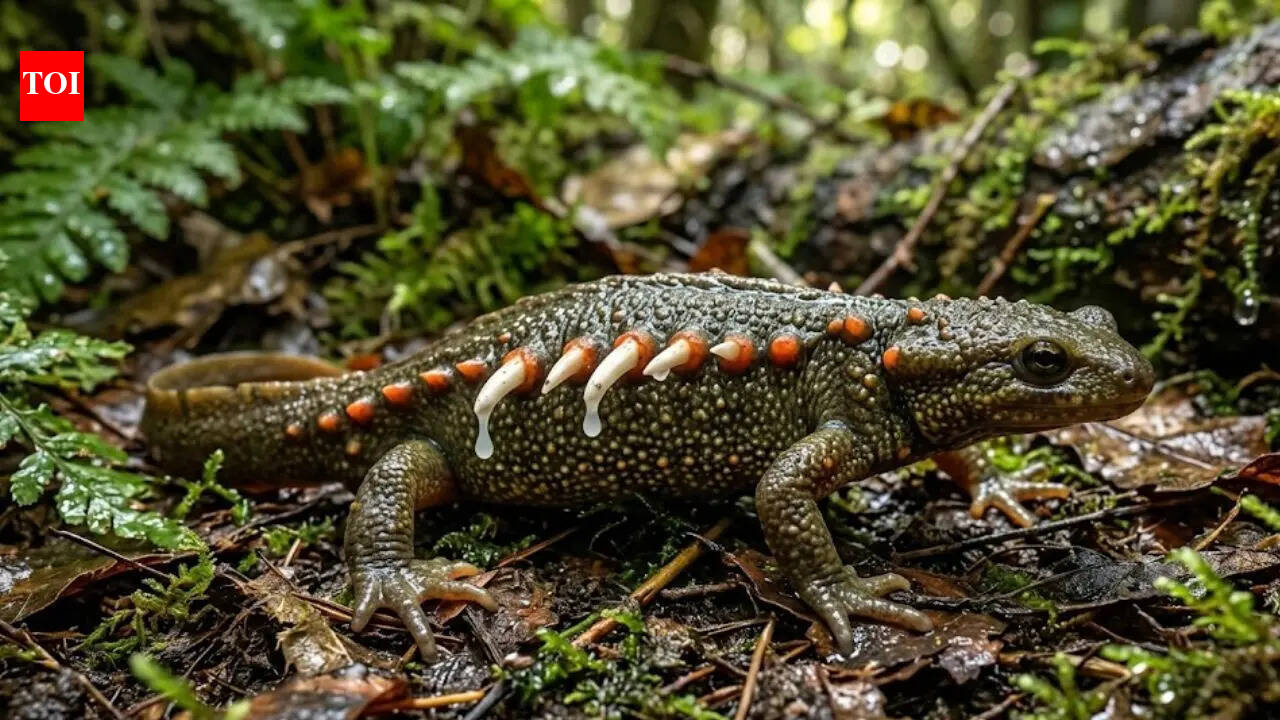
 The Iberian ribbed newt (Pleurodeles waltl) has a unique method of defence. This amphibian has earned the nickname ‘real life Wolverine’ because it can rotate its ribs in such a way that the ribs will puncture through its skin, creating bony skeletal spikes on its exterior. According to the Journal of Zoology, the exposed ribs have a layer of lethal white poison produced from specialised glandular warts, which creates a painful chemical reaction with any animal that tries to eat the Iberian ribbed newt. These creatures can heal these self-inflicted wounds in seconds and will leave no scar. This unique biological ‘switchblade’ aspect of this animal is providing researchers studying vertebrate tissue repair and methods for survival through evolution.
Iberian Ribbed Newt uses its skeleton for survival
The Iberian ribbed newt relies on an unusual way to defend itself. It has a special way of moving its skeleton, with its ribcage being able to rotate up to 50 degrees forward. As per the Journal of Zoology, this increases the pressure inside its body, causing the ribcage to push out through the sides of the body. This bone cage acts as an external deterrent to any predator wanting to eat the newt; the only way for a predator to eat this newt is if it endures internal soft-tissue punctures by attempting to swallow the newt.
The hidden poison coating in the Iberian Ribbed Newt
According to the Journal of Morphology, in addition to the mechanical effect of the ribcage puncturing the skin, the granular glands also secrete a poisonous milky fluid that coats each spike of bone that punctures the skin as it comes through the skin. Together, these two effects create a very severe, painful sensation when a predator eats the newt and cause a predator to vomit out the newt and avoid eating them in the future.
The capability of rapid recovery without scars
One of the most astonishing aspects of the Iberian ribbed newt is its capacity for healing from injuries it has inflicted on itself. The rib’s piercing holes through the skin will close at an incredibly rapid rate – within seconds or minutes, at the cellular level – keeping the area free from infection and having no lasting scarring. The rapid regrowth of any tissue, including skin, muscle and other complicated organ systems, is accomplished by cells acting in unison to regenerate and repair. Following the successful sequencing of the genome, researchers are now identifying specific regenerative genes of the ribbed newt in an effort to find out how to take advantage of these processes in human medicine and to improve wound treatment.
What this ‘switchblade’ teaches
The ‘switchblade’ like anatomy of the Iberian ribbed newt is a definitive example of Earth’s evolutionary innovation for survival. As noted in the Nature Scientific Report, by physically weaponising their internal skeletons, the Iberian ribbed newt has found a niche where they can defend against significantly larger predators. They provide researchers with an understanding of how other vertebrate species have evolved such idiosyncratic structures in an effort to escape predation; they serve as an experimental laboratory for the investigation of extreme survival strategies in the natural world.