
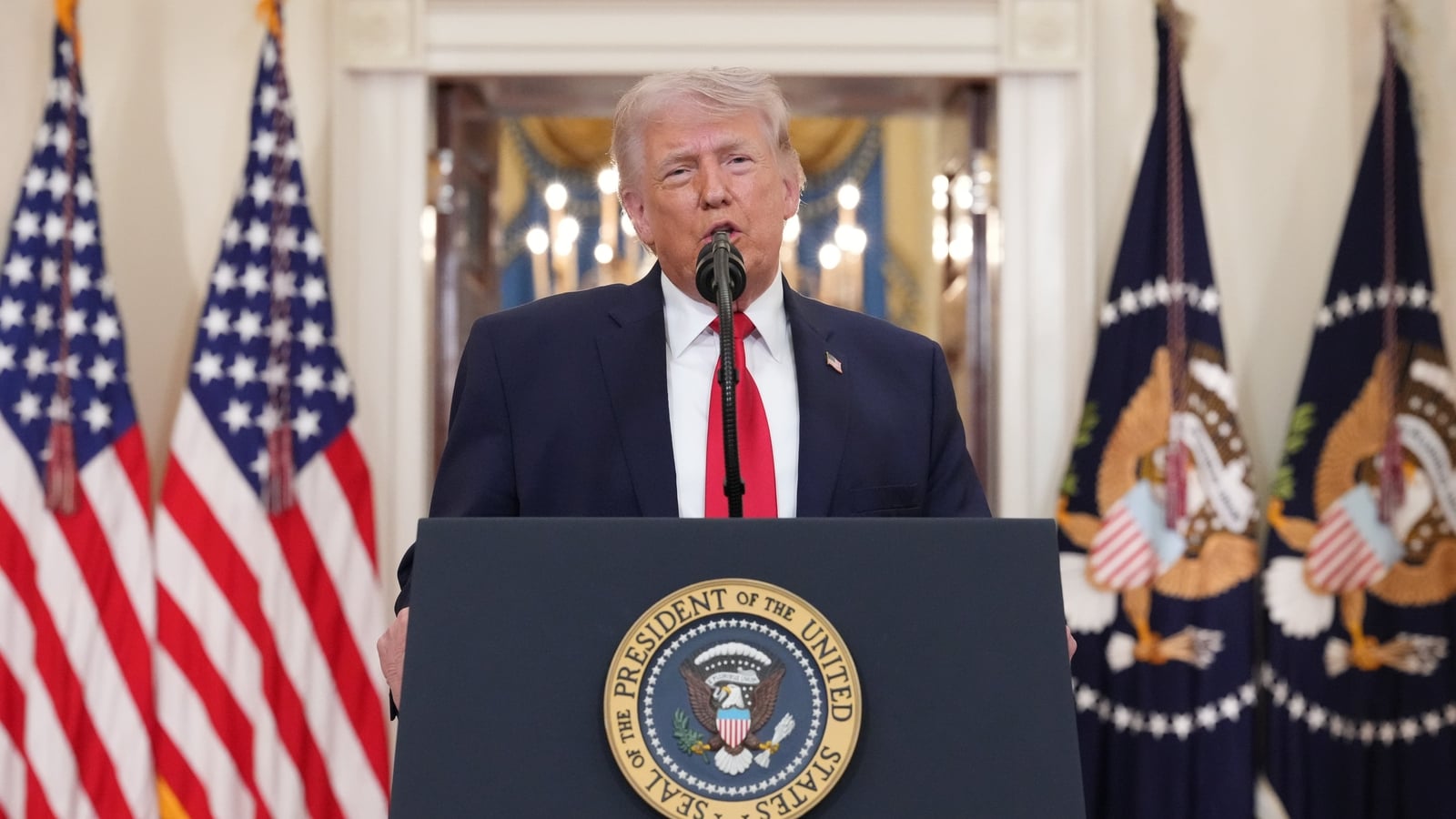
US President Donald Trump has said in a televised speech that the US military is “nearing completion” of its objectives in the war against Iran, but he declined to offer a concrete timeline for winding down the conflict.
Facing a war-wary American public, sliding approval ratings and pressure from some allies to outline his war aims in more precise and consistent terms, Mr Trump said the US had destroyed Iran’s navy and air force, and crippled its ballistic missile and nuclear programmes.
“Tonight, I’m pleased to say that these core strategic objectives are nearing completion,” Mr Trump said in his first prime-time address since the start of the conflict in late February.
He added the US would continue to hit targets in the Islamic Republic over the next two to three weeks, and assured viewers that the US would finish the job “very fast”.
But he glossed over some unresolved issues that remain during his 19-minute speech, such as the status of Iran’s enriched uranium and access through the Strait of Hormuz.
The strait is conduit for global oil supplies which Iran has effectively closed since the US and Israel launched the war on 28 February.
The president said the recent rise in gasoline prices are “short term” and called for countries that receive oil through the Strait of Hormuz to show “courage” and seize the key waterway.
“The countries of the world that … receive oil through the Hormuz Strait must take care of that passage,” Mr Trump said.
“Just take it, protect it, use it for yourselves,” he added.
Watch: Trump calls on nations that receive oil through the Hormuz Strait to ‘just take it’
He also suggested the war could escalate if Iranian leaders did not capitulate to US terms during negotiations, with strikes on Iran’s energy and oil infrastructure possible.
He asked Americans to keep perspective about a war now in its fifth week, pointing out that the conflict was much shorter than the country’s involvement in several previous wars.
He said: “I can say tonight that we are on track to complete all of America’s military objectives shortly, very shortly.
“We’re going to hit them extremely hard over the next two to three weeks.”
The US president said “discussions are ongoing”, adding “the new group is less radical and much more reasonable”.
“Yet if during this period of time, no deal is made, we have our eyes on key targets,” he added.
Mr Trump and his advisers have offered shifting explanations and timelines for the conflict.
Yesterday, Mr Trump claimed a major breakthrough, saying Iran’s president was seeking a ceasefire.
This was swiftly denied by Iran’s foreign ministry, which also accused Washington of making “maximalist and irrational” demands.
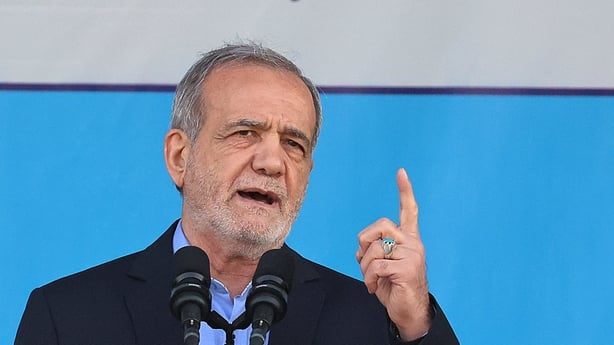
Masoud Pezeshkian asked ‘which of the American people’s interests are truly being served by this war’
Iran’s president Masoud Pezeshkian accused the US of war crimes and being influenced by Israel ahead of the much-anticipated address by Mr Trump.
He asked the people of the United States if the Middle East conflict was truly putting “America First”.
“Attacking Iran’s vital infrastructure – including energy and industrial facilities – directly targets the Iranian people,” Mr Pezeshkian said in an open letter, published to his website.
He added: “Beyond constituting a war crime, such actions carry consequences that extend far beyond Iran’s borders.”
They sow “instability, increase human and economic costs”, and plant “seeds of resentment that will endure for years”, he continued.
“Exactly which of the American people’s interests are truly being served by this war?”
Before the address, recent polling showed Mr Trump’s overall approval rating slipping below 40%, with disapproval climbing above the mid-50s as voters sour on both the war and its economic fallout.
The economic picture has compounded the problem.
Gasoline prices have surged above $4 a gallon (over $1 a liter) for the first time in years, while consumer confidence has weakened, dragging down Mr Trump’s already fragile standing on the economy.
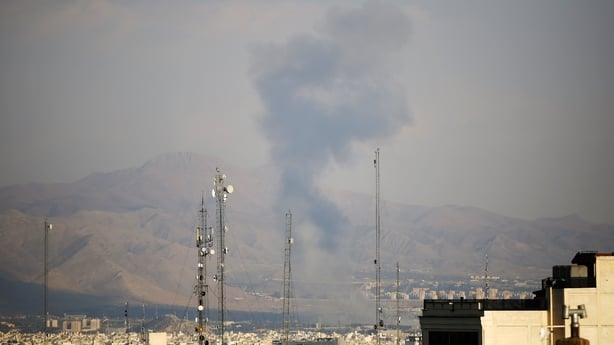
Smoke rises over residential area following the US and Israeli attack in Tehran
Ahead of the speech, markets seized on Mr Trump’s more optimistic signals.
Global equities rallied and oil prices fell yesterday on hopes of a near-term end to the conflict.
Brent crude was down around 2.7% at $101.16 a barrel, while stock markets posted strong gains.
Still, analysts warned the underlying economic risks remain acute, with oil prices elevated and the Strait of Hormuz still effectively shut.
Reflecting widespread sentiment that Mr Trump’s comments did not portend a short-term off-ramp, stocks fell, the dollar firmed and oil rose shortly after his comments.
Some allies are pushing the president to assuage growing concerns among Americans, most of whom oppose the conflict and are upset at rising gasoline prices due to disruptions in the global oil supply.
The president briefly addressed those concerns, mainly to say that gasoline prices would soon go down, that it was a worthwhile short-term sacrifice and that it was mainly Iran’s fault.
“This short-term increase has been entirely the result of the Iranian regime launching deranged terror attacks against commercial oil tankers of neighboring countries that have nothing to do with the conflict,” Mr Trump said.
Beyond the markets, the strategic picture is increasingly difficult to reconcile with the administration’s rhetoric, say its critics.
US and Israeli forces have struck thousands of targets and inflicted heavy damage on Iran’s military infrastructure.
But the conflict has dragged on, the leadership in Tehran remains in place and the economic shock has spread globally – raising questions about whether the US preisdent can deliver a clear endgame.
That uncertainty has filtered into Washington, where even some of Mr Trump’s allies acknowledge the war has become a growing political liability ahead of November’s midterm elections.
Although Mr Trump’s messaging has been inconsistent, the administration says these goals are to:
– destroy Iran’s navy.
– destroy its missiles and production facilities.
– neutralize its militia proxies across the region.
– guarantee that Tehran can never obtain a nuclear weapon.