
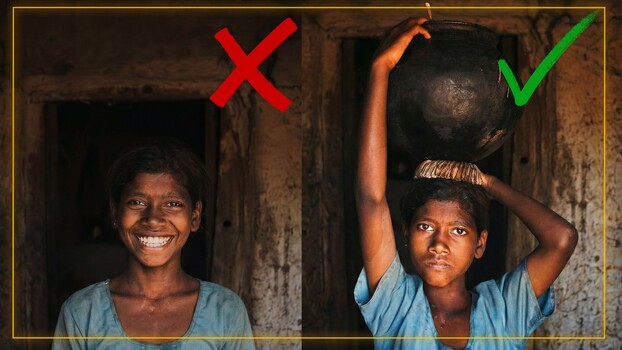
Getting a genuine portrait of a stranger is one of the hardest things to pull off in travel photography. The second someone knows a camera is pointed at them, they stop being themselves, and whatever drew you to them in the first place vanishes.
Coming to you from Mitchell Kanashkevich | mitchellkphotos, this candid and practically grounded video starts with a truth most people learn the hard way: directing strangers into posed portraits almost always kills the shot. Kanashkevich has spent years photographing regular people across India, Brazil, Ethiopia, the Philippines, Indonesia, and his birth country of Belarus, and he’s watched the same thing happen over and over. The moment a camera appears, people tense up, perform, or fire off that automatic smile that has nothing to do with how they actually feel. He’s explicit that he never asks people to smile. If a smile happens because something real caused it, great. If it happens because a camera is there, it hollows the image out.
What Kanashkevich figured out, partly by accident through years of failed shots in India, is that the problem isn’t the people. For most people on earth, standing still while being stared at through a lens is genuinely unnatural. The situation itself is the problem, and the more you try to direct someone through it, the worse it gets. His solution is to stop treating the portrait as the main event. He creates a situation where conversation or activity is happening, the camera becomes secondary, and he makes the photo while things are already in motion. He points to photographers like David Alan Harvey, William Albert Allard, Steve McCurry, and Alex Webb as examples of this working at the highest level. Their strongest people photos rarely look like portraits at all.
A big portion of the video covers something that doesn’t get enough attention: the role of guides and translators, and how badly it can go wrong when they’re not aligned with what you’re trying to do. Kanashkevich tells a specific story about a well-meaning guide in the Philippine rice terraces who would jump in the moment he showed interest in someone, immediately instructing them to stand here, smile, look this way. The moments evaporated every time. His point is direct: if you’re working with a guide or translator, they have to genuinely understand what you’re after. Not just nod along. A guide who gets it can handle the human interaction while you stay in the background, almost invisible, waiting for something real to surface. Several of his favorite images exist only because of guides who understood this. He also walks through a handful of specific real-world examples, showing exactly how certain shots came together, including a wrestler caught unaware in dramatic chiaroscuro light, a woman whose genuine laugh was drawn out mid-conversation, and a shy girl in Ethiopia whose instinct to cover her face became the photograph.
What he doesn’t give away is what he calls the single most reliable thing that separates consistently strong people photos from occasionally good ones. He flags it as surprisingly controversial, something a lot of people resist, which makes it worth hearing. Check out the video above for the full breakdown from Kanashkevich.