
Main PointsKey Reads
Jack White – 4 minutes ago
Trump remarks ‘unacceptable’ – Taoiseach
Taoiseach Micheál Martin has said the threat from US president Donald Trump to bomb Iran “back to the stone age” was “unacceptable”.
Speaking on Newstalk on Thursday morning, Martin said the citizens of Iran have “no act or part” in the war and must be protected.
“That’s unacceptable. Every person involved in war has to prioritise civilian protection and innocent civilians,” he said.
“We all know that the Iranian regime was a very oppressive one. But this war is creating death, destruction to people in Iran who had no act or part in the regime.”
Martin said threatening civilians was “wrong” but said it was “not clear” whether the threats were directed at Iran’s civilian population and infrastructure.
“(We) could be forever trying to interpret president Trump in terms of what he said and what actually gets done, and that’s always been the feature,” he said, adding the US had stopped bombing of oil infrastructure. – PA
Jack White – 18 minutes ago
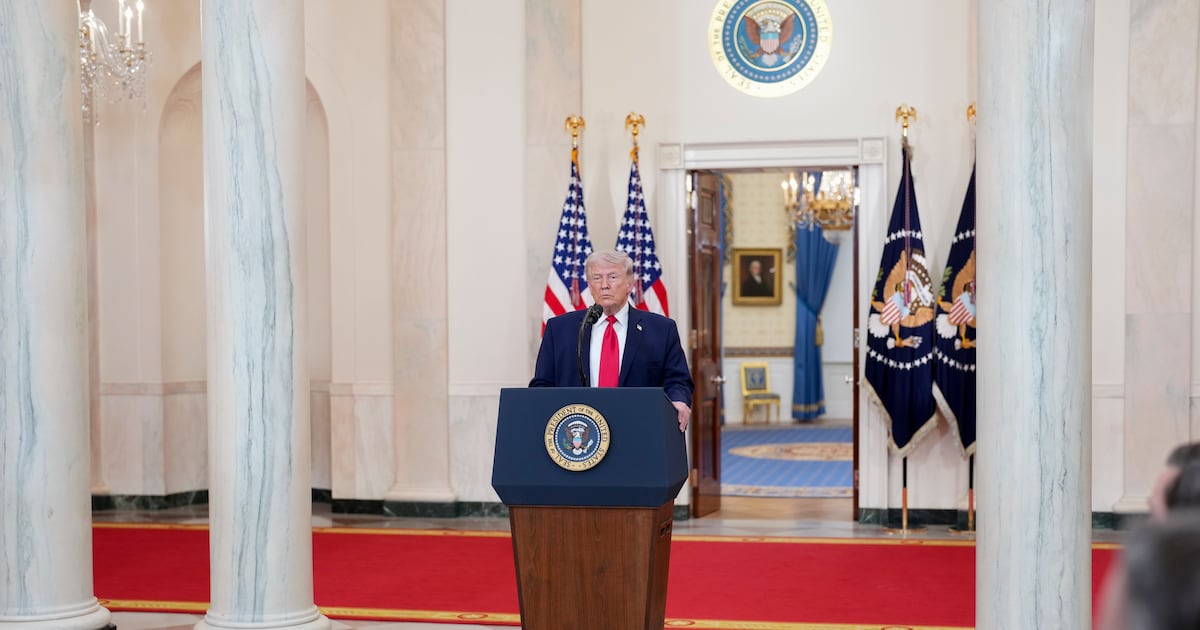
Trump leaves world no wiser on Iran objectives in 19-minute prime-time address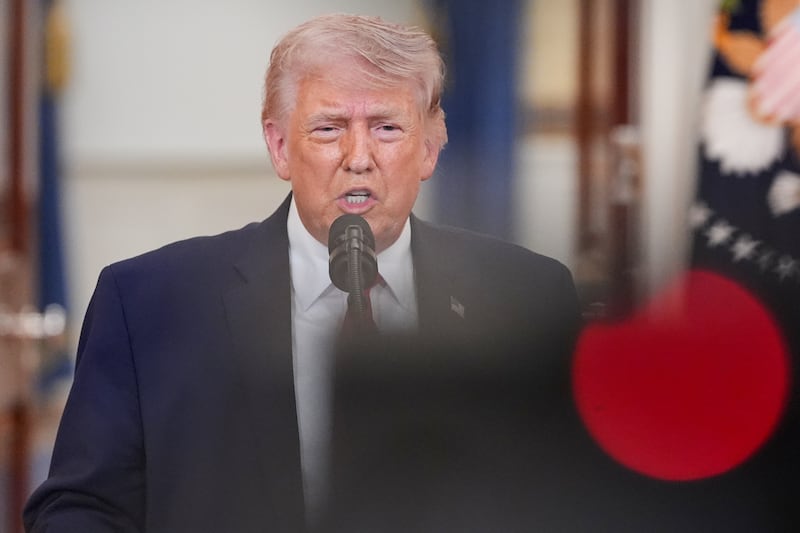 US president Donald Trump during a prime-time address in the Cross Hall of the White House in Washington on Wednesday.
Photograph: Alex Brandon/AP Photo/Bloomberg
Official presidential addresses are an exercise in nostalgia in their own right; a throwback to the analogue age and the idiot box as the family-gathering point. But it still serves the purpose of the signalling to Americans that its leader has something vital and important to announce.
Monday night’s speech was simply a more formal version of Trump’s daily riffs in which the reasons for joining Israel in obliterating Iran became more obscure and the time line for an ending less certain, Washington Correspondent Keith Duggan writes.
Read his analysis of Trump’s address here.
Jack White – 41 minutes ago
Iran’s military warns of ‘more destructive’ attacks until adversaries’ ‘surrender’
Tehran will press on with the Middle East war until the United States and Israel face “permanent regret and surrender”, the spokesperson of its armed forces’ unified command said on Thursday, according to the semi-official Tasnim news agency.
The threat followed comments by US president Donald Trump that Washington would hit Iran “extremely hard” within weeks, although Iran was “essentially decimated” with the United States on track to achieve its military objectives.
Ebrahim Zolfaqari, spokesperson of the Khatam al-Anbiya central headquarters, responded that US and Israeli assessments of Iran’s military capabilities were “incomplete”.
Iran would step up its military actions, with “more crushing, broader and more destructive” attacks in store for its adversaries, he added. – Reuters
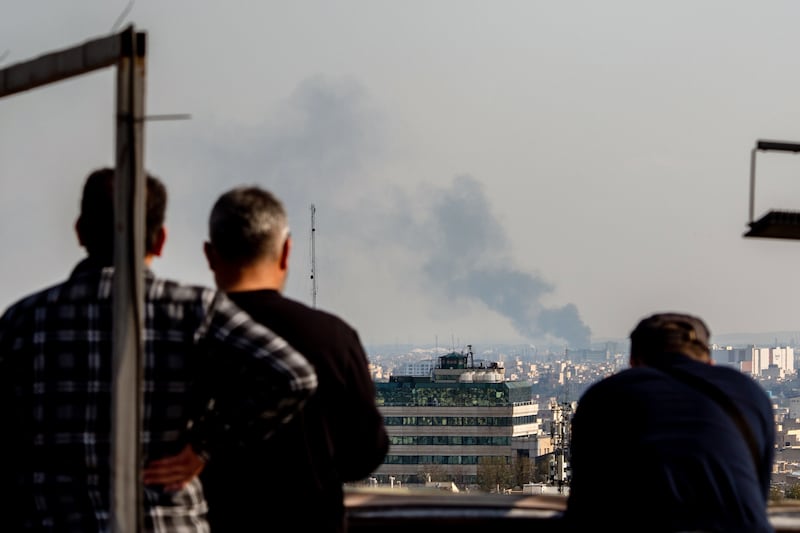 Smoke rises after an air strike in Tehran, Iran, on Wednesday. Photograph: Arash Khamooshi/The New York Times
Jack White – 49 minutes ago
Will the supply shock to jet fuel drive up air fares this summer?
Jet fuel prices have roughly doubled in major markets since the onset of the war, driven by an effective blockade of the Strait of Hormuz, through which about 20 per cent of the world’s traded jet fuel supply normally passes.
When demand outstrips supply, prices tend to rise, but it isn’t as simple as that in this case because of a practice called “hedging”, which is when airlines buy large quantities of fuel at set prices to avoid volatility like that which we’re seeing now.
International Air Transport Association (IATA) chief Willie Walsh, whose organisation represents 85 per cent of the world’s airlines, said Irish and European travellers have a “little bit more time” because of hedging.
But fuel accounts for 26 to 27 per cent of airlines’ costs, and, as margins are already tight, Walsh said airlines would have no choice but to increase fares. “It’s happening now,” he added.
Read more here.
US citizens urged to leave Iraq ahead of expected attacks from ‘terrorist militias’
US citizens have been urged to leave Iraq “immediately” in advance of expected attacks from “Iran-aligned Iraqi terrorist militias”.
The US embassy in Baghdad warned these attacks could be carried out in central Baghdad within the next 24 to 48 hours, and may target US citizens.
“Iran and its aligned terrorist militias have carried out widespread attacks against US citizens and US-associated targets throughout Iraq, including in the Iraqi Kurdistan region.
“These actors may target US citizens, companies, universities, diplomatic facilities, energy infrastructure, hotels, airports and other sites believed to be associated with the United States, in addition to Iraqi institutions and civilian targets,” the embassy said.
“Terrorist militias have targeted Americans for kidnapping, and US citizens should leave Iraq immediately,” it said.
It added that the Iraqi government has “not been able to prevent terrorist attacks that occur within Iraqi territory or launch from it”.
Security Alert – U.S. Embassy Baghdad, Iraq – April 2, 2026
Location: Iraq
Iraqi terrorist militia groups aligned with Iran may intend to conduct attacks in central Baghdad in the next 24-48 hours. Iran and Iran-aligned terrorist militias have conducted widespread attacks…
— U.S. Embassy Baghdad (@USEmbBaghdad) April 2, 2026
Donald Trump’s threat to bomb Iran back to the stone age has sharply raised stakes in a war now in its fifth week and crushed investors’ hopes for a swift end to a conflict that is squeezing oil supplies and fanning inflation.
Global markets recoiled on Thursday as war jitters over Iran deepened, with stocks and bonds sliding, oil surging and the dollar firming after Trump dashed hopes for clarity on when the Middle East conflict might end. – Reuters
Trump says countries reliant on Strait of Hormuz should ‘just grab it’
During his Wednesday night address, Donald Trump said countries that rely on the Strait of Hormuz shipping lane for oil should “build up some delayed courage” and “just grab it”.
The US president also said after the Iran conflict was over, the critical waterway would “just open up naturally”.
Despite soaring fuel prices in the US causing a headache for motorists, as in other countries, Trump insisted America did not need oil going through the maritime pinch point.
He said countries that receive oil through the Strait of Hormuz “must take care of that passage”.
“They must cherish it. They must grab it and cherish it. They can do it easily.
“We will be helpful, but they should take the lead in protecting the oil that they so desperately depend on,” he said.
He continued: “I have a suggestion. Number one, buy oil from the United States of America. We have plenty. We have so much, and number two, build up some delayed courage. Should have done it before. Should have done it with us as we asked, go to the strait and just take it, protect it, use it for yourselves.
“Iran has been essentially decimated. The hard part is done, so it should be easy.
“When this conflict is over, the strait will open up naturally. It’ll just open up naturally. They’re going to want to be able to sell oil, because that’s all they have to try and rebuild. It will resume the flowing and the gas prices will rapidly come back down.” – PA
Ahead of Donald Trump’s televised address on the Iran war this morning, media speculation focused on whether he would declare victory or announce an escalation.
In the end he did both, declaring that the military operation was almost complete but saying that it could continue for another two or three weeks, writes Denis Staunton.
The second part of the message is the more important because it signals an escalation that could easily slip out of Washington’s control as Iran retaliates. Promising to bring Iran “back to the stone ages” over the next two or three weeks, Trump explicitly threatened to destroy the country’s critical infrastructure.
“If there is no deal, we are going to hit each and every one of their electric-generating plants very hard and probably simultaneously. We have not hit their oil, even though that’s the easiest target of all, because it would not give them even a small chance of survival or rebuilding. But we could hit it and it would be gone. And there’s not a thing they could do about it,” he said.
Read more here.
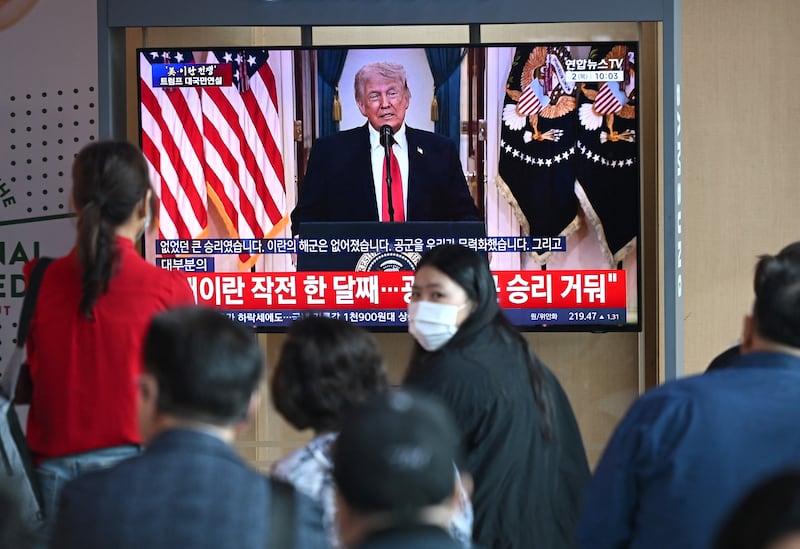 People watch a television screen showing a live broadcast of US president Donald Trump delivering a national address on the war against Iran, at a train station in Seoul on Wednesday. Photograph: by Jung Yeon-je / AFP via Getty Images Death toll: More than 3,000 people killed since war began
According to estimates from the International Federation of Red Cross and Red Crescent societies, at least 1,900 people have been killed and 20,000 injured in Iran since the war began, though precise figures are difficult to verify.
In Lebanon, more than 1,300 people have been killed, according to the country’s health ministry. Most of those who have died have been Lebanese civilians, but Hizbullah estimates about 400 have been its fighters.
And a total of 19 people have been killed and 515 injured in Israel since the war began.
At least 13 American service members have been killed, with hundreds more troops wounded.
US forces have struck more than 12,300 targets inside Iran since the start of Operation Epic Fury, according to a statement released by US Central Command on Wednesday. – The Guardian
Trump says war is ‘nearing completion’ 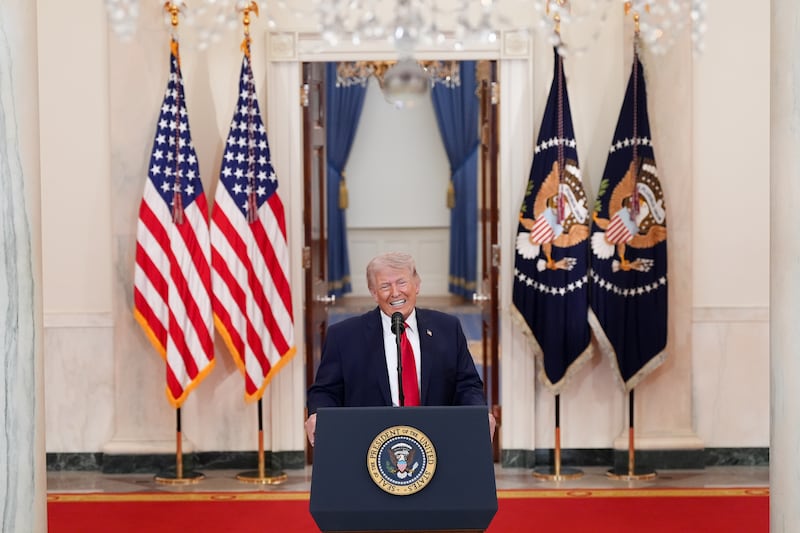 US president Donald Trump during a prime-time address to the nation in the Cross Hall of the White House in Washington on Wednesday. Photograph: Alex Brandon/AP Photo/Bloomberg
Donald Trump used a prime-time address to the nation on Wednesday evening in Washington to declare the month-long war in Iran a success “nearing completion”, despite a spiralling conflict that has caused economic turmoil across the globe, fractured transatlantic alliances and an erosion of the president’s approval ratings.
In remarks from the White House, Trump argued that the US’s “little journey” to Iran had nearly accomplished “all of America’s military objectives”, but offered little clarity on how he planned to wind down the conflict over the next “two to three weeks”.
“We are on the cusp of ending Iran’s sinister threat to America and the world,” Trump said in the 19-minute speech, delivered from Cross Hall of the White House. “We have all the cards. They have none.”
Acknowledging the economic pain caused by the conflict, he blamed a “short-term” rise in gas prices on Iran’s actions, and insisted the US had become energy independent.
Oil prices rose and Asian stocks traded lower immediately after Trump’s address, which did little to soothe investor concerns over the closure of the Strait of Hormuz. The US president reiterated his call for other nations to help secure the global oil chokepoint: “Grab it and cherish it.”
Ticking through a list of claimed achievements, Trump said Iran’s navy and air force had been decimated, leaving the country weak and “no longer a threat” to the US and the world. He, however, said the US would continue to hit Iran “extremely hard” for next several weeks.
“We’re going to bring them back to the stone ages, where they belong,” he said, even as he said “discussions were ongoing”.
Democrats criticised Trump’s address as “incoherent” and doing little to answer “the most basic questions the American people”.
In his speech, the president also took pains to distinguish the current conflict from America’s often lengthy past wars, calling the 32-day military campaign “so powerful, so brilliant”. – The Guardian
Oil prices jump and stocks sink
The price of oil jumped and stocks sank after president Donald Trump, in an address from the White House in the early hours of Thursday morning (Irish time), offered no timeline to end the war against Iran even after he said the conflict was “nearing completion”.
Trump, in remarks that lasted 19 minutes, said US forces would hit Iran “extremely hard over the next two to three weeks”.
The price of Brent crude oil, the global benchmark for oil, was about $106 a barrel, up almost 5 per cent. West Texas Intermediate crude, the US benchmark, was around $104 a barrel, up 4 per cent.
Investors and analysts have remained focused on the Strait of Hormuz since the fighting began over a month ago. The narrow waterway between Iran and Oman is a vital trading route for oil and natural gas that normally carries as much as one-fifth of the world’s oil supply. Shipping traffic exiting the Gulf through the strait has been effectively halted since the war began.
Stocks in Asia, where countries import vast quantities of oil and gas, were broadly lower Thursday, reversing the prior day’s rally. The Nikkei 225 in Japan was down 1.5 per cent. Stocks in South Korea were the worst performers, falling 2.6 per cent.
Futures on the S&P 500 pointed to a 1 per cent decline when stocks resume trading in the United States on Thursday. The S&P 500 rose 0.7 per cent Wednesday.
US gasoline prices rose again Wednesday, jumping to a national average of $4.06 a gallon, according to the AAA motor club. The cost for drivers has risen by 36 per cent since the war began. Diesel prices have increased even more quickly, rising to $5.49 on Wednesday, up 46 per cent since the start of the war. – New York Times