
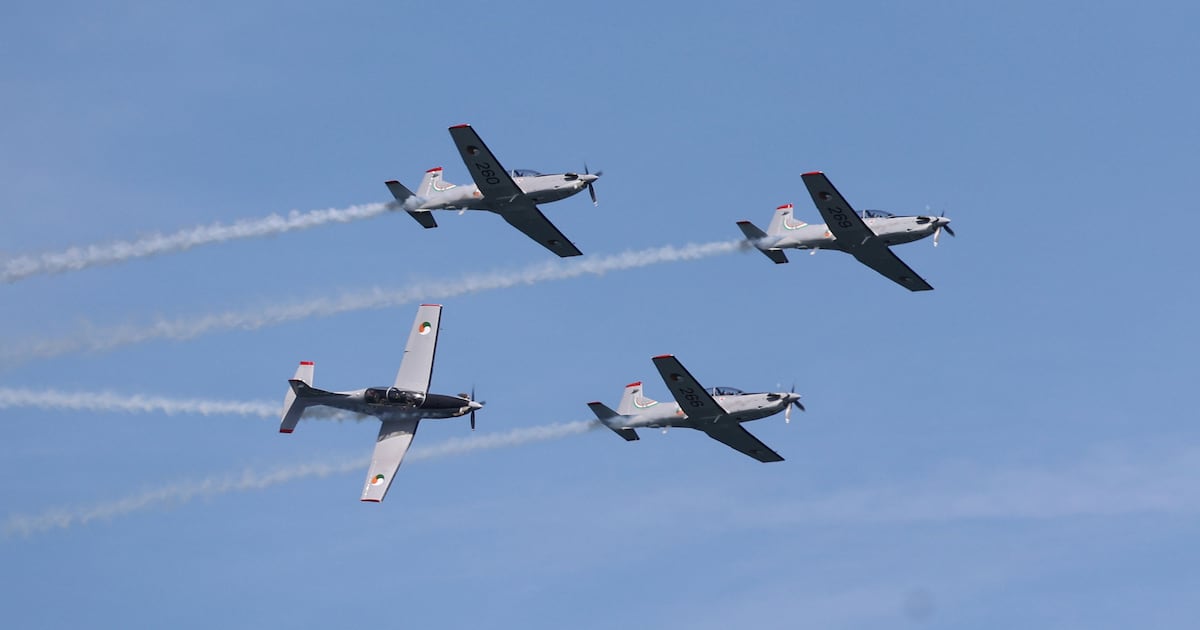
The Irish Air Corps is hiring civilian contractors to teach its pilots to dogfight, after losing the ability to conduct in-house combat training.
The Air Corps operates eight Pilatus PC-9M turboprop aircraft. They are chiefly used for pilot training but have the ability to engage in limited combat against air and ground targets.
However, due to the number of trained pilots leaving the organisation in recent years, the Air Corps has now lost its combat training capabilities due to a lack of knowledge, military sources said.
The Defence Forces is now attempting to rectify this by hiring civilians, likely former military pilots, to train its instructors in basic air combat techniques.
This is a “train the trainer” arrangement, meaning the instructors will then pass the training on to new pilots after they complete their introductory flight courses.
The arrangement will see four Air Corps instructors trained in “basic fighter manoeuvring [BFM] and air intercept [AI] training” over six weeks starting this April. The contract is worth an estimated €100,000 plus VAT.
It will involve up to 70 flights and include training in “gunsight tracking, battle formation [and] radar intercepts”, a request for tender states.
“This is basic enough training. It could be called basic dogfighting,” said a source. “It’s not Top Gun.
“They will learn aggressive manoeuvring and how to put themselves in a position to take down targets. They will be trained to deal with targets such as drones or unresponsive aircraft.”
The PC-9M aircraft are armed with .50 calibre machine guns and ground-attack rockets.
The training will be completed in time for Ireland’s assumption of the EU presidency. However, it is not known if the aircraft will play any role in providing security during the six-month presidency.
The aircraft were used to provide some air defence capability during Ireland’s previous term in the presidency and during the visit of British queen Elizabeth in 2011.
Due to their relatively slow speed and flight ceiling, the aircraft are not capable of intercepting fast-moving aircraft, including civilian airliners.
Internally, it has been suggested they could be used to intercept drones during high-profile events. However, this would require radar guidance from the ground.
The Defence Forces is acquiring a national military radar system but this will not be in place for several years.
It is not the first time the Air Corps has sought outside assistance in training pilots. In recent years, officers have been sent to Australia and the United States for basic flight instruction.
Separately, plans to replace the PC-9M fleet with more modern training aircraft are at an early stage. The Government has also committed to eventually acquiring a fleet of combat interceptor jets capable of providing a full air-policing service.
“It is something that may happen in the next decade,” Brig Gen Rory O’Connor, the head of the Air Corps, told the publication European Defence Review this month.
He said fighter aircraft such as the Saab Gripen or the Korean FA-50 “could be options if funding is available”.
However, any such move would require an advanced training programme. He said this could be achieved by replacing the PC-9M with jet trainers or sending pilots to the International Flight Training School in Italy.
Asked about the role of the PC-9M aircraft during the EU presidency, a Defence Forces spokesman said he could not comment for reasons of operational security.