
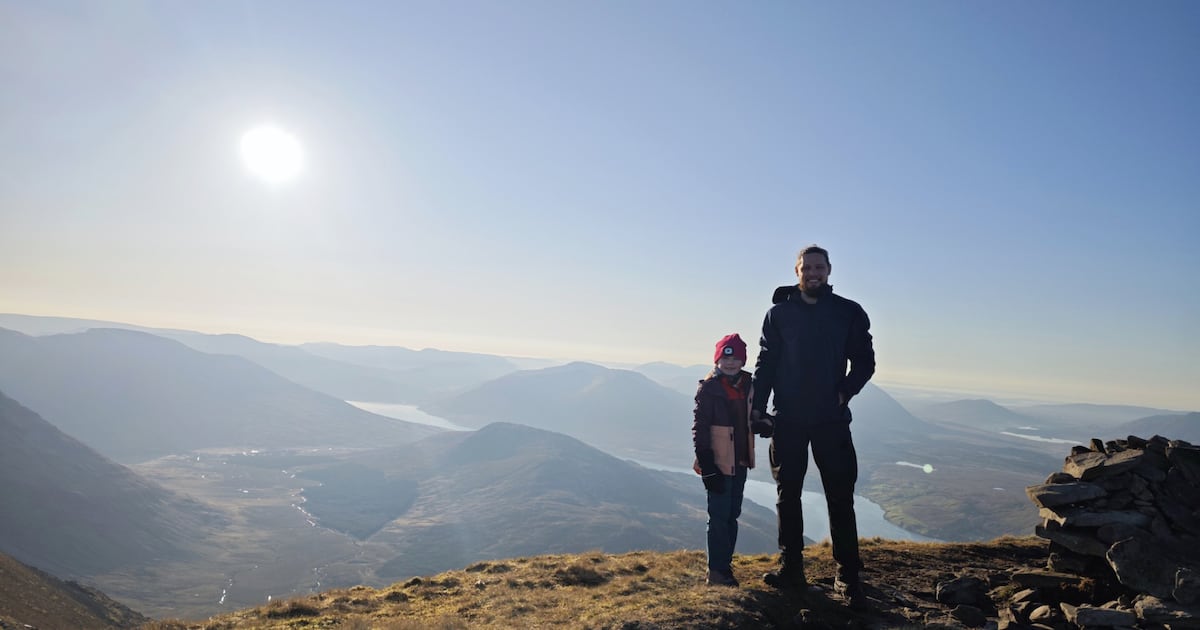
There were so many nights when Pádraig O’Hora walked alone up and down the mountain. Himself and his brain and sometimes, when it was really important, the decadent luxury of nothing. No outside world, no real internal one either. Just his breathing and his path and the next step and the one after it. That’s when peace came.
Ostensibly, he was training himself to climb Everest. He’d set himself mad challenges, such as doing Croagh Patrick six times in 13 hours. Or playing a full match in the Mayo championship for Ballina Stephenites and then heading straight off to do a 12-hour hike. Or dehydrating himself the day before a long session, just to get intimate with how it feels.
Still, odd as it might sound, Everest might be the least of it. It’s both the most important part of the whole enterprise and the one he is most suspicious of over-analysing. He flew out of Dublin this past Monday and hopes to fly into the Tenzing-Hilary Airport in Lukla, Nepal this weekend. Over the next couple of months, he’ll either get up and down Everest or he won’t. If all he was aiming for was the top of the world, he’d be pointing himself at the wrong summit.
“When things get flaky for me,” he says, “or if things get hard and I start to struggle work-wise or personally or whatever, I go to the water or I go to the mountain. I don’t go anywhere else. My answer isn’t in the pub. My answer is in the sea or it’s on the mountain. And that is the only place you’ll find me.
“This world we’ve built – and I know we can’t change it – but it ain’t for us. And it certainly ain’t for people like me. I have a million things going on in my head right now, you know? As do you. And there’s a lot of angles and avenues and things that need to be remembered – times and constraints and this and that and the other.
“Go out to the mountain and see what you’re doing. Food, water, shelter, direction – that’s it. What it does to your mind after a couple of days is extraordinary. Trust me, there’s no anxiety or depression up there. I can tell you that much.
“I know. I’ve been there. I know what it feels like to be in your head. I know what it feels like to hate yourself. And then, half an hour later, to feel fine. And then hate yourself again. I know that I will have this rollercoaster of emotions. I think you prep for all of it.”
O’Hora played his last match for Mayo in June 2024, a Sam Maguire group game against Roscommon in Dr Hyde Park. Seven months later, he was sitting on top of Aconcagua in Argentina, the highest point in the Americas and the world’s highest peak outside of Asia. All of it went into what he’s doing now. Yes, even the Rossies in the Hyde.
O’Hora is 33 and has a partner and three kids at home, meaning that when he says heading off for two months to climb Everest is “the most selfish thing I’ve ever done”, he’s not over-egging it.
He’s going to miss one of his daughters turning four. The other one has her Communion coming up and he can’t give her a cast-iron guarantee he’ll be back in time for it. And yet, in terms of disruption to his family life, he reckons his years as a Mayo footballer were at least comparable and often even worse.
“That’s the funny thing,” he says. “It didn’t matter how much I trained for Everest or how big the training plan was, it was basically nothing compared to intercounty football. Okay, the output was far higher. But in terms of time and commitment, intercounty was way worse.
“Because at least with this, my schedule was my own. I trained when the kids were in bed. I trained at 10 o’clock at night until six in the morning. I picked my hours around my home life. So it was nowhere near as impactful as playing for Mayo. Nowhere near it.
“And then even when it came to going to Argentina for three weeks to climb Aconcagua, it nearly wasn’t much different from being in the depths of the championship with Mayo. Like, she’d have been saying: ‘We’ve been here so often at this stage, we’re so used to you being gone with Mayo that it’s basically the same thing.’”
Everest was a bug he picked up when he was a kid. Over the years, life threw all sorts of treatments and therapies into the mix but none of them got rid of it, not entirely. Not getting in trouble as a teenager, not becoming a father when he was 20, not the mental health struggles he has been so open and generous about sharing in public. Somewhere down beneath all the layers, the low hum of Everest kept calling.
I’d say it’s more risky for me to play another intercounty season than it would be to go and climb Everest
It won’t surprise anyone that the Mayo Mental Health Association is his charity partner for the climb. O’Hora has become one of the most passionate voices around on the subject, talking in a particular radio frequency aimed at being picked up by young men. He’s played in an All-Ireland final, he’s fought MMA, he’s come through Ultimate Hell Week. He’s not just some crusty old do-gooder telling lads to be kind to themselves.
“I always had an issue with the hard man attitude. Tough, indestructible, bury it all down and nothing can break me, that kind of thing. Because I spent a significant amount of time behaving that way as a teenager and as a young adolescent. That’s just what you did to be a man, to be one of the cool guys.
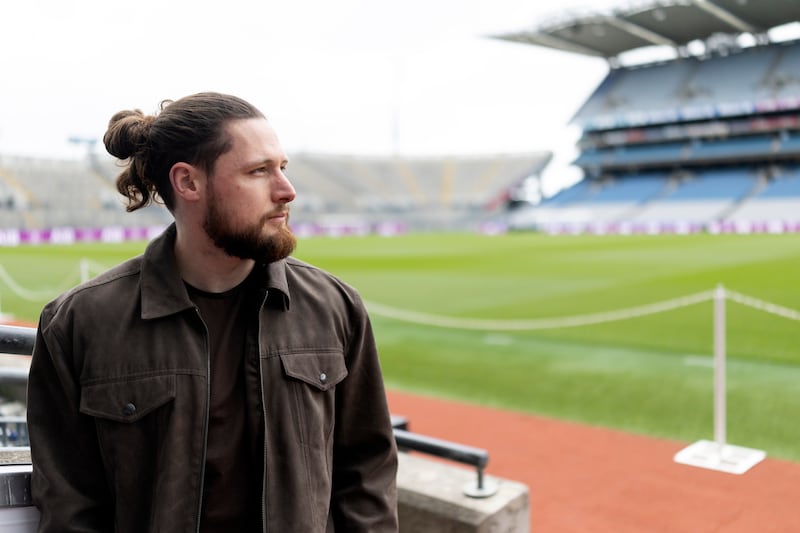 Mayo footballer Pádraig O’Hora, see her eon the pitch at Croke Park, is planning on climbing Everest this spring – and he will also be writing a diary during the expedition. Photograph: Chris Maddaloni/The Irish Times
“As I got a little bit older, I was very ashamed. I am a little bit embarrassed and ashamed about that style of behaviour. It was never who I was. But it was what I thought was required to fit in or to be cool or to be accepted.
Everest is a privilege. I will not be going up that mountain feeling at any stage ‘Oh, this is hard’ or ‘Poor me’
“But if you want to actually have a clear impact with people, then you have to be vulnerable. And if you’re not comfortable in that space, I think you’re wasting time. If I’m going to do this, it needs to be honest. I don’t mind that level of vulnerability being out there.”
That’s what makes his expedition such a potent blend and gives him such a rich story to tell. When he gives talks on mental health, he knows the best ones happen when he ditches the slide shows and just gets people talking about their experiences. That only happens when they feel they can talk to him, when he opens that door.
On the face of it, Everest sets an unreachable bar in that respect. It’s hard to showcase your vulnerability when people are already conditioned to see you as some kind of superhero for climbing to the roof of the planet. It’s something he’s been wrestling with throughout, interrogating it, poking it for holes. How can he relate climbing Everest to helping people back on the ground?
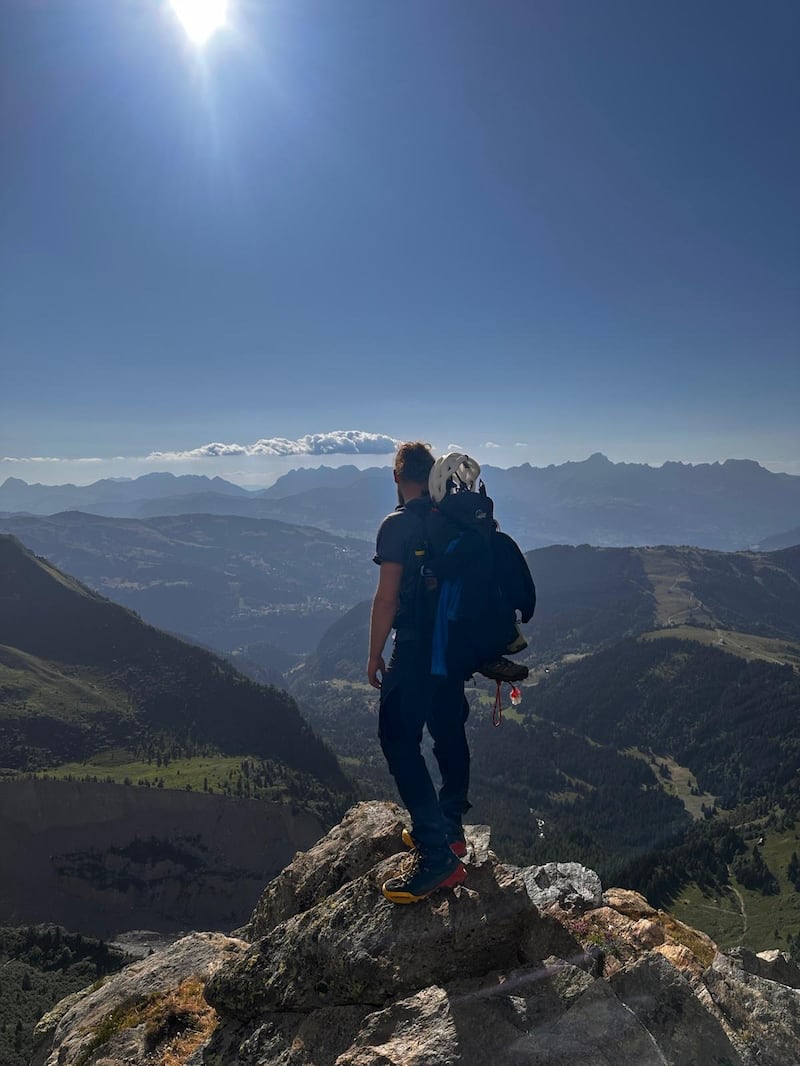 Pádraig O’Hora on a peak in Chamonix, Mont Blanc, French Alps
“The symbolism of Everest is undeniable,” he says. “It’s right there. You climb Everest, you’ve won the ultimate battle, right? But in the lead-up to this, I’ve realised how naive I was.
“To look at Everest as a battle, it deviates from what real mental health battles are. You’re talking about the mother or the father or the family having to work an extra job or struggling to pay the rent. Or looking at bills coming in and having to take a child out of a certain activity because ye can’t afford it. The actual real-life struggles that people have.
“Everest isn’t that life. Everest is a privilege. I will not be going up that mountain feeling at any stage ‘Oh, this is hard’ or ‘Poor me’. Any time my mind clicks into that, I will be thinking of the harsh realities that people go through.”
This is who he is. Someone who long ago dropped the pretence of being interested in social conformity. Who is hard on himself, almost as a defence mechanism designed to ward off any slings and arrows fired his way. Who doesn’t shy away from the messiness of life and leans into it instead.
Most of all, someone who is searching. For what, he might not be entirely sure. Peace, maybe. Contentment, sure. A future for his family, absolutely. Decamping to the Himalayas for six to eight weeks is for him but it’s for them too.
“This will carry my family a very, very long way. This has the potential to change our lives in ways we probably don’t even understand yet. If I can successfully achieve this, I think it changes everything. I think it changes potential career opportunities. It certainly changes perspective. I think it unlocks the door.
“Actions over words. Like, ‘My dad climbed Everest’. What does that say to a child? No matter who puts them down or whatever is ever said to them or whatever dreams they have, I don’t think anybody can ever take that away from my son or daughter. Because they see me, they know all my flaws. They know I’m far from polished.
‘And for them to be able to go, ‘My dad played for Mayo, he hit the summit of Everest…’, like, Jesus, we can do whatever the hell we want. It’s right there. It’s in the blood.”
His schedule has a little flexibility in it but not a lot. They left Dublin on Monday, spent a couple of days in Kathmandu in the middle of the week before heading to Lukla to start the trek. It takes 14 days to get to Base Camp and after that, it’s a countdown basically. The aim is to have everything ready for some time around May 10th and push on from there. The window is small to hit the summit but he’s going to give himself every chance.
It’s not without risk, of course. Five people died on Everest last year, nine died the year before, 18 the year before that. He’s not blithe about the dangers. But he’s not the least bit put off by them either.
“It is what it is. So many people said that. But if you look at Everest and go through the statistics, the mortality rate is under 1 per cent. So are you going to take them odds? I’ll take them odds all day.
“You take risks driving your car on the M50. I know maybe that’s a little bit cliched but for me, life unlived is far more dangerous. Somebody told me that more people die sitting on the couch than climbing mountains and whether or not that’s true, it’s true for me anyway. Sitting there and wasting away, watching other people do things or fulfil dreams that you wish you went for? No thanks.
“I don’t think anything bad is going to happen. And if something bad does happen, I’ll take it on the chin. I’ve got hurt playing football more than I’ve done anything else. I’ve boxed, Jiu Jitsu, kick-boxing. I’ve jumped off things you shouldn’t jump off, I’ve climbed things you should never climb. And still, the only thing I’ve ever got hurt doing is playing Gaelic football.
“So, like, I’d say it’s more risky for me to play another intercounty season than it would be to go and climb Everest!”
Onwards, then. And soon to be upwards.
What a thing to do.
Pádraig O’Hora will be writing an exclusive diary of his Everest expedition in The Irish Times, beginning on Saturday, April 11th.