
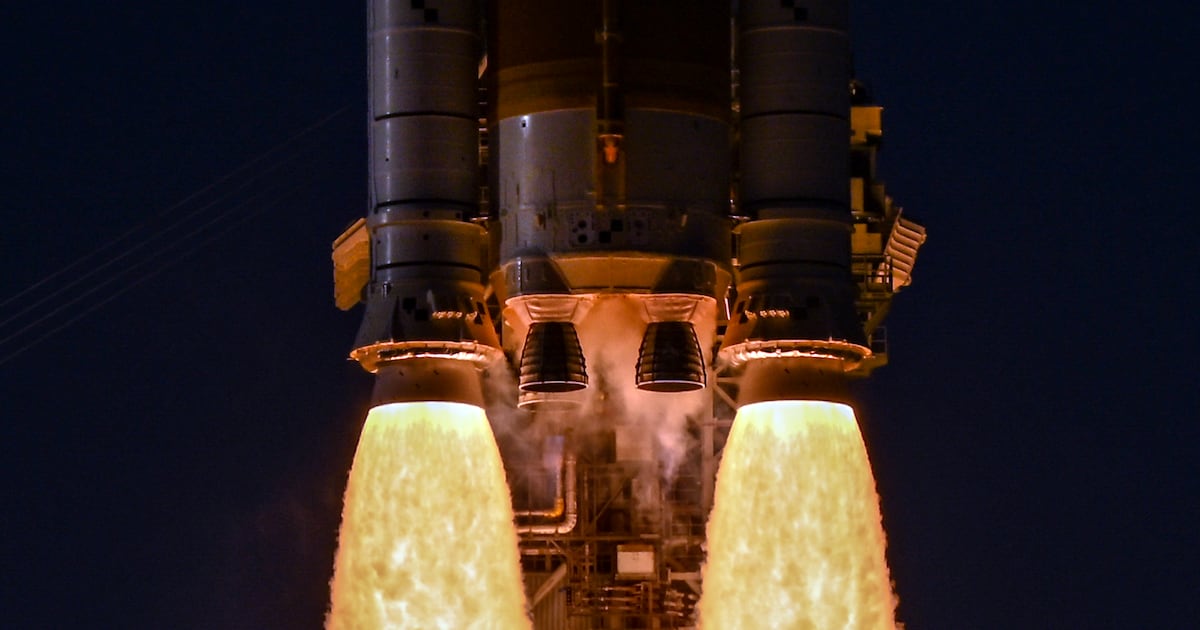
Four astronauts are preparing to leave Earth’s orbit and slingshot towards the moon as Nasa’s Artemis II mission enters its second day.
The high-stakes 10-day voyage is expected to mark the return of humans to the vicinity of the moon for the first time in half a century. It is a crucial test of Nasa’s ambition to land humans back on the lunar surface this decade and stay there permanently.
After about 3½ hours of post-launch rest on Thursday, the Artemis II crew was woken up by mission control. They were instructed to prepare for the Orion spacecraft’s engines to fire for a one-minute “burn” to adjust the orbital path even higher above Earth.
“Christina, Houston is go for the burn,” mission control said, talking to the mission specialist Christina Koch, who will become the first woman to fly around the moon.
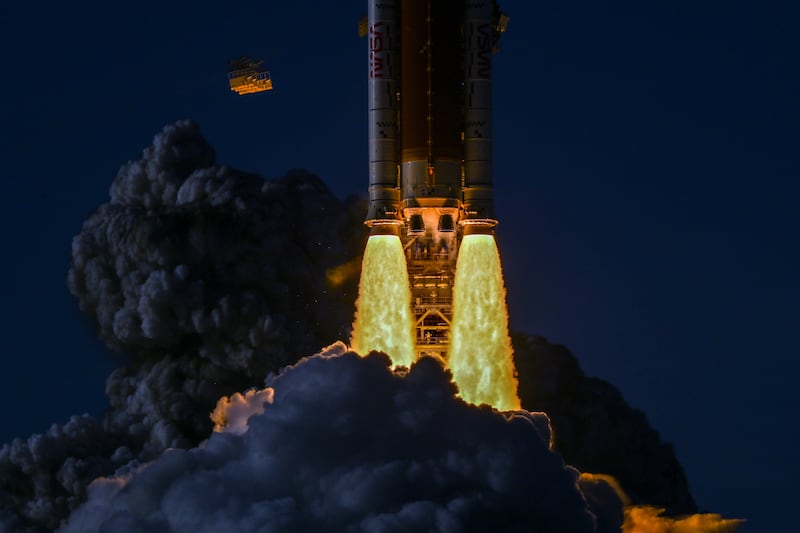 NASA’s Space Launch System rocket, carrying the crew of the Artemis II mission, lifts off from the launchpad at the Kennedy Space Center. Photograph: Kenny Holston/The New York Times
Nasa has said if “all systems remain healthy” on the Orion spacecraft, then mission controllers will later give the command to conduct a translunar injection burn – a six-minute engine firing that will send the capsule on its journey to the moon.
The crew will then loop around the back of the moon, in the process becoming the four people to travel the farthest from Earth in history. They will then use the celestial body’s gravity to launch back home.
The astronauts – three Americans and one Canadian – took off from the Kennedy Space Center in Florida on Wednesday in front of tens of thousands of people who gathered to witness the launch of Nasa’s most-powerful rocket, called the Space Launch System.
The scenes were reminiscent of the Apollo launches in the 1960s and 70s, which put humans on the moon for the first time. In Greek mythology, Artemis is a goddess of the moon and twin sister to Apollo, the god of the sun.
 Large crowds gathered to watch the launch at a park in Titusville, Florida. Photograph: Miguel J Rodriguez Carrillo/AFP via Getty Images
Much of the trip will serve to test systems for future Artemis missions. There have already been minor issues, including a temporary communication problem, reports by the astronauts that the cabin was a little cold and a blinking fault light with the on-board toilet that the crew noticed shortly after launch.
The crew also completed a proximity operations demonstration in which they manually manoeuvred the capsule to assess how it would handle when docking to another spacecraft. Future missions will include a lunar lander that the capsule will need to dock with.
The astronauts have also been photographing Earth from huge distances. “The view out window three, from about 38,000 nautical miles, the entire view of the Earth is spectacular,” said the mission commander, Reid Wiseman, on Thursday.
Artemis II is expected to break the record for distance travelled away from Earth – currently 400,171km, set in 1970 by the Apollo 13 crew, who slingshotted 254km above the lunar surface in an emergency procedure to return to Earth. The Artemis mission will go much higher, at an altitude of between 6,500-9,600km above the moon. This means if the engines fail at any point, the capsule will still remain on a gravity-powered trajectory to return to Earth.
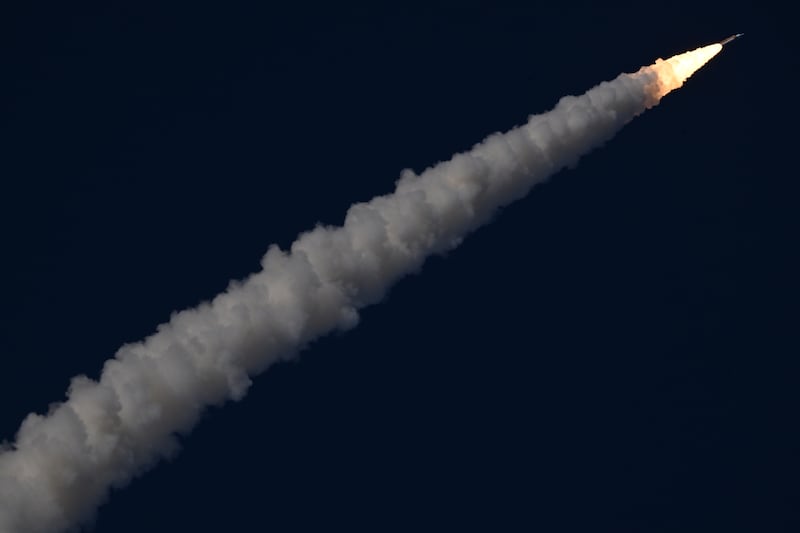 Nasa’s Space Launch System rocket, carrying the crew of the Artemis II mission, lifts off from the launchpad at the Kennedy Space Center in Florida on Wednesday. Photograph: Kenny Holston/The New York Times
The higher altitude also gives the crew a wider field of view of the far side of the moon – which will appear to them as about the size of a basketball held at arm’s length – and opportunities to test deep-space conditions on the spacecraft.
While Artemis III will conduct further docking tests in Earth’s orbit, Artemis IV, the launch of which is ambitiously set for 2028, aims to land astronauts on the moon’s south pole. Washington is in a new space race to return to the moon, with China on target for a planned crewed mission to the same lunar region as early as 2030.
Nasa has plans to build a lunar base that can house a permanent human presence. It said the Artemis missions “will bring us closer to living on the moon and Mars”. – Guardian