
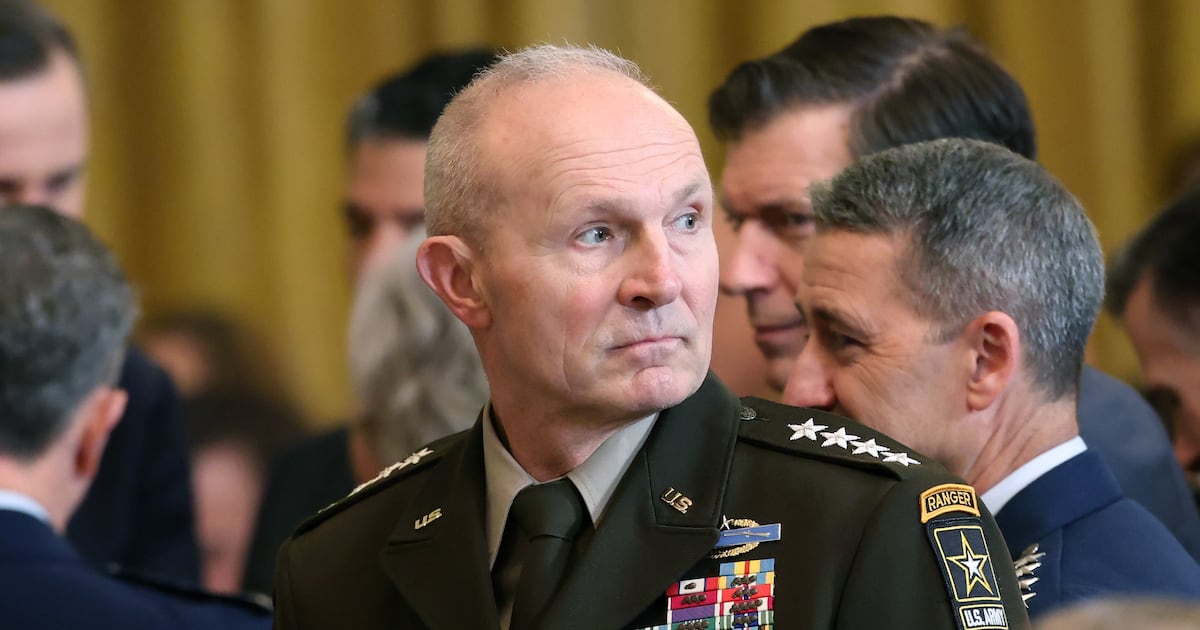
US army chief of staff Randy George has been asked to step down by defence secretary Pete Hegseth, two US defence officials and a source familiar with the matter told Reuters on Thursday.
A Pentagon spokesperson said late on Thursday night that George would be retiring from his position with immediate effect.
Hegseth, a former Fox News host, has moved quickly to reshape the department, firing top generals and admirals as he seeks to implement Trump’s national security agenda.
The sources did not indicate why Hegseth asked George to leave his post. The move was first reported by CBS News.
George, an infantry officer who served in Iraq and Afghanistan, was confirmed to the top Army post in 2023. Terms in that role usually run for four years.
George’s removal adds to recent upheaval at all levels of leadership at the Pentagon, including the firing last year of the previous chairman of the joint chiefs of staff, air force gen C Q Brown, as well as the chief of naval operations and air force vice-chief of staff.
The office for George did not immediately respond to a request for comment.
Also on Thursday night, United Nations secretary general António Guterres again called for a “peaceful way out” of the conflict in the Middle East, saying in a post on X: “The spiral of death and destruction must stop now.”
Every day the war in the Middle East continues, human suffering & devastation grow, indiscriminate attacks grow & the perils to our world grow.
The conflict is being felt everywhere.
We must find a peaceful way out.
The spiral of death & destruction must stop now. pic.twitter.com/rqAnWYgiII
— António Guterres (@antonioguterres) April 2, 2026
“We are on the edge of a wider war that would engulf the whole Middle East with dramatic impacts around the globe,” he said earlier on Thursday.
Elsewhere, French president Emmanuel Macron hit out at Donald Trump, saying he was undermining Nato by creating “daily doubt about his commitment” to the alliance.
The US president, in interviews to various media this week, made disparaging comments about Nato, calling it a “paper tiger” and threatening to pull the US out of it.
Macron said it would be “unrealistic” to try to reopen the Strait of Hormuz through military means.
Such an operation would take an indefinite time and expose those involved to risks from Iran’s Islamic Revolutionary Guard Corps, including ballistic missiles, he told reporters on Thursday.
“This has never been the option that we’ve chosen and we think it’s unrealistic,” Macron said. “We must be able to reopen this strait because it’s strategic for energy, fertilisers and international trade, but it can only be done in consultation with Iran.”
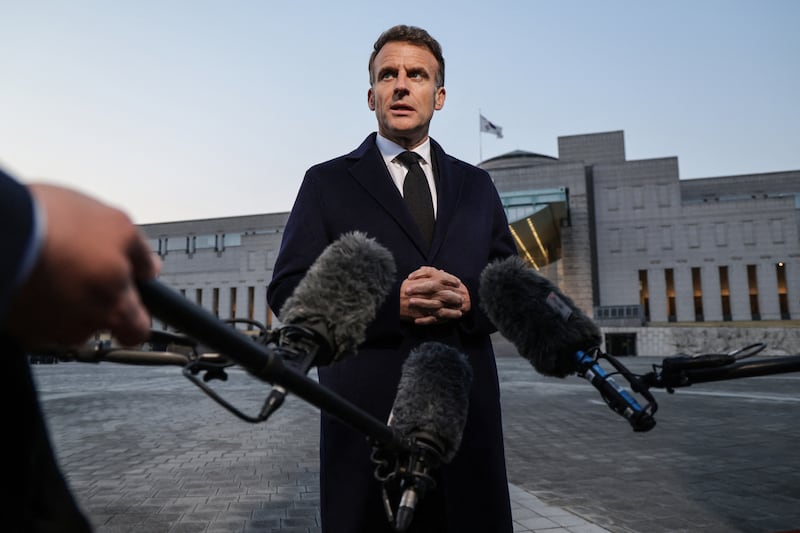 French president Emmanuel Macron during a visit to the War Memorial of Korea in Seoul on Thursday. Photograph: Ludovic Marin/AFP via Getty
Dozens of countries are urgently seeking ways to restart energy shipments through the Strait of Hormuz after Trump vowed more aggressive strikes on Iran, causing oil and gas prices to surge on world markets.
Trump said operations would be intensified and gave no timeline for ending hostilities, drawing threats of retaliation from Tehran and sending share prices lower.
“We’re going to hit them extremely hard over the next two to three weeks. We’re going to bring them back to the stone ages where they belong,” Trump said in a televised address.
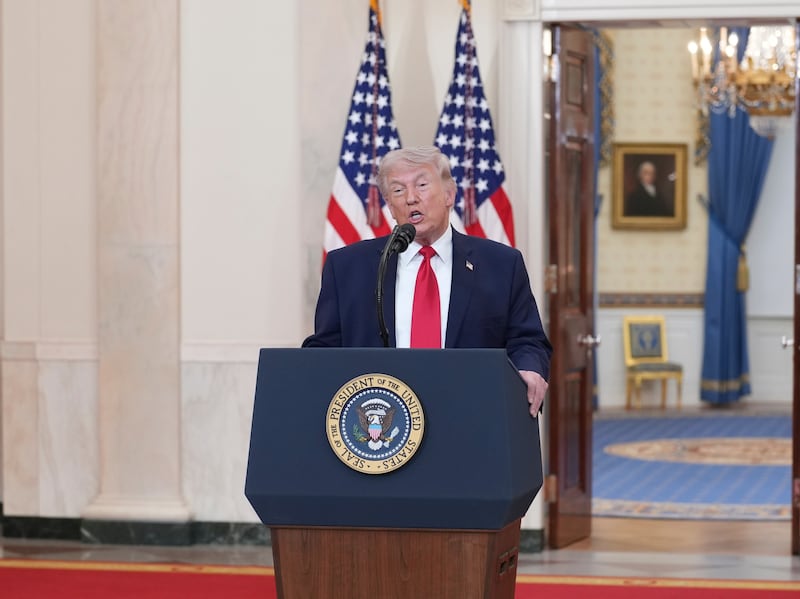 US president Donald Trump addresses the nation from the White House on Wednesday. Photograph: Doug Mills/New York Times
However, his speech offered little new, as he repeated that the US was still on track to reach its objectives “shortly” while at the same repeating his threat to send Iran back to the “stone ages”.
“When this conflict is over, the Strait will open up naturally,” he said.
British foreign secretary Yvette Cooper reiterated the “urgent need” to reopen the strait during a virtual summit with more than 40 global counterparts to discuss the fate of the strategic waterway, where ship traffic has been blocked during the Middle East war, causing oil and gas prices to surge on world markets.
Macron also said US military operations would not prevent nuclear proliferation, calling for an international mission of inspectors to verify Iran’s sites.
“I would remind you that six months ago, we were told everything had been destroyed, that everything was settled and done with,” Macron said.
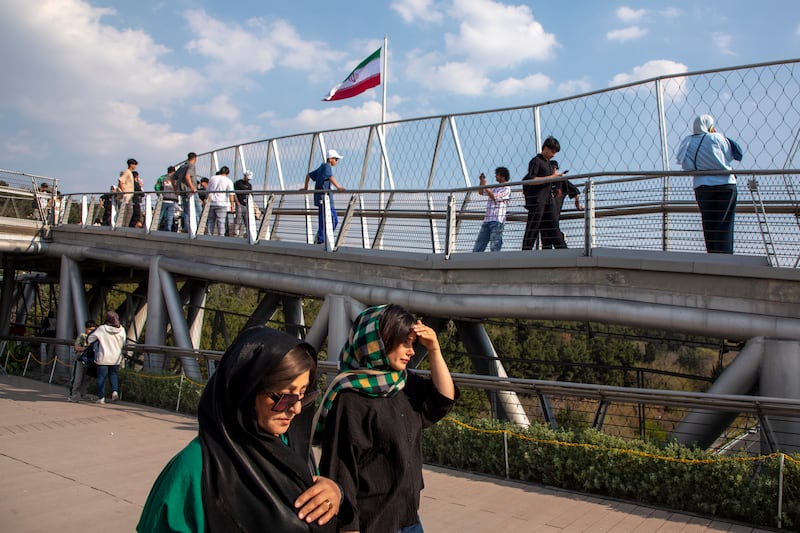 People walk along Tabiat Bridge in Tehran as Iranians celebrate Sizdah Bedar, also known as nature day, on Thursday. Photograph: Majid Saeedi/Getty Images
On Thursday, day 34 of the war, the Iranian city of Isfahan was heavily bombed along with Karaj, and a bridge on a highway connecting the city to the capital Tehran was hit.
Iran’s Islamic Revolutionary Guard Corps said it targeted US-linked steel and aluminium facilities in Gulf states, adding that if Iranian industries are hit, Tehran’s “next response again will be more painful”.
The United Arab Emirates defence ministry said it intercepted 19 ballistic missiles and 26 drones launched on Thursday.
Iran’s parliament speaker Mohammad-Bagher Ghalibaf claimed that seven million Iranians have volunteered for military service since the start of the war.
“We’ve done it before, and we’re ready to do it again. You come for our home … you’re gonna meet the whole family,” he said, adding: “Bring it on.”
Eighteen European countries, including Ireland, have issued a joint statement calling on Israel and Hizbullah to end hostilities.
Lebanese prime minister Nawaf Salam stressed that “we are committed to working to end the war”, adding that statements by Israeli officials and Israel Defense Forces actions point to a significant expansion of the occupation of Lebanese territory. – Additional reporting: Reuters