
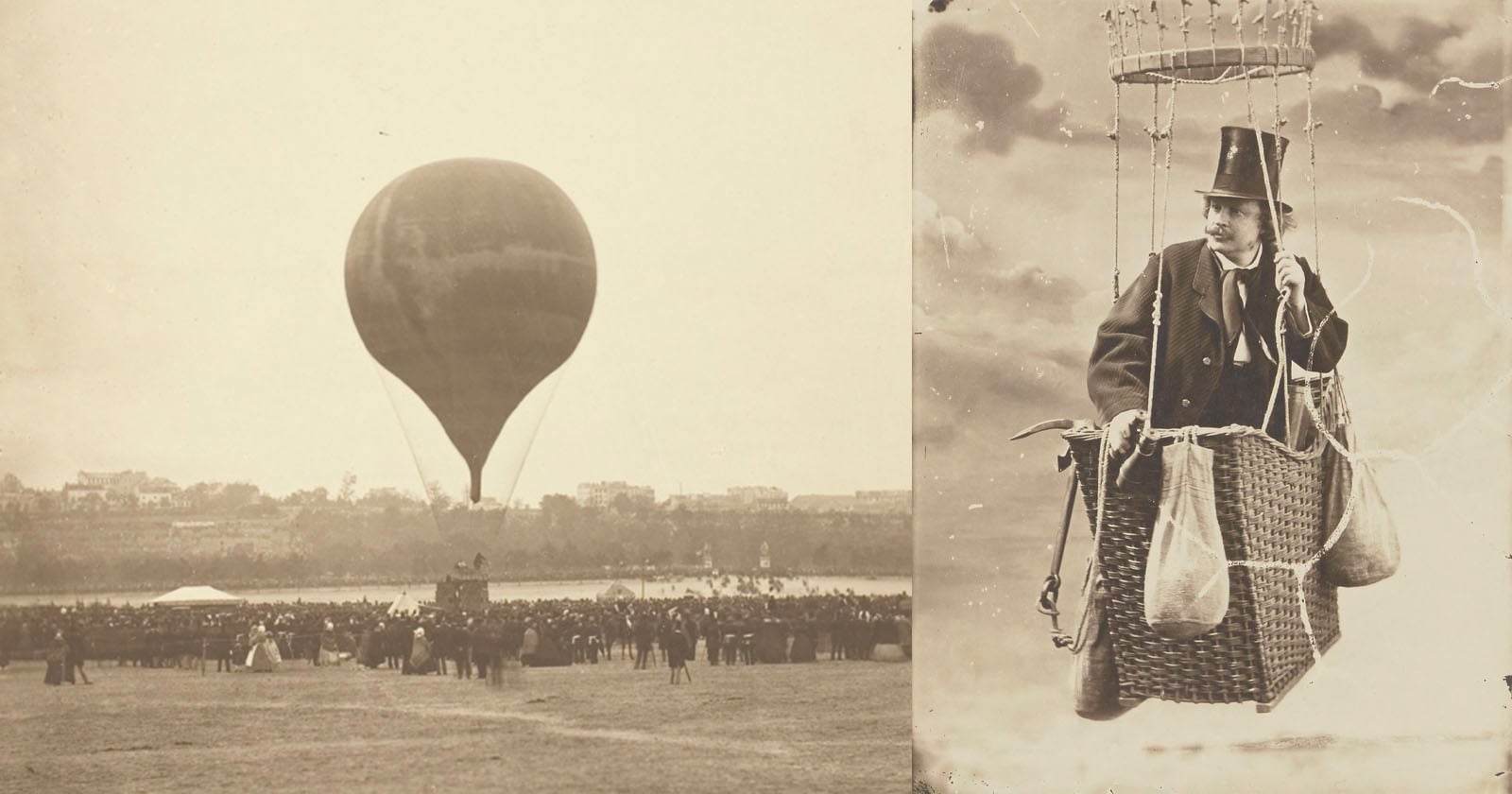
 Le Géant gas balloon, left, and Félix Nadar, right.
Le Géant was an enormous 196-foot-tall gas balloon that photography pioneer Félix Nadar used in his bid to master aerial imagery — it all ended in a 25-mile-long crash and his wife landing in a river.
It was October 1863, and Le Géant was about to take off for only its second journey; its first journey in front of a gathered crowd of one million Parisians had lasted only 15 minutes.
But Nadar had a vision that balloons could become not just vessels for aerial photography, but an entire industry of air travel. That’s why Le Géant carried a two-story basket that held a darkroom, galley kitchen, a printing press, 12 beds, a toilet, and a wine store. An upper deck allowed passengers to take in the view; it was like a flying house.
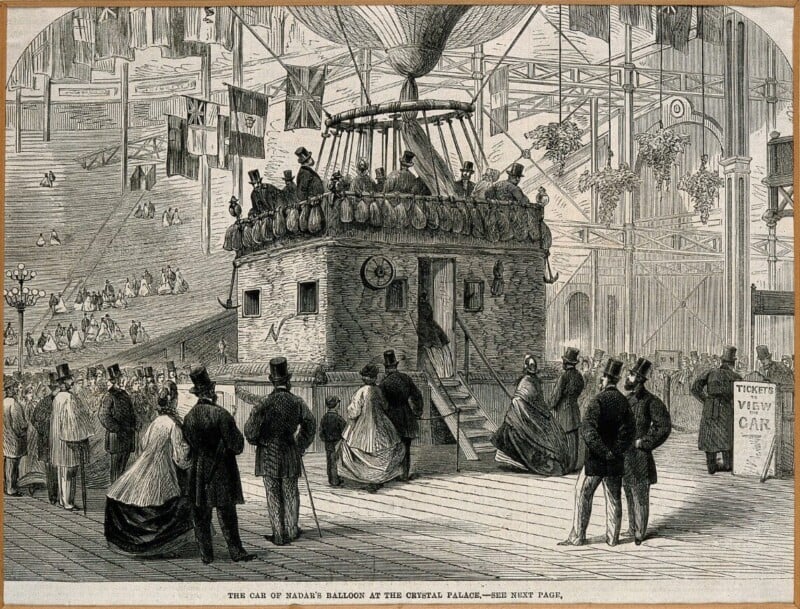 An engraving showing the elaborate basket. | Wellcome Collection
 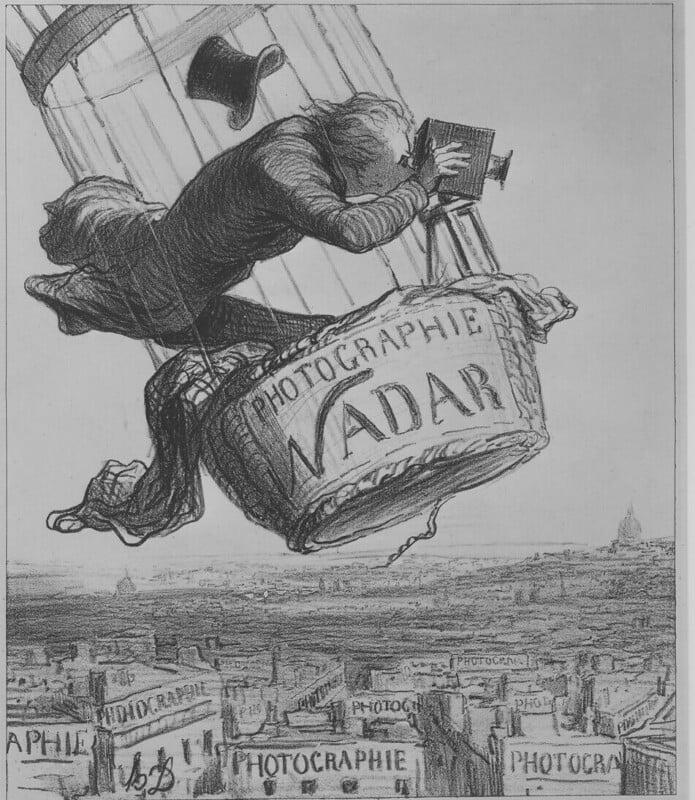 A cartoon of Nadar taking aerial photographs. | Metropolitan Museum of Art
The darkroom was necessary since Nadar was using the wet collodion process, which required photos to be instantly developed. His first attempts had been scuppered by excess gas venting into the basket and spoiling the sensitive photographic plates.
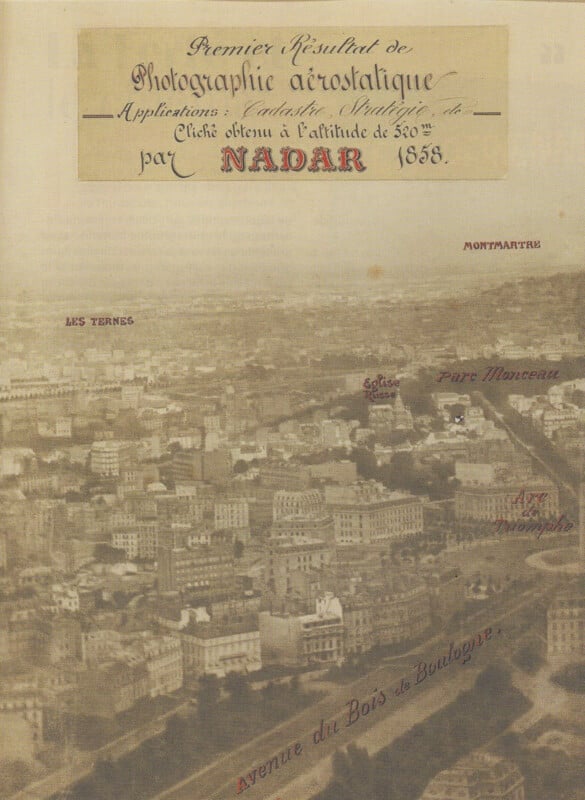 One of Nadar’s early aerial photographs.
 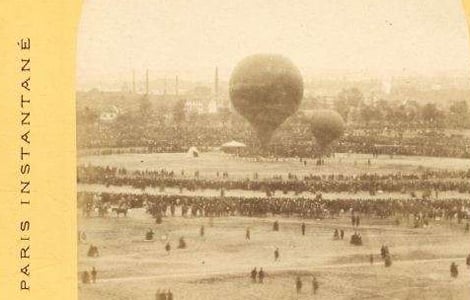 Le Géant was taller than the Statue of Liberty, when measured from her toes to her torch.
According to Anika Burgess’ book, Flashes of Brilliance, Nadar’s second journey initially went far better. The nine passengers, including Nadar’s wife, Ernestine, flew for a day, and the next morning enjoyed coffee and croissants on the observation deck. It was a serene scene, before it all went horribly wrong.
Some accounts say that as the balloon began its descent, Nadar panicked after mistaking a cloud bank for the open sea (they were flying over Belgium) and pulled the valve; another theory is that the aeronauts took the balloon down too quickly. Whatever happened, the valve line broke, and they didn’t have enough ballast to get rid of, meaning they could no longer ascend upward.
The aeronauts threw two iron grapnel hooks off the side, but they snapped off as the basket grazed the ground and bounced back into the air.
“The balloon ricocheted high into the air several more times — somewhere between 25 and 40 meters (around 80 to 130 feet), according to one passenger’s estimation — before slamming back to the earth,” Burgess writes in Flashes of Brilliance.
“For the next 25 miles, the basket was dragged by the partially inflated balloon, crashing through trees and hedges. At one point in its frenzied journey, the balloon approached a train track, where an express train was hurtling toward them. They avoided a collision only because the engineer saw them and slowed the train down.”
Just before Le Géant came to a halt, a journalist onboard had thrown himself overboard, convinced he was about to be smashed to smithereens. Nadar suffered a broken leg, another passenger broke his arm and dislocated his ankle, while Nadar’s wife, Ernestine, had been flung out of the basket into a river; she almost drowned.
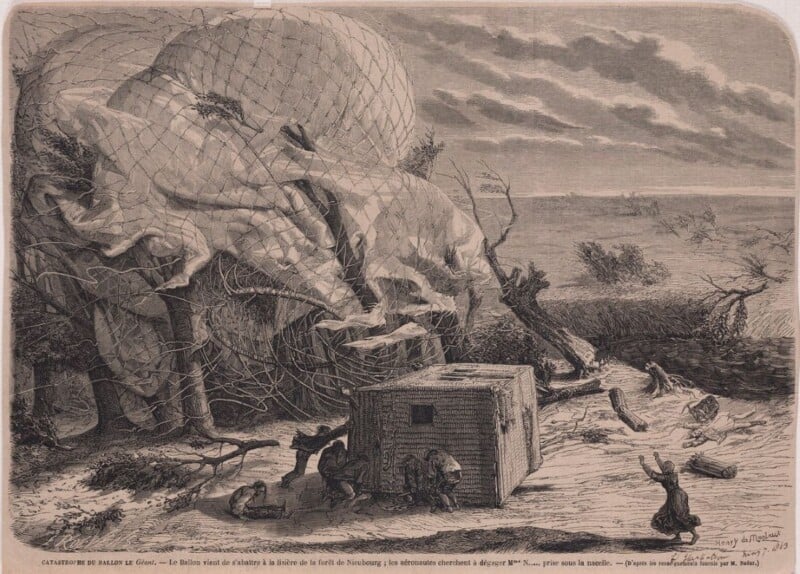 An illustration showing the wreck of Le Géant.
 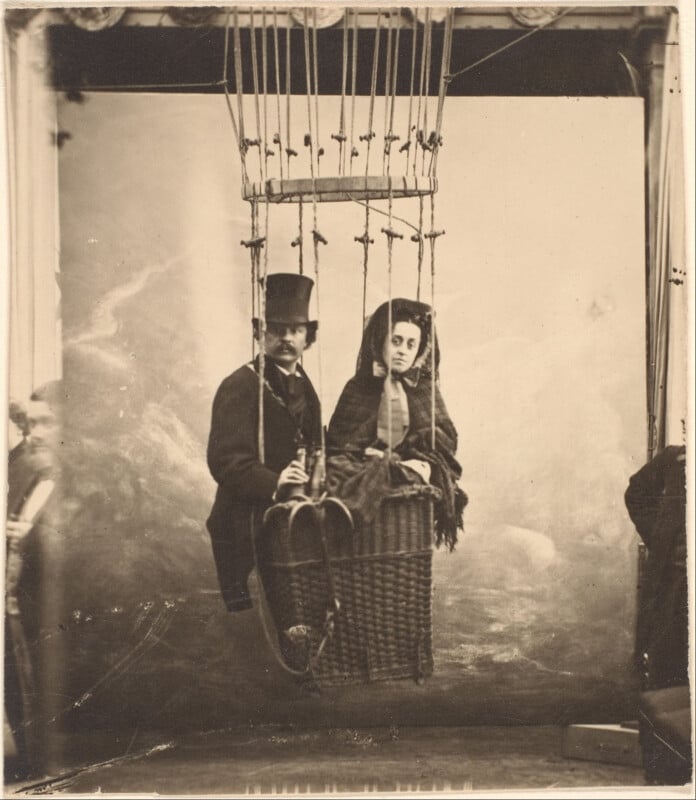 Nadar and his wife, Ernestine, in a publicity photo. She doesn’t look thrilled.
It was a heavy financial blow for Nadar, who repaired the balloon and eventually sold it in 1867. If he did take any photos from Le Géant, they have all been lost. He did manage to take a few successful aerial photos over the course of his lifetime, but his vision of balloon air travel never came to fruition.