
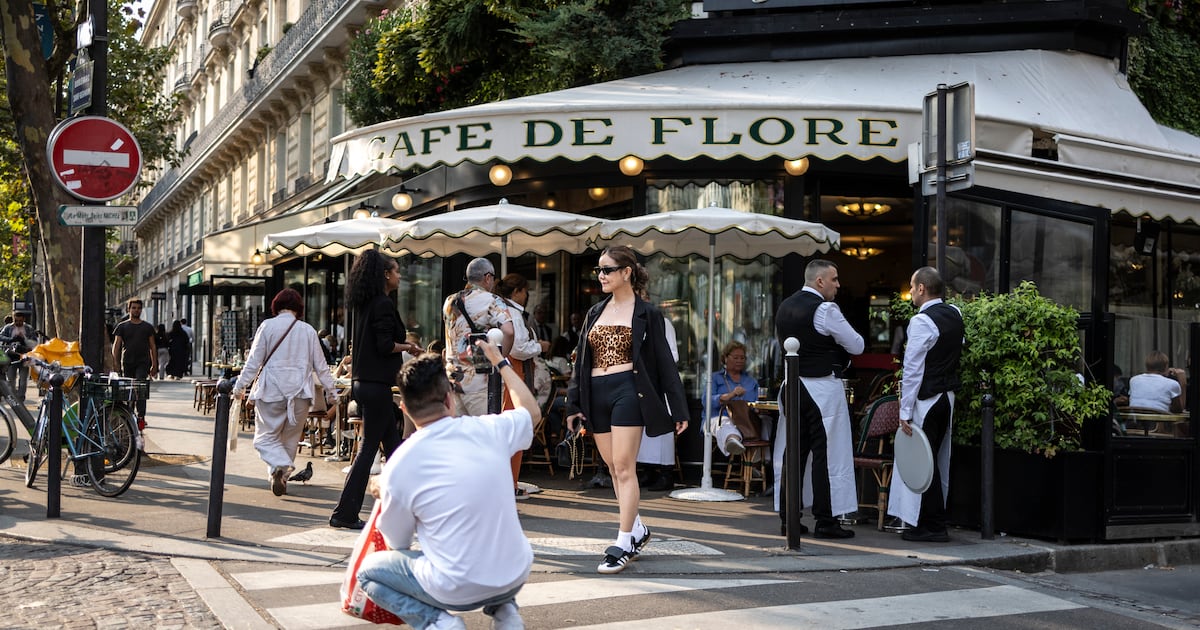
The young woman pushed her hand against the large Parisian front door as though to open it and posed for a photo, capturing her moment in the world of Emily in Paris. Then reality hit, as an elderly resident leaving the building opened the door from within and paused confused, the tourists peering in at him.
The tourists were among the crowds who gather daily at sites made famous as filming locations in the hit Netflix series, which a recent study found was by far the most popular inspiration for tourists visiting Paris.
The apartment and workplace of eponymous main character Emily Cooper, a young American sent to live in Paris for work, are marked on Google Maps as though they are real places (“a little dream come true”, a recent reviewer wrote).
A small industry of Emily in Paris-themed tours brings fans to the sites, many in eye-catching outfits and colourful berets to create the perfect picture to share on social media.
Naomi O’Leary looks at the popularity of Netflix’s Emily in Paris, and the differing views it has caused in France’s capital. Video: Naomi O’Leary
The phenomenon has divided Paris: a boon for local businesses, but an aggravation to some residents and a symbol of how tourism is pushing up prices for locals.
Unprintable anti-Emily graffiti was recently scrawled across the shutters of a shop on the square, and the words “Emily not welcome” written on the wall of her apartment building.
“The intrusion, the selfies, this Instagram carry on … these attitudes can be extremely disrespectful and deeply offend the locals,” said Monika Siejka, an academic and lecturer at Paris-Saclay University.
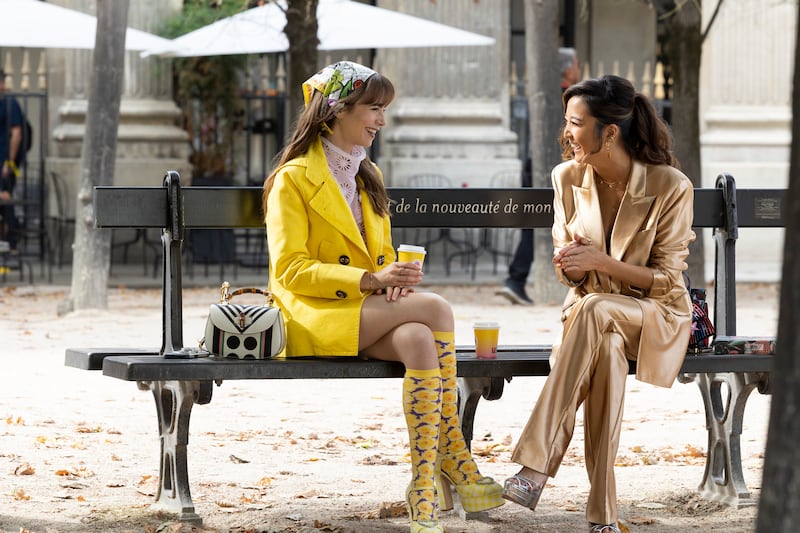 Lily Collins as Emily and Ashley Park as Mindy in Emily in Paris. Photograph: Marie Etchegoyen/Netflix
The tourists who “invade neighbourhoods not designed to handle this mass tourism, who stop to take countless selfies, who wear berets – it can be felt as a real intrusion in many neighbourhoods,” she said.
“It’s not just Emily in Paris that’s associated with this – but the ‘Emily in Paris effect’ is very real.”
A 2024 study of tourists by France’s national Centre of Cinematography found that 80 per cent had been inspired to visit by viewing films or series filmed in the city.
Among them is a hard core: for one in 10, their main reason for visiting was a series or film they had seen, and among those Emily in Paris was the most cited inspiration by far.
Standing on the picturesque square in the 5th arrondissement where Emily lives in the series was Bethany Brown, who had been surprised by her husband on Christmas day with a puzzle that came together to reveal the words “Beth in Paris”.
“I think everybody thinks – I certainly think – god, that would be such a fun life to live,” said Brown (44), an interior designer. Inspired by the series, the couple travelled on the Eurostar from Britain and had just completed an Emily in Paris-themed tour.
“I didn’t think it would be that popular, but at every spot we stopped at people were taking photos,” Brown said.
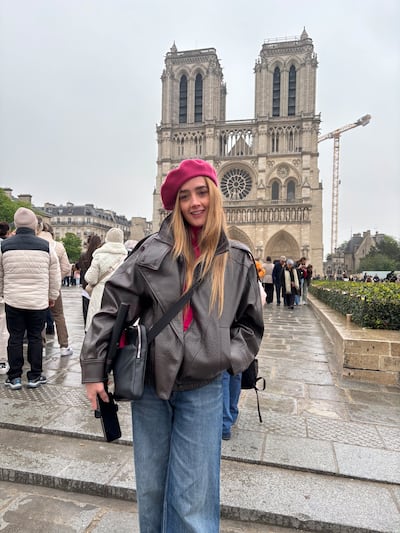 Denisse Favela bought her beret on a visit to Spain as a practical hat but felt it was apt to wear it for her Paris trip. Photograph: Naomi O’Leary
Denisse Favela (36), the operator of a dress rental boutique in Mexico, was wearing a pink beret with matching lipstick.
“I do identify with her. It’s every girl’s dream to live in Paris…to look like her,” Favela said enthusiastically. “It might not be realistic for everybody, to look that fashionable every day of your life, but it does give you an inspiration.”
Businesses featured in the show are now mobbed. The boulangerie frequented by Emily in the series is besieged at all hours, and has embraced the development by adopting Emily-themed paper bags for their croissants and sandwiches.
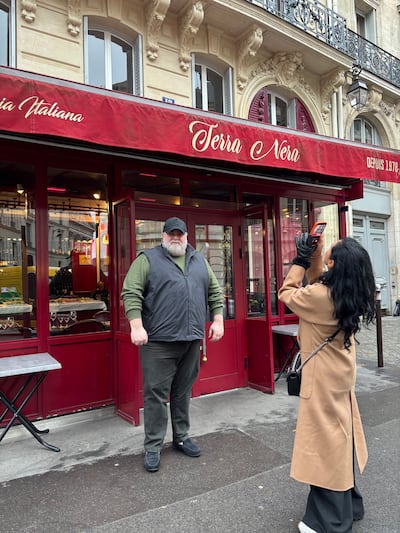 Valerio Abate, owner of a restaurant made famous by its appearance in the series Emily in Paris, stands outside as a tourist takes a photograph. Photograph: Naomi O’Leary
The restaurant next door features in the show as the workplace of Emily’s love interest, Gabriel. In reality it is an Italian joint operated by Sicilian Valerio Abate, a cinema enthusiast who adores the crowds.
“Thank you to Netflix,” he said as yet another tourist held up her phone to take a photo of the restaurant. “Sometimes they ask if Gabriel is here. In general they’re joking. Maybe some really believe it,” Abate said. “Sometimes cinema and reality can get mixed up.”
The first series of Emily in Paris was launched in 2020 and it became an escapist pandemic-era hit. When restrictions gave way to a post-Covid tourism boom, the crowds returned to Paris wearing berets.
Hat sellers have noticed an uptick in sales of the traditional hat, which is worn by Emily in several episodes as part of her overtly colourful outfits.
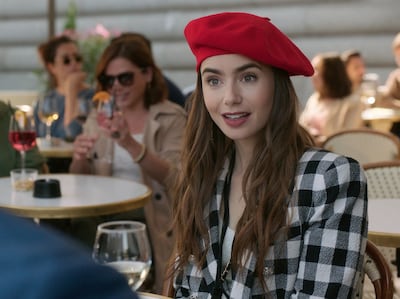 A beret is worn by Emily as part of her overtly colourful outfits in the series
While berets have long been sold in France as souvenirs, some sellers are emphatic that they have been re-popularised among foreigners by Emily.
“I think the tourists are doing it more. I think they want to take a photo with the beret in the spirit of Emily in Paris,” said Johanna Pinto, who makes and sells berets and other hats in her Odèle Paris boutique.
She has noted an increase in beret sales to foreigners and attributes it to the series.
“I don’t see it negatively,” Pinto said. “I think it’s cute and nice that a series inspires people to come.”
Traditionally associated with the Basque Country of southern France and northern Spain before becoming a symbol of Parisian bohemianism, the berets are now marketed online by many companies as “Emily” hats.
Groups of tourists in colour-co-ordinated berets now swamp the pavements of Paris, and any busy tourist spot in the city will be peppered with the hats.
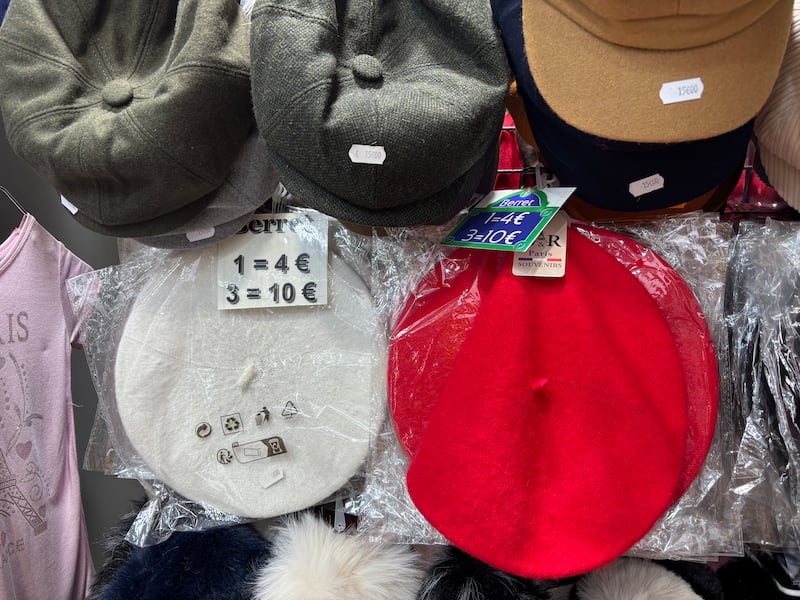 Hat sellers in Paris credit a rise in sales of the traditional beret to the Emily in Paris series. Photograph: Naomi O’Leary
Not all of those wearing berets link their choice of headgear to Emily in Paris, with some saying they had been inspired by images on Instagram.
Analysts see the phenomenon as part of a broader trend in tourism of visitors seeking to recreate viral images from social media. The volatile currency of virality can have unpredictable, distorting effects, causing long queues to form outside apparently innocuous cafes while an equally good place next door stands empty.
Things that were once part of ordinary life in Paris, such as shopping at a fruit and vegetable market, have become commodified for tourists.
“I know people who used to shop in their local market, but that’s become too expensive,” said Hannah Thompson, a French literature professor at Royal Holloway University of London.
In parts of Paris, pains au chocolat pastries can be found for sale for the scandalous price of €6: a three-fold increase or more on the price locals might expect.
“If shops and restaurants sense they can charge more to tourists, they’re going to do that, and that’s going to push up prices for the locals,” Thompson said.
Emily in Paris has become a shorthand in Paris to refer to such issues.
In the recent campaign to elect a Paris mayor, the series was referenced as a byword for out of touch privilege and inequality.
“Rachida Dati wants Paris to be like an episode of Emily in Paris,” the socialist Emmanuel Grégoire said in a broadside against his main right-wing opponent in his final campaign speech.
“But that’s not the reality of our city. That’s not its history … we don’t want that cardboard city.” He was elected mayor.
Thompson, the professor, notes that one telltale sign that Emily in Paris is an American view of the city is that the characters in it constantly take taxis rather than public transport.
“It’s got this look, which is so out of out of step with the day-to-day reality of living in Paris, precisely because of its lack of acknowledgment of the housing crisis, economic tensions, homelessness, violence, just the everyday pressures of work and existence,” Thompson said.
“But then again, it’s not a documentary is it? It’s supposed to be escapist fiction. It’s just important that people realise this is not Paris.”
Lou, a native Parisian, lives something akin to a real version of Emily’s life. She is in her 20s and works in marketing in the city.
“I think a lot of people came to Paris thinking that was how life worked and it’s not like that at all. You can’t just go to Paris and expect to live in a Hausmannian building,” Lou said. “It’s a cut-throat world.”
The apartment depicted in the series was far too generously sized for someone working in Emily’s job, she said.
“Her ‘chambre de bonne’,” a traditional maid’s quarters on the attic floor, “would be 6m² with a tap on the wall and a shared toilet outside.”
Outside the famous apartment stood Chelle, who had travelled from the United States with her daughter to show her the city where she once studied as an exchange student.
Why does the series have such appeal?
“Things are really heavy right now in the world, right?” Chelle said. “It’s just such a breath of fresh air. It’s very colourful, and it’s sort of like an escape.”
And not just for foreigners. When the fifth season of Emily in Paris was released in December, it immediately went to number two in the Netflix top 10 charts in France.
The French-dubbed version features an Emily who, unlike in the original, speaks French to the other characters, albeit with a heavy US accent.
“Let’s be honest, it’s a very successful series in France too,” said Siejka, the Paris-based academic. “It’s a bit of a guilty pleasure we don’t admit to.”