
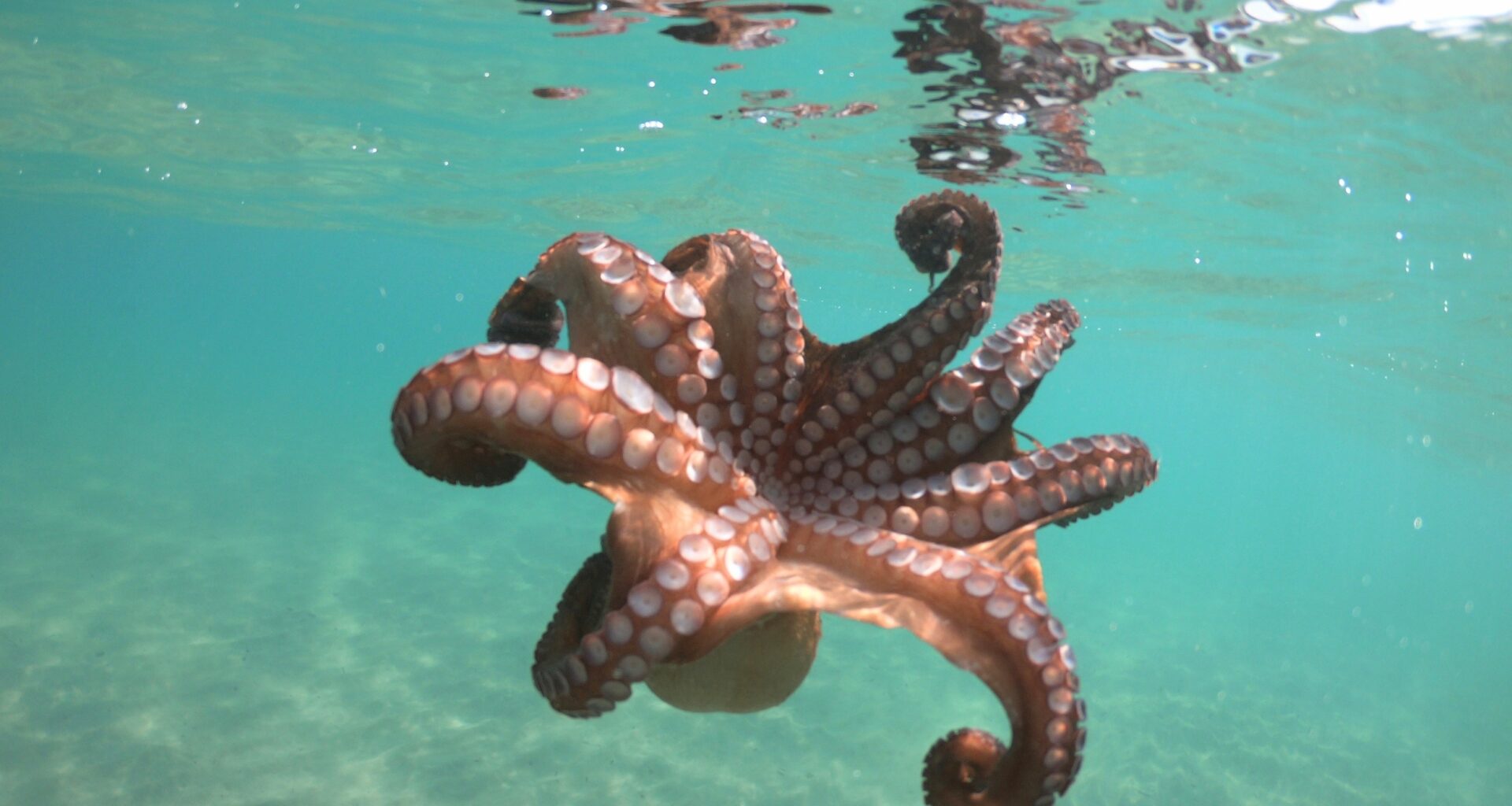
What if love could happen without even seeing each other? In the mysterious world under the ocean, octopuses show that connection can go far beyond sight.
A new study by Harvard biologists reveals a surprising and almost romantic story about how these creatures find their mates using touch and taste combined.
Octopuses find mates without seeing

Octopuses live mostly alone and meet others only when it is time to reproduce. This makes finding the right partner difficult.
Yet nature has given them a clever solution. Instead of depending on vision, octopuses use a special system called “taste by touch.” This system helps them sense chemicals through their arms.
Even in darkness or behind barriers, a male octopus can locate a female and begin mating. This discovery shows how powerful and unique their sensory world is.
A special arm with an important role
Male octopuses have eight arms, but one arm stands out. This arm, called the hectocotylus, plays a key role in reproduction.
It moves toward the female’s body and delivers a packet of sperm. Scientists have known about this arm for a long time, even since the time of Aristotle.
However, its ability to sense and recognize a mate remained a mystery until now. This new study reveals that the arm is not just for delivery but also for detection.
“The specialized arm for mating had been documented long ago, but it wasn’t known that it’s also a sensory organ,” said Professor Nicholas Bellono, senior author of the new paper.
“This is the mechanism by which the octopuses recognize their mates and facilitate fertilization.”
Arms that can think and feel
Octopus arms are not simple limbs. Each arm acts almost like a brain of its own. A single suction cup holds thousands of sensory cells.
In fact, most neurons in an octopus exist in its arms instead of its brain. This allows each arm to explore, sense, and react independently.
Researchers have described these arms as muscular tongues that taste the environment. This unique setup helps octopuses survive and now, as shown, helps them find partners too.
Mystery of the mating arm
The discovery began by accident in the lab at Harvard. Researcher Pablo Villar noticed something unusual while studying octopus receptors.
The special mating arm had sensors similar to the ones found in other arms. This was surprising because males do not use this arm for exploring or feeding.
Instead, they keep it curled close to the body. This observation led scientists to study how this arm works during mating.
“That was surprising, because the males generally don’t use the hectocotylus for exploring or finding food,” said Villar, lead author of the study. “They keep it close to their body, coiled up, and don’t really use it for sampling the sea floor.”
Mating through barriers and darkness
To test their ideas, scientists observed California two-spot octopuses in tanks. They placed males and females on opposite sides of a barrier with small openings.
Even without seeing each other, a male could reach through the opening, locate the female, and begin mating.
Sometimes both animals stayed still for over an hour during this process. This showed that sight was not needed at all.
“They mated through the divider,” said Villar. “For us, that was the simplest and most clear demonstration that they can recognize each other just using chemosensation and mate with no full body contact.”
Role of hormones in attraction
The study also revealed the importance of hormones. Female octopuses release a hormone called progesterone. This hormone acts like a signal that attracts males.
When scientists exposed a detached arm to progesterone, the arm still reacted strongly. This showed that the arm could sense the hormone even when separated from the body.
In another test, males tried to mate with tubes coated in progesterone, thinking it was a female.
Evolution and the science of species
Scientists from Harvard, the University of California San Diego, and research groups in Okinawa and Sweden worked together on this study.
They found that special receptors in the arm respond to progesterone. These receptors have evolved over time, helping octopuses identify the correct partner from the same species.
This process supports what Charles Darwin once described about how species change and grow different over time. Small differences in sensing can lead to big changes in evolution.
A deeper lesson from the ocean
The research shows more than just how octopuses mate. It highlights how nature finds creative solutions to challenges. It also reminds scientists to stay curious and open minded.
“There’s also a philosophical point about how one does science,” added Bellono.
“Support and emphasis to be open-minded and follow what diverse biology shows us is actively being deterred.
“But this study shows that approach can produce something very fundamental – not only about octopuses mating, but also about the origin of species, which is like THE biological question.”
The study is published in the journal Science.
—–
Like what you read? Subscribe to our newsletter for engaging articles, exclusive content, and the latest updates.
Check us out on EarthSnap, a free app brought to you by Eric Ralls and Earth.com.
—–