
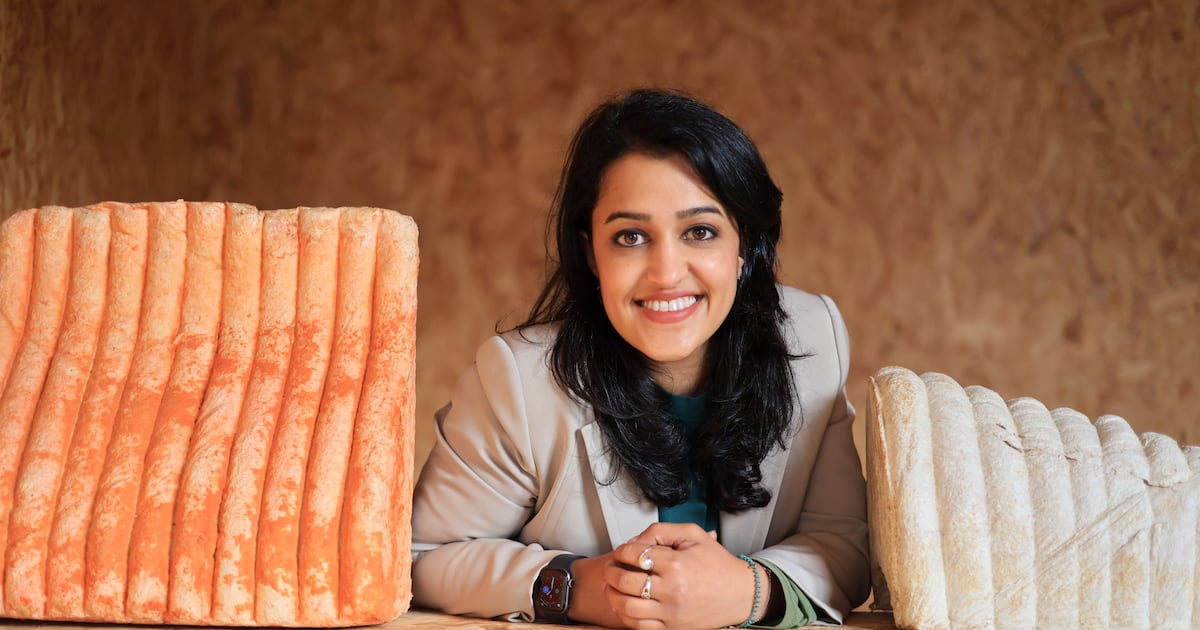
At her workshop in Co Cork, Lavanya Bhandari is growing the future of packaging. Using mycelium – a fungal material that feeds on farm waste – she grows small containers in just a few days. Once formed, the lightweight and durable material protects items in transit and, after use, decomposes naturally, returning nutrients to the soil.
Mycelium is the living network of thread-like filaments that make up the main body of a fungus. If the mushroom is the fruiting body, the apple on the tree, then mycelium is the tree itself: unseen, yet essential to life above. It forms a vast web that weaves through soil, wood, and leaf litter, releasing enzymes that break down organic matter.
Sometimes it is microscopic, forming colonies too small to see, and sometimes it stretches across thousands of acres, making it one of the largest living organisms on Earth. Although it now thrives beneath forests, mycelium predates them by hundreds of millions of years. It is older than trees, flowers, and the first land animals, shaping the planet’s ecosystems long before modern life evolved.
Mycelium is now at the cutting edge of sustainable design, part of what’s being called the “shroom boom”. Big companies such as Dell began using mycelium packaging in 2011 to ship servers, while Ikea has set an ambitious target of phasing out plastic from all consumer packaging by 2028, which includes the use of mycelium to replace styrofoam.
The stakes are high: more than 400 million tonnes of plastic are produced globally each year, while less than 10 per cent is recycled. Paper and cardboard are produced in similar volumes and, while recycling rates are higher, much is still shipped abroad for processing. Amid this waste crisis, mycelium offers a locally grown alternative.
It feeds on agricultural byproducts such as brewery grain, hemp and sawdust, growing into custom moulds to form strong, biodegradable packaging. Once fully formed, the material is heated to stop growth and to harden, “so you’re not going to get mushrooms growing out of your packaging”, explains Bhandari. The beauty is in the versatility: by experimenting with different species and food sources, mycelium can be tailored for furniture, lamps, insulation panels, shoes and even experimental buildings.
Operating from an 750sq m facility in Cork’s Marina Commercial Park, Bhandari’s company Ecoroots has come a long way from her first experiments in her sister’s London home, where she grew prototypes under couches and in the bathroom. Made from brewery and distillery spent grain – which Bhandari estimates at 200,000 tonnes produced annually in Ireland – the packaging is water-resistant for up to four weeks, fire-resistant, and biodegrades within three months when exposed to moisture and microbes. Production generates 90 per cent less CO2 than conventional polystyrene.
While initially comparable in price to conventional packaging, Bhandari says costs will decrease with automation and scale, and businesses save money by needing fewer materials overall: mycelium’s strength eliminates the need for additional bubble wrap or loose fill.
“With any new product, there are going to be natural blemishes,” says Bhandari. “It’s about understanding that nature has its beauty in its colours and variations. As we lean into this natural curve, we need consumers to embrace it rather than expecting beautiful, crisp, pure white, bleached packaging.”
Bhandari’s long-term ambition is pharmaceutical cold-chain packaging – a major Cork industry. “Pharmaceutical companies are one of the biggest users of cold chain packaging. That’s the market that needs to be disrupted. It’s going to take five to 10 years, but we’re focusing on enhancing mycelium’s properties to attack that very big market down the line.”
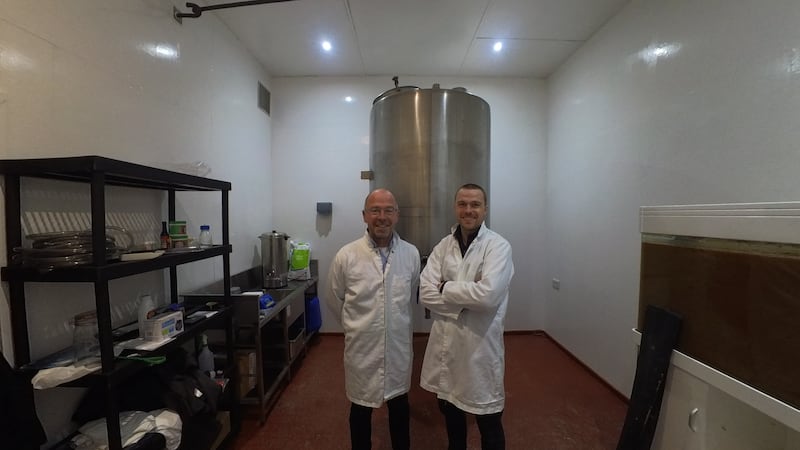 Brendan and Pierce Cleary of Ethica Planet, which is based in Co Offaly
Meanwhile, Ethica Planet, based in Co Offaly, represents a different kind of transition story. The Midlands has been heavily dependent on peat extraction and carbon-intensive industries, which are being phased out as Ireland decarbonises. Supported by the EU Just Transition framework, Brendan Cleary, son of Glenisk founder Jack Cleary, is building a new industry literally from the ashes of his previous venture.
Cleary had been running Ethica Foods, developing fermented oat-based yoghurt alternatives, when, in 2021, a fire at the Glenisk facility destroyed his operation overnight. Rather than rebuild the same business, he pivoted to an idea he’d been developing since 2020: using mycelium to process waste materials. He launched Ethica Planet after the fire with his son Pierce, a botanist, as the company’s first employee. The company now has four employees, including a microbiologist and designer.
[ Buy, eat, bin, repeat – we are locked in a never-ending flow of wasteOpens in new window ]
“Ireland is swimming in a sea of cardboard,” says Cleary. The company shreds this waste and feeds it to mycelium as a growth substrate, turning discarded cardboard into new mycelium-based packaging.
“If you make a genuine effort at home to recycle, the amount of plastic in your utility room – it’s just scary,” says Cleary. “That mountain keeps getting bigger and somebody has to say stop. The only way you can say stop is if you have an alternative, and that’s what we’re working on.”
Early trials suggest the approach could be transformative: conventional cardboard can only be recycled seven times, but Cleary says their mycelium keeps fibres strong enough for multiple additional cycles, potentially tripling conventional cardboard’s lifespan. He emphasises the need to be cost-competitive, noting that the carbon-negative process and lean production will help match conventional packaging prices.
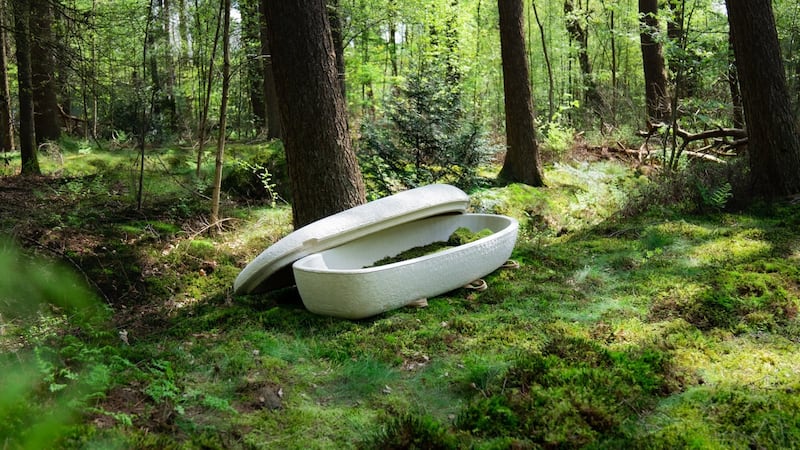 The Loop Living Cocoon, a coffin developed by Dutch inventor Bob Hendrikx and his firm Loop Biotech
The same properties that make mycelium ideal for packaging – strength, lightness, and biodegradability – are inspiring uses elsewhere. Mycelium is being tested in surfboards, where surfers have few alternatives to boards made from polyurethane, epoxy resin and polyester, materials that take hundreds of years to decompose.
Twenty-five-year-old Steve Davies from Porthcawl in south Wales is pioneering mycelium boards using horse bedding and straw from his family farm, experimenting with protective coatings such as beeswax, linseed oil and plant-based resin. The project is evolving, with durability and scalability remaining key challenges, but Davies believes mycelium boards could eventually compete at a professional level.
[ Dutch coffins return corpses to nature in a fraction of the timeOpens in new window ]
Perhaps the most unexpected application is coffins. The Loop Living Cocoon, developed by Dutch inventor Bob Hendrikx and his company Loop Biotech, is a sleek, pod-like coffin grown in just seven days from mycelium feeding on hemp fibre. Hendrikx, whose design-forward approach has earned him a Ted talk and Vice magazine’s Human of the Year 2020, represents a new style of funeral innovation.
Traditional burials often rely on non-biodegradable coffins with plastic linings and embalming chemicals such as formaldehyde, which can linger in the soil and leach into water. By contrast, Loop Biotech claims that the coffin decomposes in roughly 45 days, while the mycelium actively aids body decomposition over two to three years, helping to neutralise toxins such as metals and microplastics. Lined with moss, the coffins are available for shipping to Ireland.