

Nvidia just revealed DLSS 5 at GTC 2026, and, well, to put it lightly, the internet hasn’t taken kindly to it, including yours truly. For once, however, the skepticism feels justified. What was shown off as a bold leap forward instead landed somewhere between a weird tech demo and a proof-of-concept filter pass, dripping in generative AI flair.
DLSS has historically been a technology suite that has stood for practical gains. It has given us better performance, cleaner image quality, and smarter rendering, and by all means, it’s done a fantastic job at all that… so far. DLSS 5, however, feels like a sharp, downright confusing pivot, and I’m not buying it.
Related
DLSS 5 is further proof that rasterization’s days are numbered
For better or worse, rasterization continues to be buried, and it won’t be long until games are unrecognizable
DLSS 5 feels like a detour instead of a progression
The trajectory felt clear up until now
Credit: Nvidia
If you’ve followed DLSS from its early, artifact-ridden beginnings to the remarkably polished state it reached with DLSS 4.5 earlier this year, the trajectory has always been clear. It has given us better performance along with better image quality, working hand in hand. That balance was the entire point, after all. In fact, DLSS 4.5 genuinely felt like the culmination of years of iteration, with its remarkable reconstruction, fewer artifacts, and fantastic temporal stability. It firmly reminded us all why DLSS mattered in the first place, and why Nvidia’s upscaler has always been head and shoulders above the competition’s.
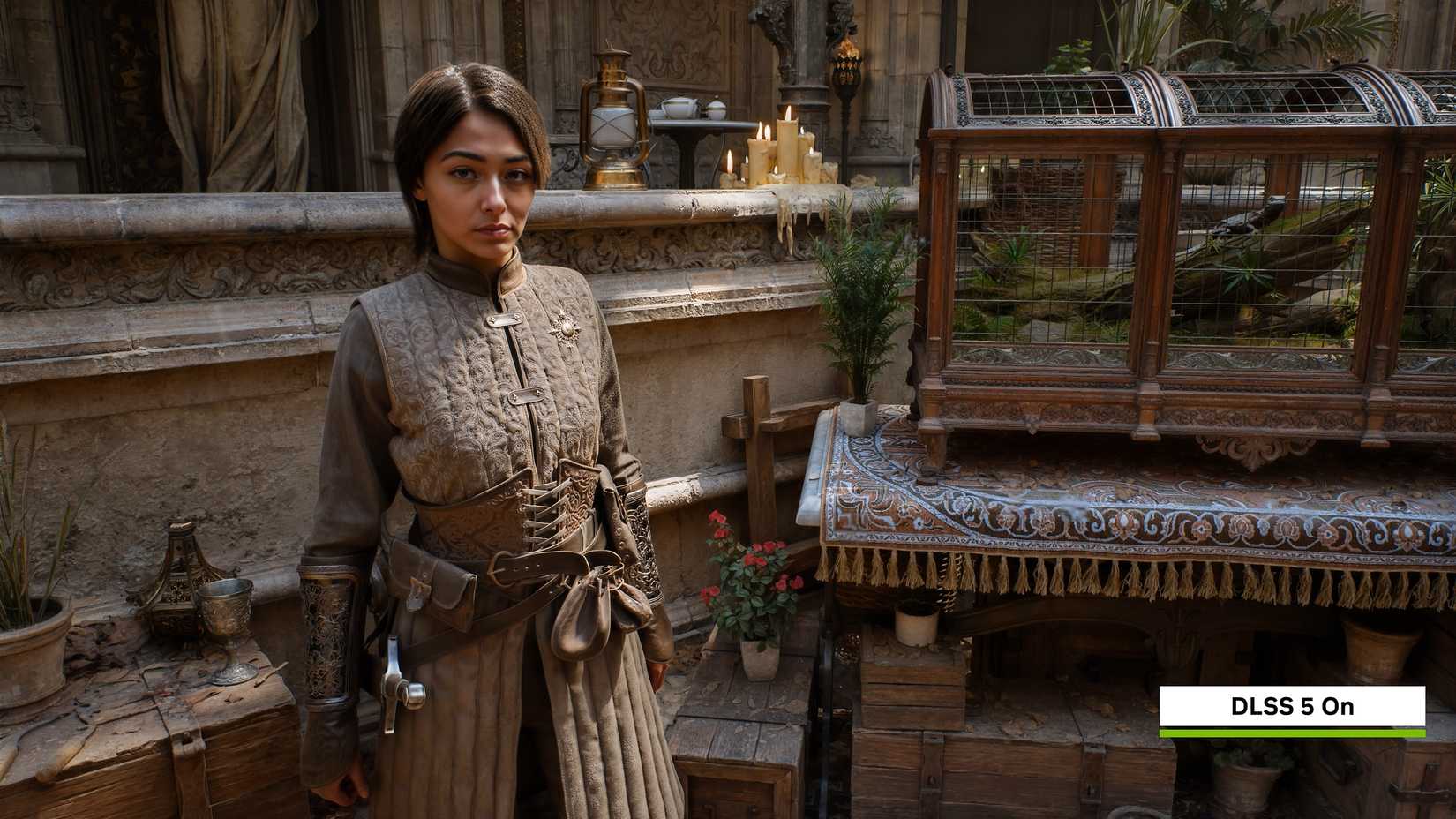
And then, DLSS 5 just showed up, and veered off in a completely different direction. Instead of refining the core philosophy of the upscaler with better performance, Nvidia seems to have pivoted towards a generative AI visual layer. It’s a filter-esque system that alters the image rather than reconstructing it. First, it doesn’t feel like the next step in DLSS’ evolution at all, and more importantly, it feels like an entirely different experiment, only in DLSS branding. This disconnect has been nothing short of jarring, and I’m not saying so because it’s new, but because it genuinely seems to ignore everything that made DLSS worth caring about in the first place.
If it doesn’t boost performance, why call it DLSS?
A generative AI filter with an identity crisis
DLSS has always stood for “Super Sampling.” The name itself connotes upscaling, reconstruction, and improvements in performance efficiency. DLSS 5, on the other hand, seems to do none of that. There’s no meaningful upscaling in the traditional sense at all here. There’s no frame rate uplift, either, because if DLSS 5 improved frame rates even by a fractional margin, Nvidia would have been screaming that from the rooftops. The claim of “improved image quality” is still here, but in this case, it’s highly debatable at best. What DLSS 5 does introduce, however, is a kind of generative AI pass that overlays a distinct, uncanny aesthetic over everything, and that uncanny valley is not a good place to be.
There’s a very specific “AI-generated” look here — the kind you’d associate with ComfyUI outputs or over-processed diffusion models. With DLSS 5 on, textures feel over-smoothed, lighting gets exaggerated, character models become absolutely unrecognizable, and the entire scene on the screen starts to lose its grounding in the original render, giving way to a final result that feels as wrong as it feels artificial. So, if this isn’t about super sampling or performance, then why is it being positioned as DLSS at all?
Related
Lossless Scaling is what I wanted DLSS to be
DLSS may be more polished, but Lossless Scaling is what it should have evolved into
Two RTX 5090s, and still struggling
DLSS seems to be forgetting its own mission statement
I’ve said it before, and I’ll say it again: DLSS has always been about democratization. It allowed mid-range GPUs to punch above their weight, enabling higher resolutions, better lighting, and smoother frame rates without brute-forcing performance. That accessibility was the entire point, and that’s why we’ve all lauded Nvidia for bringing DLSS 4.5’s latest improvements to their 6-year-old GPUs as well. However, the new kid on the block, DLSS 5, flips this entire idea on its head.
The current tech demo reportedly requires two RTX 5090s to run, which is almost absurd when you consider just what DLSS was built for in the first place. Sure, it’s early stages right now, but DLSS 5 is supposed to be hitting our PCs in an update scheduled for Fall 2026. That does give Nvidia plenty of time to ensure that the tech becomes more efficient, but right now, even with the absolute highest tier of hardware available for consumers, it’s struggling.
Slow the demo down, and the cracks become instantaneously visible. You immediately understand why the demo mostly has people standing around instead of showing real gameplay, since you can see temporal inconsistencies, flickering details, and terrible ghosting artifacts that are the exact opposite of the progress DLSS has made over the years. So far, DLSS has always hidden its imperfections behind intelligent reconstruction, but DLSS 5 puts them front and center, and all it takes to clearly see it are the two seconds of DLSS 5’s FC 25 demo where you can see at least three soccer balls on the screen at the same time. So, since DLSS 5 abandons performance gains, demands extreme hardware (so far), and still can’t maintain stability, you’d be forgiven for not being able to tell what problem this is actually solving.

Related
Native 4K still isn’t worth it, even if you have an RTX 5090
Native 1440p or DLSS 4K still makes more sense
It does one thing right, at least
DLSS 5’s improvements aren’t enough to hide its real cost

Credit: Nvidia
To be fair, DLSS 5 does something interesting with lighting. While it makes every single character model in a bevy of games stick out like sore thumbs, it does make global illumination look richer. With DLSS 5 on, scenes certainly look more dynamic, and materials react in ways that almost feel like they’re from a generation ahead. That improvement, however, comes with a trade-off that’s much harder to ignore — overriding intent.
Game visuals are never just about technical fidelity, and they are always about art direction. That includes carefully chosen color palettes, deliberate lighting setups, and handcrafted textures, which all come together to create a specific mood that stays with you years after the credits roll. DLSS 5’s generative AI-backed approach risks flattening that individuality into something more generic, and ultimately less handmade.
The problem here is that we’ve already seen developers lean on DLSS to compensate for poor optimization. DLSS, at its core, is there to benefit gamers, and yet, there’s no denying that it has become a safety net and a crutch for a lot of developers who skip real optimization. DLSS 5, then, opens the door for that same mindset to extend into visual design itself, where lighting, materials, and even stylistic choices could be offloaded to AI systems instead of being crafted intentionally. Boy is that a slippery slope if there ever was one.
Related
Nvidia’s 6x frame generation proves that we’ve reached the hardware ceiling for GPUs
There’s only so much VRAM to go around.
This is about innovation forgetting its purpose
DLSS 5 doesn’t seem to be solving real problems for real players like DLSS always has since day one.
DLSS became almost essential for over 80% of Nvidia’s RTX user base because it was useful, and it proved its worth. Since day one, it has been solving real problems for real players, and it has done so by respecting both performance and visual integrity.
On the other hand, DLSS 5 seems to be chasing something else entirely. I have no doubt in my mind that there is potential here, but without direction. And with no direction, potential can only muddy the waters instead of moving the needle.