
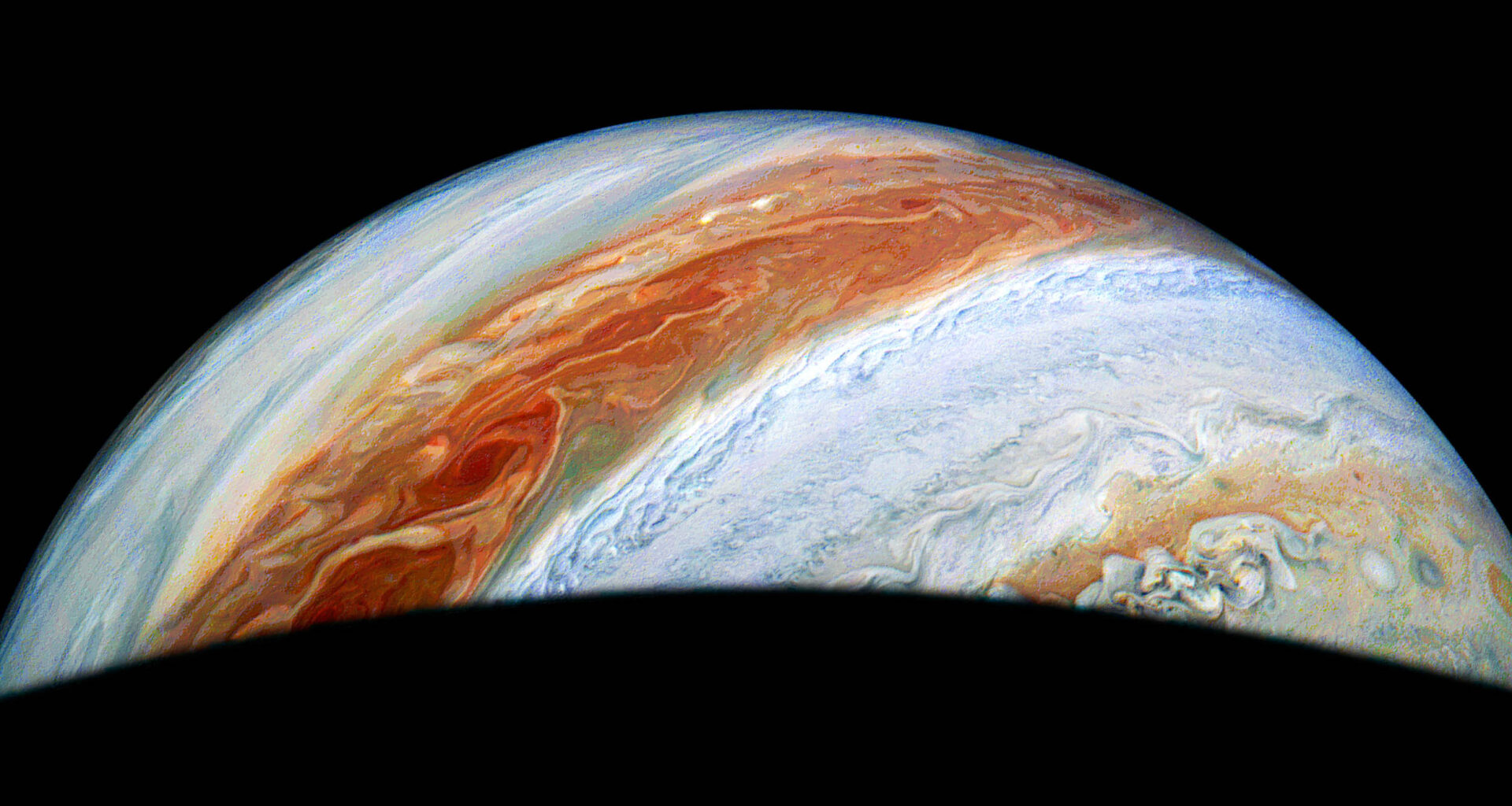
Researchers have revealed that Jupiter’s upper atmosphere maintains a stable, planet-wide structure that has persisted over multiple years.
That finding replaces decades of apparent variability with a fixed pattern shaped by enduring physical forces.
Across the planet

Across Jupiter’s sunlit hemisphere, the newly assembled global map shows temperatures and charged gas arranged in consistent, repeating structures.
Working through an extensive set of observations, Kate Roberts at Boston University (BU) documented this pattern directly in the planet’s upper atmosphere rather than inferring it from isolated snapshots.
Those observations confirm that temperatures fall smoothly from the poles toward the equator while bright and dim regions remain anchored in place.
This stability establishes a fixed baseline for interpreting how heat and charged particles move across the planet, setting up the mechanisms that drive those patterns.
Heat from poles
Across nearly every longitude, warmth thinned out from the poles to lower latitudes instead of forming random hot spots.
The team calculated a global mean near 833 Kelvin, about 1,040 degrees Fahrenheit, with equatorial values near 754 Kelvin, about 900 degrees Fahrenheit.
That pattern matches a planet heated mainly near its poles, where auroras dump energy into thin gas before winds spread it.
Because the gradient barely changed from 2022 through 2025, and equatorial swings stayed under 10 percent, brief heating bursts now look uncommon.
Shapes that stayed
Another surprise came from oddly shaped dark lanes and bright knots first noticed more than 25 years ago.
The new maps showed those features had persisted for decades, which ruled out fleeting weather as their main cause.
Instead, the stubborn pattern tracked changes in charged-particle density, not temperature, across places tied closely to Jupiter’s magnetic field.
That result solves a long-running argument and points attention toward the forces moving charged material up and down.
Why the air glows
At the center of the maps sits H3+, a charged form of hydrogen that shines in infrared light.
That glow let researchers separate heat from density, which is why the old mysterious streaks finally made sense.
In that ionosphere, an electrically charged atmospheric layer, denser patches shine more strongly even when temperatures hardly move.
So the planet was not hiding a second temperature map but revealing where charged gas had piled up or thinned out.
Winds steer ions
Planet-wide winds drive vertical motion that lifts or sinks charged gas along magnetic lines over wide regions.
Where upward drift carries plasma, electrically charged gas, away from the main H3+ layer, fewer electrons remain to destroy it.
Downward drift can push electrons into other heights instead, changing how much H3+ survives and altering the brightness pattern.
That mechanism gives Jupiter a coherent upper atmosphere without requiring every bright patch to come from a new heat source.
Energy still leaks
Jupiter did not only trap heat in the maps but also dumped enormous energy back into space as infrared light.
From the mapped glow, the team estimated a noontime loss of 25.8 trillion watts across the planet.
More than half of that loss came from lower latitudes, not the bright auroral rings that usually steal attention.
That imbalance means any explanation for Jupiter’s heat has to work well beyond the poles, across much calmer territory.
Storms and exceptions
One famous suspect, the Great Red Spot, had already been tied to a hotspot high above the storm.
Six nights in the new dataset covered that region, yet deeper air muddied the signal and no clear lasting spike reappeared.
That leaves room for short-lived wave heating, but it no longer looks like the main explanation for global temperatures.
With a steadier baseline now in hand, future bursts from storms or the solar wind should stand out faster.
Beyond one planet
The result reaches past Jupiter because giant planets share the same basic problem of staying hotter than sunlight alone predicts.
A 2024 interview with Roberts linked the Jupiter work to the wider problem of understanding other atmospheres.
“Understanding upper atmospheres as a whole will help us understand Earth,” said Roberts.
That perspective matters for worlds across the solar system and perhaps beyond it, where hot upper air shapes atmospheric escape.
What changes now
A stable map also changes how astronomers can study Jupiter because departures from the pattern now carry more information.
An unusual hot spot, a warped density band, or a sudden polar flare can be tested against this new benchmark.
“The goal of my research is to try and narrow down where all this extra energy is coming from,” Roberts said.
That turns the map from a snapshot into a tool for catching the rare moments when Jupiter breaks pattern.
The bigger picture
Jupiter’s upper atmosphere now looks less like a jumble of surprises and more like a system with durable large-scale rules.
Those rules still leave room for brief shocks and local waves, but they finally give astronomers a clear framework for testing them.
The study is published in The Astrophysical Journal Letters.
—–
Like what you read? Subscribe to our newsletter for engaging articles, exclusive content, and the latest updates.
Check us out on EarthSnap, a free app brought to you by Eric Ralls and Earth.com.
—–