
There is a particular smell that belongs only to Sunday mornings. It drifts through the hallway and up the stairs some time after midday, warm and fatty and deeply reassuring – the smell of a joint in the oven, of something good coming.
For generations of Irish families, it was as reliable a fixture of the weekend as the Angelus bell or the Sunday papers spread across the kitchen table.
But in many homes this Easter Sunday that smell was absent. In its place a chicken pie, perhaps, or grilled salmon – something, anything, that didn’t require spending €30 on a leg of lamb that has quietly become a luxury item.
Saskia Edwards knows exactly when that shift happened. She and her husband Eoghan live with their two children, Rian, 10, and nine-year-old Isla, just outside Wexford town – far enough from Dublin that life is manageable, close enough that they know how much worse it could be.
Owen works in accounts, Saskia works part-time from home in administration. Together, they bring in just over €5,000 a month – two salaries and child benefit – and they know, almost to the cent, where every euro goes.
About a year ago, Saskia started a YouTube channel, OurIrishLife, posting grocery hauls and honest meal plans to show what feeding a family in Ireland actually costs. The videos began as a hobby but quickly became something else – a gathering point for hundreds of parents who recognised their own weekly struggle in hers.
It is a struggle rooted, for Saskia, in something much older than a cost-of-living crisis. Ask her about Sunday dinners and she goes straight back to her grandmother’s table.
‘It was a really big deal,’ she says, her voice warm with memory. ‘You had your two different potatoes – roasties with that crunchy edge, and creamy mash. Veg all perfectly cooked. The stuffing… sometimes beef, sometimes lamb, and chicken only every now and then. My gran would make multiple stuffings – one was a lovely moist one, and then she’d do another that she’d fry in the pan so it came out all crunchy. I can’t even imagine how long that must have taken.
‘But she did it for us, to bring us all together. There was something really special about it. Just being together, sharing all of that food.’
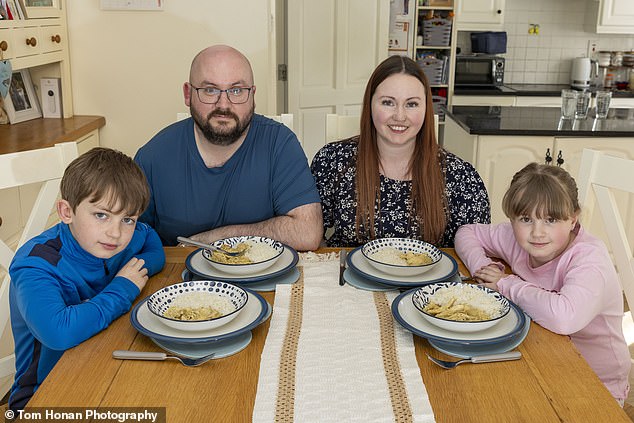
Easter’s new look: Rian, Eoghan, Saskia and Isla Edwards prepare to enjoy a curry
Now, it’s rarely beef or lamb any more. The weekly shop that once came in comfortably under €100 has quietly but relentlessly edged up, now creeping toward €150 – even with the trolley stripped bare.
‘Especially this last year, you really notice it,’ she says, shaking her head. ‘Meat prices have just shot up. Even mince – something that used to be completely doable – it’s crazy now. You almost don’t recognise the numbers when you see them at the till.’
She is far from alone. CSO figures show beef and veal up 22.4 per cent in the year to December 2025, lamb up 18.9 per cent. These are not gentle increases – they are the kind that reshape what a family can realistically put on the table. Irish farmers are being paid more for their animals. That money is coming from somewhere – and increasingly, it is coming from the weekly shop.
Shoppers have been complaining for months that their bills bear no resemblance to what they paid just a few years ago, and Dáil debates confirm that many families are spending up to €3,000 more per year on groceries compared with 2021. Fact-checkers note that this figure tends to reflect higher-spending or larger households, but whether the true increase is €2,000 or €3,000, the direction is unmistakable.
For most families, the result is the same. The Sunday roast is now something you budget for.
The Easter leg of lamb is something you debate. And sometimes – more and more often – it is something you simply don’t buy.
The most vivid illustration of how far prices have climbed is not to be found in a spreadsheet, however. It is playing out in supermarket aisles – and increasingly, in courtrooms.
Retailers across the country report a rise in meat theft – not just the casual lifting of a steak, but organised removal of high-value cuts: legs of lamb, rib roasts, joints that once sat in trolleys without a second thought.
Saskia has noticed the symptoms herself.
‘They have security tags on steaks and all the fancier stuff now,’ she says. ‘You’ll actually set off the alarm walking through with them, which is crazy.’
Gardaí do not classify meat theft separately, but court cases involving significant quantities of premium cuts are appearing with striking regularity. In Limerick, a man was accused of stealing 20 steaks and eight legs of lamb. In Cork, another was jailed for taking a single leg of lamb. When a lamb roast costs €30, it becomes something far more than dinner: it becomes a temptation.
For those whose livelihoods depend on selling the cuts disappearing from trolleys, the shift has been equally stark. Jim Flavin has been a family butcher in Castletroy, Limerick, for over 30 years, and he has watched the change happen in real time.
Customers are budgeting carefully, he says, choosing smaller joints and showing a growing interest in alternative cuts that offer better value. The collapse in demand for Easter lamb has been particularly marked.
‘While it was once the centrepiece for many households, demand has declined in recent years as lamb prices have increased significantly,’ he says.
More families are now turning to beef and turkey as their Easter centrepiece – still celebratory, but easier on the wallet.
There is one trend, though, that Flavin finds genuinely encouraging amid the gloom. ‘Customers want to know where their meat comes from and how it’s produced,’ he says. All of his beef is sourced from his own farm in Grange, Co. Limerick, just 20 minutes from the shop.
In a market in which every euro is scrutinised, that traceability – the knowledge that you are buying Irish, buying local, buying from a farm you can point to on a map – has become a selling point in itself. The craft butcher, it turns out, may be better placed than the supermarket to weather a crisis built on distrust as much as price.
Saskia has been finding her own answers. It was last September – the children back at school, her grocery videos a few months in – when the reality of it properly landed. She had wanted to cook a leg of lamb for a back-to-school dinner. It cost €20.
‘So I saw you could get a packet of diced lamb for less than €5,’ she says. ‘I took two packets and changed it into a lamb casserole, served with roasties and veg. You have all the components of a roast dinner, still nice and homemade, but it’s less than half the price of just the meat on its own.’
For beef, she buys lean stir-fry strips and turns them into a pie – less than €5 a packet, and one of the children’s favourites.
‘They don’t miss the beef joint at all,’ she says.
A bolognese becomes a chilli – one packet of mince, two meals. Chicken is bought in bulk, broken down and frozen so a Sunday roast becomes soup or curry days later. The last proper joint she bought – a modest housekeeper’s cut – cost €14 before Christmas.
‘And that wasn’t even one of the fancier ones,’ she says.
‘You get used to reinventing things. You look at what you have and think, right, how else can this stretch?’
She laughs, but there’s a tiredness underneath it. ‘It’s like a puzzle every week.’
For families who still want to mark Easter Sunday with something that feels like a centrepiece, chef Catherine Fulvio, owner of Ballyknocken Cookery School in Co. Wicklow, has practical, unfussy advice. She suggests leaning into pork – ‘particularly good value,’ she says – and transforming a simple fillet into a Wellington-style main course.
‘Sprinkle beautiful spices like cumin and coriander, pan-fry to seal, then wrap with mushrooms or spinach and bacon and enclose in puff pastry. It doubles the servings and still feels luxurious.’
She also recommends filling a deboned leg or shoulder with hearty stuffing – sourdough, sausage meat, even apricots and walnuts – so that every generous slice is half meat, half something delicious and affordable. And she urges people not to overlook what comes the day after.
‘A roast isn’t finished when the tray is empty – a beef stroganoff or even a fragrant pho the next day can feel like a whole new meal,’ she says.
It is advice that speaks directly to where Irish families actually are right now. But even the most inventive home cook cannot stretch her way out of what is coming next – because the next wave of price rises will not be driven by supermarkets, farms or even domestic inflation. It will be driven by geopolitics.
Since late February, conflict in the Middle East has effectively closed the Strait of Hormuz – the narrow sea lane through which roughly one-third of the world’s traded fertiliser normally passes. In a matter of weeks, fertiliser prices have surged 30 to 60 per cent globally.
The Irish Farmers’ Association has raised serious concerns about food security.
Agricultural economists warn those soaring input costs will work their way through the food chain – making grass and feed more expensive, driving up the cost of producing beef and lamb, and pushing those higher costs on to supermarket shelves with an inevitability that no amount of clever cooking can prevent.
The Society of St Vincent de Paul said it continues to hear from individuals and families struggling to cover the cost of everyday essentials, with food now the biggest driver of calls for help to the charity.
In 2025, food-related requests were the largest category of support, with SVP receiving 112,772 requests for food assistance, up 8,548 on 2024. For four months of the year, food requests exceeded 10,000 a month.
Politicians have noticed – though their response so far amounts to watching. Sinn Féin TD Ruairí Ó Murchú has warned that Ireland’s fertiliser supplies are only guaranteed until mid-April, with urea levels already critically low.
Minister Michael Healy-Rae confirmed to the Dáil that Ireland produces no fertiliser of its own and relies entirely on imports.
The closure of the Strait of Hormuz, it is estimated, could add up to €600 a year to the average Irish grocery bill. If shoppers think meat is expensive now, they haven’t seen anything yet.
Resilience is what Saskia Edwards has been running on. When I ask what she would want her children to remember about Sunday meals growing up, the answer comes carefully.
‘I’d prefer them to remember sitting down for family dinners every day, not just Sundays,’ she says.
The ritual, for her, isn’t tied to a joint of meat, it’s tied to presence. ‘They’re always dying to go sit somewhere else – “Can we watch a movie when we eat our dinner?” – and it’s like, no. This is our time. Half an hour, that’s all.’
This Easter, she didn’t servie lamb. Family came over, a Thai chicken curry went in the slow cooker, brownies came out afterwards.
‘You’re still gathering people together,’ she says. ‘Just in a slightly different way.’
The roast may be becoming a luxury. The habit of gathering, she hopes, will not.
‘If they remember that we always sat down together,’ she says, ‘that’s the bit that matters.’