
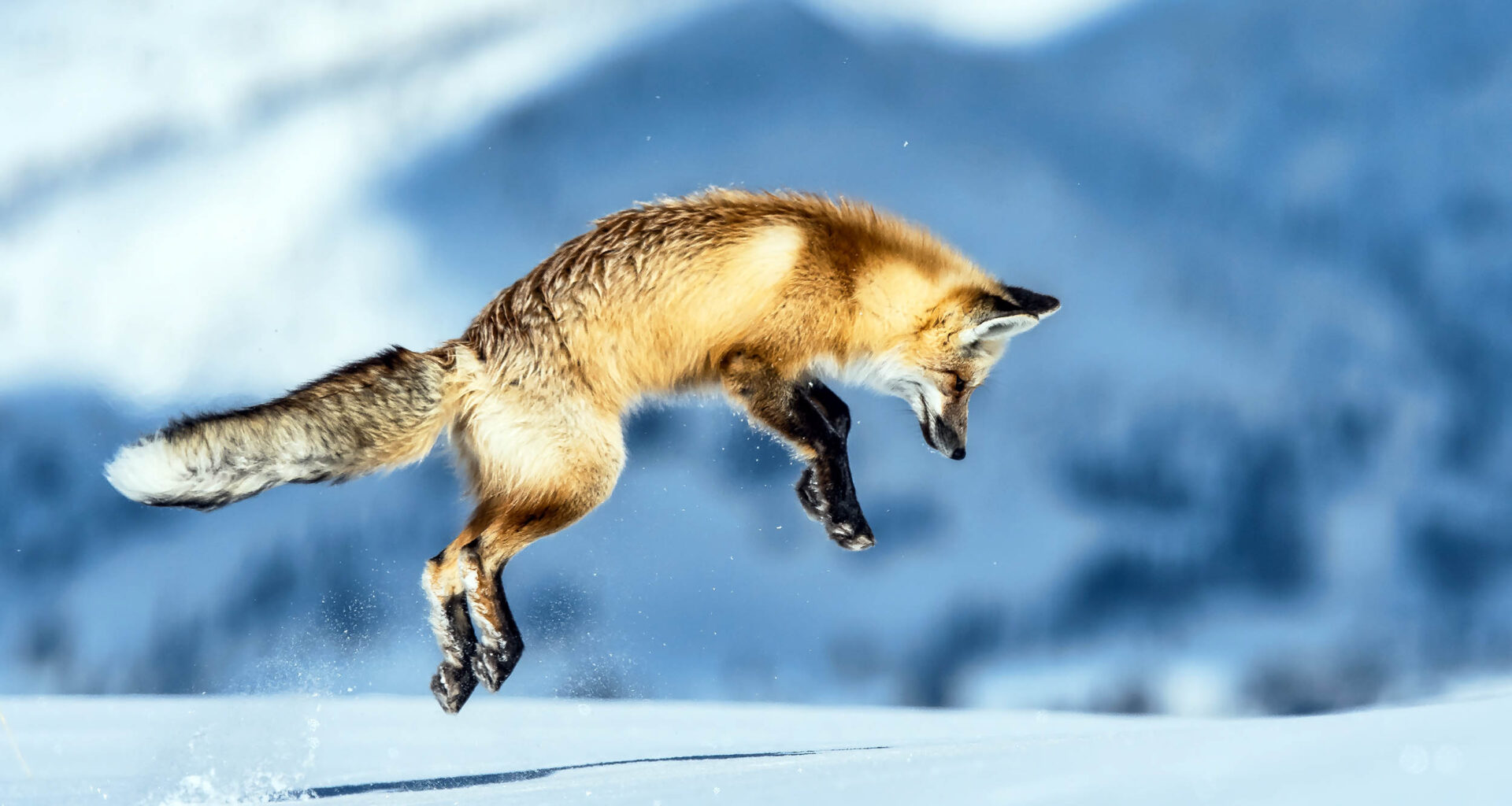
Researchers have found that mid-sized carnivores in northern Yellowstone National Park, like coyotes, track the movement and whereabouts of wolves while completely avoiding cougars at all costs. Conversely, other medium predators, like red foxes, will often do the reverse.
Those contrasting strategies demonstrate that life among the park’s smaller predators is a series of species-by-species calculations about food, risk exposure, and their ultimate survival.
Predator behavior in Yellowstone

Across three Yellowstone winters, cameras and carcass records kept pointing to the same split in how smaller carnivores responded to the park’s top hunters.
Drawing those patterns together, Wesley Binder, a doctoral student at Oregon State University (OSU), documented coyotes shadowing wolves while foxes aligned more closely with cougars.
The distinction held close in time, with coyotes appearing soon after wolf detections and foxes doing the same after cougar visits.
Those repeated pairings established that danger alone does not organize this food web, which left the article to explain what each predator relationship was actually offering or threatening.
Hunger shapes winter movement
Winter on Yellowstone’s northern range leaves fewer easy meals, especially for mesocarnivores, mid-sized predators living below the top hunters.
A global review found that scavenged carcasses make up about 30% of these animals’ diets, so risk can pay.
Coyotes need more food than foxes, and the study suggests that winter hunger pushes them toward bigger carcasses.
That difference helps explain why both species scavenge, but only one keeps gambling on the heaviest and riskiest meals.
Coyotes follow wolves
Where wolves turned up, coyotes were much more likely to use the same ground, rising from 35% to 75% across sites.
After wolf detection, coyotes were also more than twice as likely to appear within 24 hours.
Their average delay after cougar detections stretched to about 57 hours, the longest gap among the pairings researchers measured.
Wolves clearly offered food with danger attached, but cougars looked less like an opportunity and more like an ambush.
Foxes trail cougars
Red foxes told a different story, showing up more often where cougars moved and doubling after cougar detections.
At sites with cougars, foxes used the area about 96% of the time, compared with 82% elsewhere.
Night activity probably helped, because foxes were most active after dusk, when cougars also tended to be moving.
That overlap still carried risk, yet foxes seemed better able than coyotes to keep taking advantage of it.
Dividing the 24-hour clock
Time of day mattered because the four carnivores were not running on the same schedule.
Wolves were most active near dawn and dusk, coyotes peaked around late morning, and foxes stayed mostly nocturnal.
Cougars moved mainly around dusk, which placed them closer to foxes than to coyotes in daily routines.
Those mismatched clocks reduced some collisions, but they also steered each species toward different leftovers and different threats.
Yellowstone predator encounters
Carcasses were not just food patches; they were also the places where many deadly encounters happened.
Researchers tracked 327 wolf kills and 257 cougar kills, then recorded which smaller carnivores arrived to eat.
Coyotes appeared at 68% of wolf kills and 31% of cougar kills, far more often than foxes.
That pattern brought a price, because 61% of coyote deaths caused by wolves happened at wolf feeding sites.
Predators kill differently
Wolves and cougars killed smaller carnivores in very different ways, and that difference helps explain the study’s split behavior.
Wolves usually killed coyotes near contested carcasses and often left the bodies uneaten, which points to defense of food.
Cougars, by contrast, killed coyotes away from elk or deer kills and consumed them, meaning the smaller predators were prey.
Earlier work by Binder’s team on wolves and cougars also found that rough cover helps the cats reduce encounters.
Pressure moves downhill
The study suggests one predator’s pressure can pass into the next rank down, rather than stopping with a single clash.
Because wolves were restored to Yellowstone in 1995 and 1996, coyotes have been living with renewed competition for decades.
Coyotes then appear to push foxes into a different daily rhythm, one that lines up better with cougars.
“In North America and worldwide, carnivore communities are undergoing major changes,” said = Binder.
Managing Yellowstone predators
Wildlife agencies now face more places where wolves and cougars overlap again, so Yellowstone offers an unusually clear warning and guide.
A recent study from the same Yellowstone program showed that cougars adjust what they hunt and where they move to avoid wolves.
Add the new fox and coyote results, and recovery planning starts looking less like counting predators and more like mapping relationships.
“Our research provides insight into how two apex predators compete, which informs recovery efforts,” Binder said.
Yellowstone’s smaller predators were not simply dodging danger; they were reading which top hunter left food, which one defended it, and when.
Spring and summer may rewrite some of those choices as rodents, insects, young deer and elk, and bears change the menu.
The study is published in Ecology.
—–
Like what you read? Subscribe to our newsletter for engaging articles, exclusive content, and the latest updates.
Check us out on EarthSnap, a free app brought to you by Eric Ralls and Earth.com.
—–