
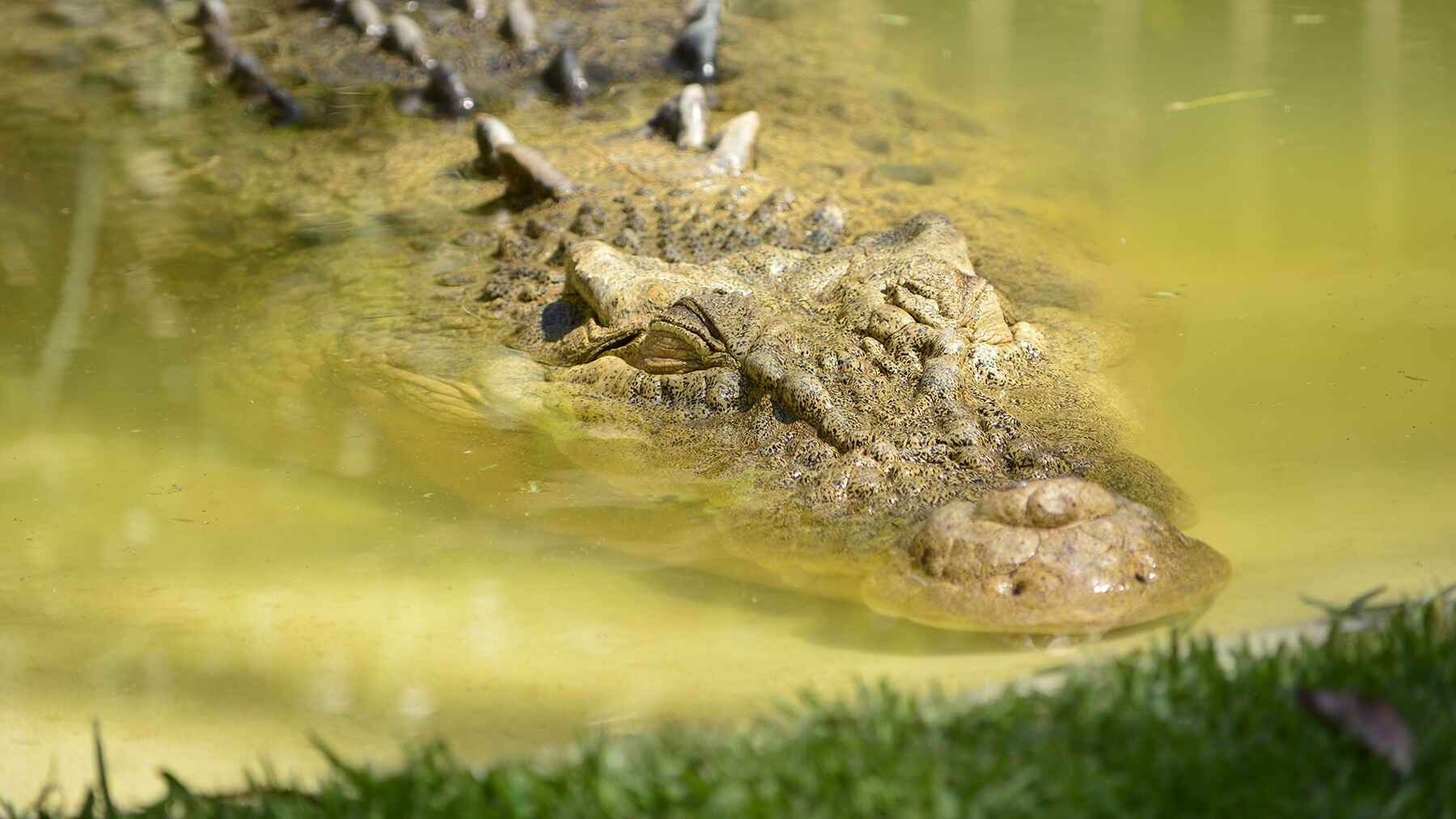
Crocodiles are ancient creatures that have outlived most species.
We know that crocs have evolved from an ancient cousin that led to several animal species over the last few million years. But a recent discovery made in Brazil rewrites the history of how these “living fossils” evolved over time, with a few surprising facts to boot.
What has this discovery meant for science and the world as a whole?
How animal life has evolved over millions of years is truly astonishing
The remarkable animal life that populates the planet has evolved over a long-drawn-out process over millions of years.
We know that what we consider to be whales evolved from four-legged land mammals that were roughly the size of a wolf. Their nostrils slowly moved to the top of their heads to create the blowholes that have become emblematic of whales today.
Convergent evolution has also been found to have taken place across time in several species.
We know that humans and octopuses developed eyes through convergent evolution, and now these “camera-style” eyes can be found in several species, from insects to us humans.
Living fossils have broken the rule book of evolution
Science has taught us that several species have remained relatively the same for millions of years.
But as these ancient species are subjected to dramatic changes in their habitats, they are forced into regions of the world where we struggle to even get a glimpse of them. Such as a team of researchers finding an ancient cephalopod that hid from the world for decades.
Recent rediscoveries of “living fossils” have emerged from all over the world, proving that life expanded into every nook and cranny of the planet.
Animals have an innate ability to reshape their natural habitats to allow the planet time to heal itself, mostly from human-led devastation. Recent behavior of elephants in the oldest national park in Africa has seen them repopulating the region.
As several species make a comeback worthy of a Rocky movie, others are finding it more challenging.
It must be noted that remarkable conservation efforts have been made to address the challenge of saving certain species from extinction. However, a recent discovery of a “warrior crocodile” in Brazil has shifted the scientific community’s attention.
The study, “A fierce crocodile ancestor that hunted before dinosaurs has been found,” published by Taylor & Francis Group in ScienceDaily, has provided details.
A long-lost “warrior crocodile” has been found in Brazil
Crocodiles evolved from two distinct ancient species, namely the Pseudosuchia and Avemetatarsalia lineages.
While we view these ancient creatures as living fossils, they are actually variations of either one of these two species. The “split” took place roughly 200 million years ago during the Triassic period, when dinosaurs were the dominant species in the world.
However, a newly identified predatory pseudosuchian species of crocs has been found in the Amazon in Brazil.
Saving crocodiles is important to maintaining a perpetual balance with Mother Nature, but the discovery of these ancient crocs has proven that they lived long before the dinosaurs that roamed the Earth, roughly 240 million years ago.
The discovery of these ancient “warrior crocodiles” has reshuffled our understanding of life on Earth
The “warrior crocodile” name comes from the Latin word for this ancient species, bellator, which is Latin for “warrior” or “fighter”. The findings made in Brazil prove without a doubt that these croc warriors lived at the top of the food chain long before the age of true dinosaurs began.
While some scientists have focused on the similarities between humans and other species, the discovery in Brazil notes that crocodiles dominated the world for an exceedingly long time, longer than we ever knew.