
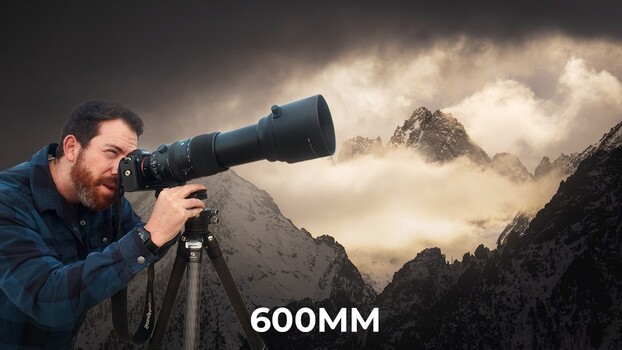
Telephoto lenses have fundamentally changed what’s possible in landscape photography, letting you isolate distant peaks, compress atmospheric mist, and capture moments that a standard wide angle setup would miss entirely. The Eastern Sierra Nevada is one of the most dramatic proving grounds for that kind of shooting, and getting it right means being fast, adaptable, and a little stubborn.
Coming to you from Michael Shainblum, this immersive vlog follows Shainblum through an evening and morning session in the Eastern Sierra Nevadas, where he’s putting his new Sigma 150-600mm lens through its paces on mountain scenes that most lenses simply can’t reach. He shoots at f/6.3 and f/5.6 with a moderately elevated ISO 500 to stay nimble, avoiding the trap of locking into a long-exposure setup when mist and light are shifting by the second. One of the most striking early shots in the video shows a V-shaped rocky ridge mirroring the peak above it, a composition that existed for only a few seconds before the light shifted and the moment was gone. That kind of shot doesn’t come from careful deliberation. It comes from already being in position.
Shainblum is direct about the core challenge here: fleeting moments don’t wait. He shares a story from a workshop in Ireland where a rainbow appeared over the landscape after a rainstorm — the kind of scene where, ideally, you’d have ND filters on, a long exposure running, and maybe some focus stacking happening. None of that was possible. The rainbow was there and then it wasn’t. He bumped his ISO, shot as many frames as he could, and that was the right call. The same logic applies to birds flying through a wave, mist lifting off one edge of a mountain, or light beams breaking through clouds at the last moment before sunset. The question he keeps returning to is whether you can redirect your attention fast enough when something unexpected happens, and whether your camera is already in a state that lets you shoot it.
The Mount Whitney sequence later in the video is where patience enters the picture. After the mountain gets socked in and the dramatic sunset light fades, it would have been easy to pack up and leave. Shainblum doesn’t. He waits. And in near-darkness, Whitney breaks through the clouds just long enough for him to get a long-exposure shot with real mood and atmosphere. Then, after he’s already mentally checked out, a vivid red glow appears behind the peaks, followed by the moon rising through surreal cloud textures, a shot he captures with a high ISO to keep the clouds and moon sharp, then blends with darker exposures for the moon detail in Lightroom. The morning session adds another layer entirely, with a time-lapse of a cottonwood tree set up on his Sony a1 in aperture priority mode while he shoots stills on his Sony a7S III with a Sony 100-400mm lens, including a vertical panorama sequence as warm light starts hitting the tree. There’s also a moonset sequence planned with PhotoPills that still required real-time adjustments, blending two bracketed exposures to handle the extreme dynamic range between the sky and the shadowed mountain face. Check out the video above for the full breakdown, including the moonset capture and Shainblum’s complete post-processing approach in Lightroom.