
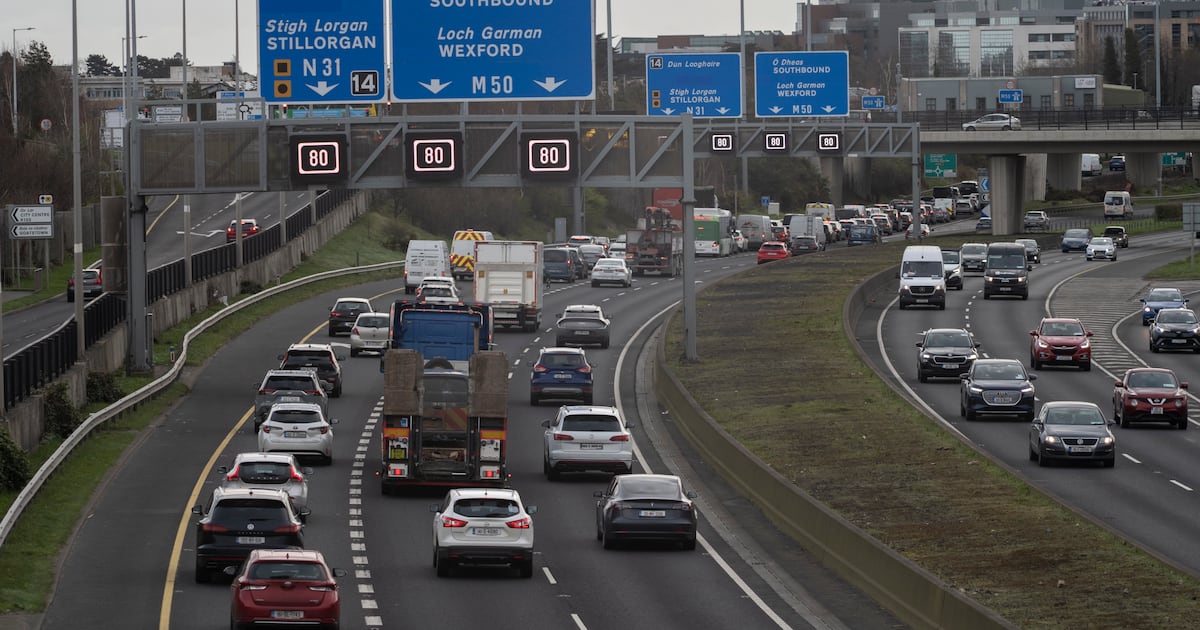
Main PointsA national fuel protest is taking place today over spiralling diesel, petrol and home heating oil prices caused by the ongoing war in the Middle East Convoys have set off from sites across the country before merging into a single convoy as they approach DublinMotorists have been warned the protest may bring commuting routes into Dublin and other major roads around the country to a standstillThe Irish Road Haulage Association (IRHA) said it is “not involved”, with activists seeking to highlight the tax burden on fuel in a context of spiralling costs
The government will do “as much as it can for as long as it can” to respond to rising fuel prices, the Minister for Higher Education James Lawless has said. Vivienne Clarke writes.
“We’ve cut the price of diesel and petrol at the pumps,” he said. “We’ve extended the winter heating scheme into another four weeks. So we’re doing as much as we can for as long as we can, but one of the things about this war, this situation, is it’s moving so rapidly and it is quite a volatile situation. So the war could ramp up or the war could ramp down.
“As Government we have to do something that’s sustainable, that’s costed, that’s repeatable, and the taxpayer ultimately can stand over. So we’re taking it one step at a time. We are engaging with industry, trying to manage people’s expenses, because we know it’s hard, and pump heating in particular is a strain.
“We’ll revisit again at the end of the four weeks. But look, I think at the moment it’s one week at a time, and that’s very much the way the war has been playing out as well. It could be all over, or it could be into another escalation.
The government was looking at short term measures and long term measures, he said. “I think with the long term, we need to look at our energy mix, we just need to really drive it home. The longer that we’re importing fossil fuels from outside the EU, the longer we will continue to be dependent on oil stocks or gas stocks or these kind of surprises in the markets and these kinds of exposures.
“We need to become more sustainable in terms of energy independence, renewables, other fuels, other sources beyond fossil fuels, and have a wider energy mix.”
Research was ongoing for “the optimal energy mix” including hydrogen, nuclear, hydro, he said.
‘It’s scary, the immense pressure we’re under’
Sonny Boyd, who runs a tow truck business in Co Kildare, and is part of the convoy on the M4, said he could see more than 100 lorries and tractors in his rear view mirror, with more ahead of him and a gathering waiting at Maynooth to join in. Caroline O’Doherty reports.
He said the protest was necessary because businesses reliant on fuel were on their knees.
“We don’t want to do this but we need to highlight what’s happening. It’s scary, the immense pressure we are under,” he said.
“I looked in my bank account this morning and there’s €109 in it.
“I spoke to one lad this morning who only set up in business a few years ago and is owed €25,000 in invoices that he can’t get paid.
“I know of school bus operators who have told parents they’ll need to pay €50 a week extra or they can’t run the service.
“I know of services that have told parents already they’re going to stop.”
Boyd said the Government should cap fuel prices at €1.70 and scrap the carbon tax.
He said there was surprise and disappointment that the Government did not reach out with an offer to prevent the protests and there was a mood among many to repeat the action weekly until they did.
Convoys have moved off from around the Midlands and East of the country, Sarah Slater reports.
At Junction 8 Cashel north and south, long lines of trucks, minibuses and cars groups gathered from before 8am to make their way to Dublin’s M50.
The Portlaoise fuel protest involving trucks, tractors and vans continues to travel from J17 in a slow-moving convoy back to the same junction.
On the N81 a protest convoy is currently traveling though Brittas.
In Athlone protesters are involved in a slow drive from Moate to the town with hauliers, farmers, bus companies, taxis and the general public.
As of yet there are no delays on the M4 which is the primary route from Sligo to Dublin connecting from the M50 at Junction 5 north-westwards.
Drop in footfall, drop in goodwill
The chief executive of the business organisation Dublin Town has warned that today’s fuel price protests will cost goodwill, Vivienne Clarke reports.
Richard Guiney told Newstalk’s Claire Byrne show that while he had sympathy for everybody in the current circumstances, businesses were also facing large energy price increases.
The experience from previous similar protests was that the city continued to function, but that the protestors lost the goodwill of people who could have been their allies.
“I’m not sure that they’re going to get what they want out of this kind of protest. And, you know, in terms of the general public, a lot of people will just work from home during the protests.”
Guiney anticipated there would be a decrease in footfall in the city centre today “probably in the region of about ten per cent. That’s what the experience was before.
“But, you know, those businesses, particularly in the retail side of the house, are already, with all the other options that are out there, online shopping, etc, are feeling a fair amount of stress.
“Obviously, we all need a strong economy, that’s what we need to work together towards.”
Message from the Editor

Thanks for reading. If you’re interested in Irish politics, becoming an Irish Times subscriber can give you access to all of our coverage, including exclusive news stories, in-depth analysis and thought-provoking commentary. Receive our politics newsletter in your inbox every morning, early tickets to Inside Politics podcast live events and full access to the best writing about the people and policies that shape modern Ireland.
At The Irish Times, our journalism is free of any personal, political or commercial control. Unlike most publishers, we have no shareholders to satisfy, no media baron owner in the background telling us what we can and cannot publish.
We are owned by a Trust that mandates us to uphold a set of public-interest values. Those values describe a worldview that is outward-looking, tolerant, curious, interested in divergent views and attentive to the needs of minorities. Our watchwords are fairness and accuracy. Our goal is to enable you to make informed and independent judgments. And any profit we make goes towards supporting our journalism.
Ruadhán Mac Cormaic
Editor
[ To join Ireland’s biggest community of news subscribers, sign up hereOpens in new window ]
Worst fuel crisis
Further to the global context point: The current oil and gas crisis triggered by the blockade of the Strait of Hormuz is “more serious than the ones in 1973, 1979 and 2002 together”, Fatih Birol, the head of the International Energy Agency (IEA), told Le Figaro newspaper.
More on that, and the war in Iran in general, in our other live story.
Convoys move off
Per Caroline O’Doherty: Transport Infrastructure Ireland, the national motorways agency, is reporting “slow-moving convoys” on the M8 near Urlingford, Co Kilkenny; on the M3 at the approach to Navan, Co Meath; and on several locations on the M7 including Limerick city and the approach to Junction 13 at Kildare Village.
Vehicles gather
Images and video shared on social media show vehicles gathering at various locations around the country in preparation for this morning’s protests, Climate and Science Correspondent Caroline O’Doherty reports.
Tractors and trucks are shown gathering outside Portlaoise, Co Westmeath; Monasterevin, Co Kildare; and Rathcoole and Lusk, Co Dublin, with the intention of travelling in convoy on the M7 and M1.
Other images show a convoy on the M6 from Galway and a gathering at Castlebar, Co Mayo. The size of the gatherings is not currently verifiable.
‘How do I remain in business today?’
More from affected sectors on this morning’s radio shows. Vivienne Clarke reports: Ger Hyland, the president of the Irish Road Haulage Association has said he does not know who is organising today’s fuel price protests. Speaking on Newstalk Breakfast with Anton Savage, Hyland declined to say whether he supported the protests.
“We empathise with them, we can see where they’re coming from,” he said. “Our position on this is that we are still at the table with Government. We had a meeting with Government last Friday, we’re meeting with them again this week.”
As an association the IRHA was not involved with the protest, he said, but it was up to every member to make their own decision. “We have members who are probably involved in this today.
“They’re involved in it because they can’t afford to fuel their trucks. It’s up to every individual haulier himself to do as he sees fit for his company”
Later on the same programme, Kevin McPartland, chief executive of Fuels for Ireland, said the crux of the issue was excise duty. The exchequer was “not as far behind as they’re letting on. They’ve let everybody off 20 cents a litre, but actually they’re collecting 16 of that back in VAT. So I have a lot of sympathy with the protesters today.
“We need an expert group to have a comprehensive review of all of the taxation and compliance costs of fuel.
“If I was a haulier, if I was an agricultural contractor, I would be saying: ‘yeah, but how do I remain in business today?’ I do think we need targeted responses for those particular sectors.”
‘Not involved’
A number of representative groups have said they themselves are not involved in organising the protests.
The president of the Irish Creamery Milk Suppliers Association, Denis Drennan, said the association would not be participating in any kind of official basis, but he had “no doubt” individual farmer members would be taking part or supporting the protest.
“This is not a matter of choice for farmers and between the surge in fuel, energy and fertiliser, we are fast coming up on the point where just getting up in the morning to work and produce food will be prohibitively expensive and farmers will just have to stop,” he said.
The Irish Road Haulage Association said it was “not involved” in the protests, but added: “We understand that each member needs to do what they feel is right for their business.”
The Coach Tourism and Transport Council said the sector was facing serious cost pressures but that its focus was on engagement with Government. It asked protesters to keep bus lanes clear.
Fuel issues around the world
World news is full of stories about fuel prices this morning as the Iran war continues, with oil and gas infrastructure in the Gulf under threat and shipments through the strategically vital Strait of Hormuz halted.
About 18 per cent of French petrol stations were lacking some kind of fuel on Tuesday morning, junior energy minister Maud Bregeon said, after one brand set prices lower than elsewhere, leading to supply issues.
Two tankers full of Qatari liquefied natural gas tried to exit the Gulf on Monday only to U-turn within hours after being denied clearance by Iranian officials, Bloomberg reported.
There were also reports of Taiwan switching back to coal, Pakistanis seeking electric motorbikes, high inflation in the Philippines, and an Indian plan to buy more Venezuelan crude.
Ireland is not alone in dealing with rising prices.
Some reports of congestion already on approaches to Dublin, although that is not a rarity on an ordinary day. Should large convoys develop, we wouldn’t expect to see their main impact for a little while yet.
Garda updates
Gardaí said on Monday evening they were aware of the planned protests and said they could produce significant additional traffic in places from 8am. Here’s the full statement:
“An Garda Síochána is aware of proposals for vehicle gatherings, and associated public activity, at various locations around the country from early tomorrow morning Tuesday, 7th April 2026.
“An Garda Síochána understands it is proposed that convoys of vehicles (including HGVs, agricultural and plant vehicles) will gather at various locations across the country. It is understood that the proposed convoys, potentially slow moving, will travel primarily along national primary routes.
“It is proposed that some of these convoys will remain in regional locations, and some will travel to Dublin to congregate in the Dublin region.
“If the convoys materialise and congregate, it is expected that there will be significant additional traffic, including slow-moving vehicles, on the main arteries leading to Dublin and in the vicinity of large urban areas across the country from 0800hrs.
“An Garda Síochána has had limited interaction with some persons involved in publishing information about these convoys. As the majority of the organisation of these convoys is taking place on social media platforms and messaging apps, An Garda Síochána is not in a position to provide accurate or detailed advice to the general public at this time.
“Members of the public travelling on National Primary Routes … 7th April 2026 are advised to plan their journeys by ensuring they leave additional time for possible traffic disruptions and to expect traffic delays, if congestion is caused as a result of these convoys.
“An Garda Síochána will provide updates, where possible by the Garda Press Office, if appropriate and required, via:
• Press releases
• Garda social media channels
“An Garda Síochána respects the right of citizens to exercise their constitutional rights, subject to statutory provisions.
“While An Garda Síochána facilitates peaceful protest, An Garda Síochána must also balance and protect the rights of individuals to travel freely and commercial organisations to conduct business.
“Any Garda activity in relation to evolving events involves a graduated policing response taking into account relevant legislation and public safety.”
Day of disruption
A day of disruption is expected in the capital and other places across the country as a national fuel protest unfolds.
Protesters were expected to assemble from 7am at various motorway services across the country before taking off towards Dublin. Many major commuter routes to the capital are expected to be affected, including the M50, the M1 and other roads.
Rolling protests will also begin outside Cork, Limerick and Galway.