
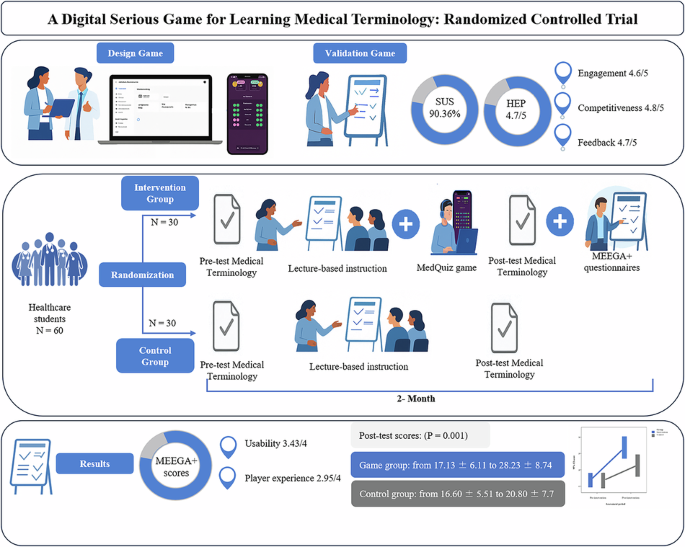
Smith, S., Fisher, J. & Goff, I. MediLex: the medical jargon-busting game. Clin. Teach. 14, 273–278 (2017).
Del Moral, B. L. M., VanPutte, C. L. & McCracken, B. A. The use of role-play in the learning of medical terminology for online and face-to-face courses. Adv. Physiol. Educ. 48, 578–587 (2024).
Seidlein, A. H., Bettin, H., Franikowski, P. & Salloch, S. Gamified e-learning in medical terminology: the TERMInator tool. BMC Med. Educ. 20, 284 (2020).
Bergman, E. M., Prince, K. J., Drukker, J., van der Vleuten, C. P. & Scherpbier, A. J. How much anatomy is enough?. Anat. Sci. Educ. 1, 184–188 (2008).
Madan, C. R. Using evidence-based learning strategies to improve medical education. Med. Sci. Educ. 33, 773–776 (2023).
Lysanets, Y. V. & Bieliaieva, O. M. The use of Latin terminology in medical case reports: quantitative, structural, and thematic analysis. J. Med. Case Rep. 12, 45 (2018).
Mueller, A. Research-based design of a medical vocabulary videogame. Int. J. Pedagog. Learn. 7, 122–134 (2012).
Ishak, S. A., Din, R. & Hasran, U. A. Defining digital game-based learning for science, technology, engineering, and mathematics: a new perspective on design and developmental research. J. Med. Internet Res. 23, e20537 (2021).
Huang, Z. et al. An evidence-based serious game app for public education on antibiotic use and antimicrobial resistance: protocol of a randomized controlled trial. JMIR Res. Protoc. 12, e45833 (2023).
Phungoen, P. et al. Precourse preparation using a serious smartphone game on advanced life support knowledge and skills: randomized controlled trial. J. Med. Internet Res. 22, e16987 (2020).
Capatina, A., Juarez-Varon, D., Micu, A. & Micu, A. E. Leveling up in corporate training: unveiling the power of gamification to enhance knowledge retention, knowledge sharing, and job performance. J. Innov. Knowl. 9, 100530 (2024).
Ghoulam, K. & Bouikhalene, B. Evaluating the impact of gamification on cognitive skills development in higher education: a case study electronics and sensors learners. J. Inf. Technol. Educ. Res. 4, 13 (2024).
Arias-Calderón, M., Castro, J. & Gayol, S. Serious games as a method for enhancing learning engagement: student perception on online higher education during COVID-19. Front. Psychol. 13, 889975 (2022).
Diehl, L. A. et al. InsuOnline, a serious game to teach insulin therapy to primary care physicians: design of the game and a randomized controlled trial for educational validation. JMIR Res. Protoc. 2, e5 (2013).
Felszeghy, S. et al. Using online game-based platforms to improve student performance and engagement in histology teaching. BMC Med. Educ. 19, 273 (2019).
Sarbaz, M., Banaye Yazdipour, A., Mousavi Baigi, S. F., Darroudi, A. & Kimiafar, K. Use of digital games for educational purposes among medical and paramedical sciences students, Mashhad, Iran. Stud. Health Technol. Inform. 302, 443–447 (2023).
Hu, L. et al. NEOGAMES: a serious computer game that improves long-term knowledge retention of neonatal resuscitation in undergraduate medical students. Front. Pediatr. 9, 645776 (2021).
Kanade, S. G., Hasanzadeh, S., Pitts, B., Esmaeili, B. & Duffy, V. G. Evaluating the effectiveness of game-based learning for long-term knowledge retention. Proc. Hum. Factors Ergon. Soc. Annu. Meet. 68, 805–810 (2024).
Lee, M., Shin, S., Lee, M. & Hong, E. Educational outcomes of digital serious games in nursing education: a systematic review and meta-analysis of randomized controlled trials. BMC Med. Educ. 24, 1458 (2024).
Gorbanev, I. et al. A systematic review of serious games in medical education: quality of evidence and pedagogical strategy. Med. Educ. Online 23, 1438718 (2018).
Xu, M. et al. Game-based learning in medical education. Front. Public Health 11, 1113682 (2023).
Baigi, S. F. M., Aval, R. N., Sarbaz, M. & Kimiafar, K. Evaluation tools for digital educational games: a systematic review. Acta Med. Iran. 60, 508–512 (2022).
Tan, J. W., Chong, D. K. S., Ng, K. B., Car, L. T. & Mogali, S. R. Rehearsal-based digital serious boardgame versus a game-free e-learning tool for anatomical education: Quasi-randomized controlled trial. Anat. Sci. Educ. 16, 830–842 (2023).
Mousavi Baigi, S. F., Sarbaz, M., Marouzi, P. & Kimiafar, K. Evaluating the impact of digital game on learning medical terminology of paramedical students: Protocol for a randomized controlled trial. Stud. Health Technol. Inform. 295, 51–54 (2022).
Amir, L. R. et al. Serious game as oral histology learning strategy for undergraduate dental students: crossover randomized controlled trial. BMC Oral. Health 23, 585 (2023).
Csikszentmihalyi, M. Flow: The Psychology of Optimal Experience. (Harper & Row, 1990).
Hamari, J. et al. Challenging games help students learn: an empirical study on engagement, flow and immersion in game-based learning. Comput. Hum. Behav. 54, 170–179 (2016).
Ryan, R. M. & Deci, E. L. Self-determination theory. In Encyclopedia of Quality of Life and Well-Being Research 6229–6235. (Springer, 2014).
Deci, E. L. & Ryan, R. M. The “what” and “why” of goal pursuits: human needs and the self-determination of behavior. Psychol. Inq. 11, 227–268 (2000).
Zhao, J., Zhou, K. & Ding, Y. Digital games-based learning pedagogy enhances the quality of medical education: a systematic review and meta-analysis. Asia Pac. Educ. Res. 31, 451–462 (2022).
Demir, B. T., Eşme, S., Patat, D. & Bilecenoğlu, B. The effect of mobile applied anatomy learning on students’ academic success, cognitive loads and attitudes. Med. Sci. Educ. 33, 1–10 (2023).
Abou Hashish, E. A., Al Najjar, H., Alharbi, M., Alotaibi, M. & Alqahtany, M. M. Faculty and students’ perspectives towards game-based learning in health sciences higher education. Heliyon 10, e32898 (2024).
Van Gaalen, A. E., Jaarsma, A. D. & Georgiadis, J. R. Medical students’ perceptions of play and learning: a qualitative study with focus groups and thematic analysis. JMIR Serious Games 9, e25637 (2021).
Health and Care Professions Council. Standards of Proficiency for Biomedical Scientists (Health and Care Professions Council, 2023).
Quality Assurance Agency for Higher Education. Subject Benchmark Statement: Biomedical Science and Biomedical Sciences. 5th edn. (QAA, Gloucester, 2023).
Scott, S., Millar, B. C. & McClean, S. Education and training in biomedical science. Br. J. Biomed. Sci. 81, 13598 (2024).
Baigi, S. F., Moradi, F., Vasseifard, F., Abadi, F. M. & Habibi, M. R. The effect of nutrition training on knowledge of students at a university of medical sciences. Top. Clin. Nutr. 37, 236–241 (2022).
Mousavi Baigi, S. F., Sarbaz, M., Darroudi, A. & Kimiafar, K. Medical and paramedical students’ perspectives on artificial intelligence in a low- and middle-income country: a cross-sectional study. Health Sci. Rep. 8, e71046 (2025).
Alrashed, F. A. et al. Incorporating technology adoption in medical education: a qualitative study of medical students’ perspectives. Adv. Med. Educ. Pract. 15, 615–625 (2024).
Jun Xin, L., Ahmad Hathim, A. A., Jing Yi, N., Reiko, A. & Noor Akmal Shareela, I. Digital learning in medical education: comparing experiences of Malaysian and Japanese students. BMC Med. Educ. 21, 418 (2021).
Deeter, A. et al. For the love of the game: exploring student motivation in game-based learning environments. In Proc. IEEE Frontiers in Education Conf. (FIE) 1–5. (IEEE, 2024). https://doi.org/10.1109/FIE61694.2024.10893400.
Mousavi Baigi, S. F., Norouzi Aval, R., Sarbaz, M. & Kimiafar, K. Assessment of the quality of smartphone-based applications and games for teaching medical terminology using the Mobile Application Rating Scale (MARS). Payavard Salama. 18, 390–405 (2024).
Al Habsi, T. et al. Are serious games an effective teaching tool in anatomy education? A systematic review. Appl. Sci. 15, 2474 (2025).
Julious, S. A. Sample sizes for clinical trials with normal data. Stat. Med. 23, 1921–1986 (2004).
Gauthier, A., Corrin, M. & Jenkinson, J. Exploring the influence of game design on learning and voluntary use in an online vascular anatomy study aid. Comput. Educ. 87, 24–34 (2015).
Nation I. S. Learning Vocabulary in Another Language (Cambridge University Press, Cambridge, 2001).
Schmitt, N. Instructed second language vocabulary learning. Lang. Teach. Res. 12, 329–363 (2008).
Asher, J. Language by command: the Total Physical Response approach to learning language. Way Learn 6, 35 (1984).
Chapelle, C. A. Computer Applications in Second Language Acquisition: Foundations for Teaching, Testing and Research (Cambridge University Press, 2003).
Hulstijn, J. H. Psycholinguistic perspectives on language and its acquisition. In International Handbook of English Language Teaching (eds Cummins, J. & Davison, C.) 783–795 (Springer, 2007).
Brooke, J. SUS: a quick and dirty usability scale. In Usability Evaluation in Industry (eds Jordan, P. W., Thomas, B., McClelland, I. L. & Weerdmeester, B.) 189–194 (Taylor & Francis, 1996).
Desurvire, H. & Toth, J. A. Using heuristics to evaluate the playability of games. In Extended Abstracts of the CHI Conference on Human Factors in Computing Systems 1509–1512 (Association for Computing Machinery, 2004).
Petri, G. & von Wangenheim, C. G. MEEGA+: a method for the evaluation of the quality of games for computing education. Proc. SBGames 28, 31 (2019).