
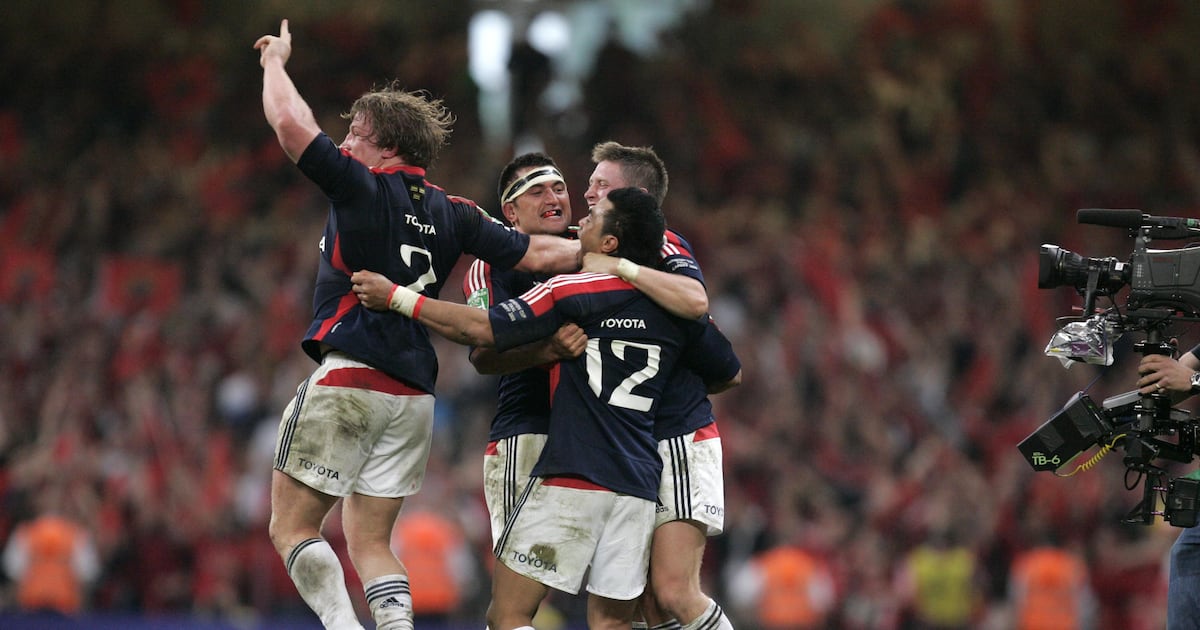
Tadhg Beirne tried to put Munster’s defeat against Exeter into context in the post-match interview at Sandy Park. It was a difficult sell. Beirne has carried that red jersey lightly on his broad shoulders in a way few of his team-mates have managed. Expectation is starting to weigh very heavily for some.
Peter O’Mahony, Beirne’s predecessor as Munster captain, was the last to lift silverware for the province when they won a United Rugby Championship (URC) title in 2023. He energised the team through the strength of his personality, the sheer will to win that was a primary driver of performance. His teammates found it easy to fall into step.
Prior to that, you had to go back to 2011, and another URC title, when Paul O’Connell led Munster to a 19-9 victory over a Leinster side that had used up most of its energy in winning a Heineken Cup. There’s a reason why teams rarely do the double.
Munster can’t escape or outrun their storied history. They are currently clinging to memories. It’s been that way for a little while. When the focus of praise is limited to less than a handful of individuals you know the collective, the team, isn’t performing up to scratch.
Munster’s exit from the European Challenge Cup, combined with the announcement last week of voluntary redundancies, is a sobering moment. Not a crisis in the way of three English Premiership clubs going to the wall, because the IRFU’s ownership model protects against that kind of contagion. But a reckoning, nonetheless.
The more pertinent question is not what happens next, but how Munster got here. It is worth pausing on that ownership model, because it matters. The decision made by Syd Millar, Tommy Kiernan and others when the game went professional – IRFU control, provincial structure, fiscal caution – has turned out to be perhaps the single most important strategic call in Irish rugby’s professional era.
There is no bottomless pit of money, but there are reserves and a structure that can absorb financial shocks. This was hammered home during Covid. When the IRFU cut the men’s sevens programme and began pushing a portion of costs for nationally-contracted players on to the provinces, it was a signal. They were looking hard at sustainability. Munster’s announcement last week fits that same pattern of scrutiny.
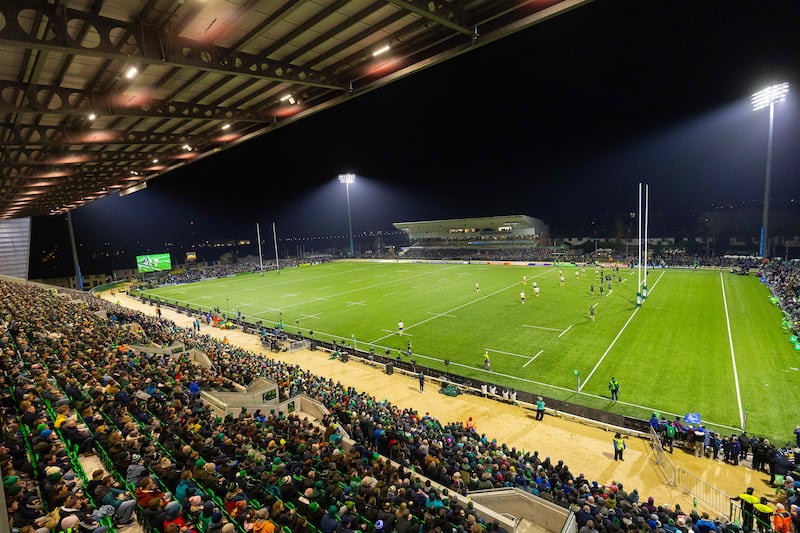 Connacht’s redeveloped Dexcom Stadium stands as a proud illustration of the strides made by the province. Photograph: Tom O’Hanlon/Inpho
I’ll be honest, this has taken me by surprise. From the outside looking in, Munster were clearly not the force they were when winning Heineken Cups, but things looked broadly functional. The question many people are now asking – how has the province reached this predicament on the pitch and on the balance sheet? – might inform the decision about the way forward.
The most striking detail to emerge is the figure of €500,000 in potential lost revenue if Champions Cup rugby is not secured for next season. Reading between the lines, that is not a commercial inconvenience. That is the difference between a province that can stand on its own two feet and one that cannot.
The mood music from the IRFU suggests Munster will not be afforded the same latitude they have previously enjoyed. That is a significant shift. There will be more than one or two pairs of eyes glancing over the fence at what Connacht and Ulster have built. It is worth remembering where the latter two provinces were in the relatively recent past.
Connacht nearly folded in 2003. Since then, they have largely been swimming against the tide, Pat Lam’s URC win was a testimony to smart stewardship and an honest reckoning with available resources. Today, Connacht are in rude health, underpinned by a redeveloped stadium, Stuart Lancaster’s appointment and a clear identity on and off the field.
 Are Leinster champions cup contenders/how have things gone this badly wrong for Munster?
Ulster had their own sliding-doors moment. It arrived after a squad containing Jared Payne and Stephen Ferris came within touching distance of a European crown. Rugby in the province became unmoored and drifted. This was characterised by a lost stadium sponsor and poor form. Eventually, there was a genuine reset.
The appointments of Richie Murphy and Rory Best were pivotal. Expectation was reduced to a sustainable level. That leeway allowed the rugby to breathe. Neither province got there by pretending they were something they were not.
Munster have been operating on the credit of a reputation that hasn’t been serviced since their 2023 URC win. It’s 20 years since they won their first European title and 18 since they claimed their last trophy in that tournament. The nobility of those achievements have lost their sheen.
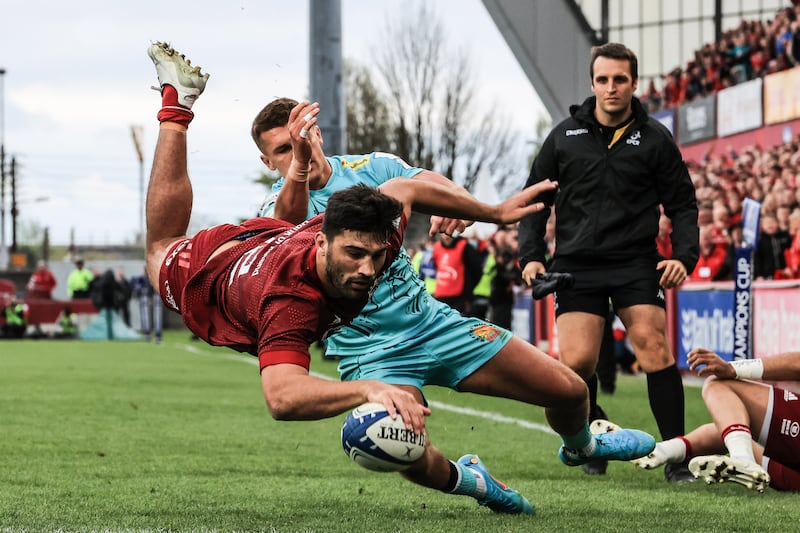 Munster’s Damian de Allende scores a try against Exeter Chiefs in a Champions Cup round of 16 match at Thomond Park in 2022. Photograph: Billy Stickland/Inpho
Conor Murray publicly questioned the recruitment process at the club towards the end of his career. A marquee signing can be hugely valuable, but with the benefit of hindsight, we now know that this type of approach is putting the cart before the horse in terms of essentials.
Munster’s squad depth, development of young talent and general recruitment are now all at odds with the prospect of attracting star quality. The last roll of that dice came when Munster unveiled Damian de Allende and RG Snyman, at a rumoured combined cost of €1.5 million per season.
The question even then was what that level of investment might have done closer to home. Munster won the URC. But three years on, the club is seeking voluntary redundancies. It is a legitimate question to ask whether the sums ever truly added up and whether the short-term ambition came at the cost of a longer-term plan.
There is a way forward. Connacht found one under the threat of extinction. Ulster found one when they stopped chasing a squad they could no longer recruit and started building the one in front of them. Both required a clear-eyed acceptance of what the province was, not what it had been.
That is the ask for Munster now. They must ensure Champions Cup qualification for next season, via their finishing position in the URC. That needs to be the line-in-the-sand moment. There are no quick fixes in sport – the performance and results are almost completely dependent on the players you have at your disposal.
Investment and embracing the clubs, as well as underage pathways, is the only sustainable way forward. Success for the club in the short-term is not taking any more backward steps.
A club steeped in history, trophies and a culture that genuinely moved people, including opponents, will find that harder than most. Humility requires cuts against everything the identity was built on. But the clubs that endure are the ones that can separate pride in what they were, from an honest account of what they are.