
.jpg)
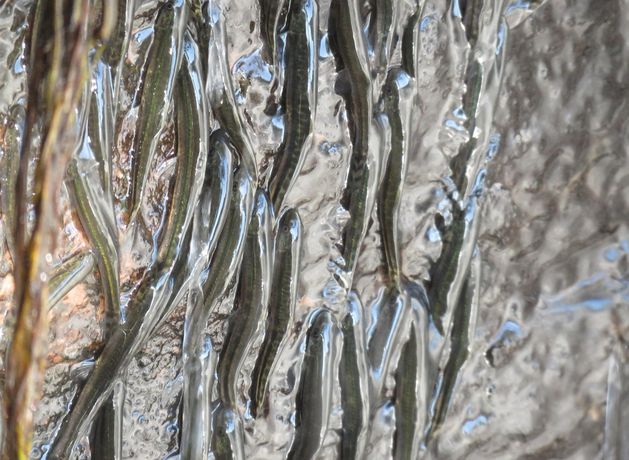
Fish crossing the Luvilombo Falls, a waterfall in the Democratic Republic of Congo. Photo: Reuters
A species of small fish has been observed by the thousands climbing a vertical waterfall 15 metres tall in the Democratic Republic of Congo in a behaviour that illustrates the surprising and ingenious ways animals can adapt to extreme environments.
The researchers documented how this species of shellear fish, whose scientific name is Parakneria thysi, scales the Luvilombo Falls in the upper Congo Basin, a vast river system spanning Central Africa and home to the world’s second-largest rainforest.
Researchers observed the fish ascending the vertical rock face during seasonal floods at the end of the rainy season, typically in April and May.
While this species can reach about 9.8cm long, the researchers observed only small to medium-sized individuals – about 3.7 to 4.8 cm long – journeying up the falls.
Observations suggest a fish may take nearly 10 hours to complete the slow and demanding climb to the top, moving in short bursts and resting frequently.
Larger individuals of the species appeared to be too heavy for their fins to support the climb.
“It prompts scientists to be even more vigilant in their observations, as anything is possible,” said Pacifique Kiwele, a researcher in ichthyology and a member of staff at the Universite de Lubumbashi in the Democratic Republic of Congo who was the lead author of the study published in the journal Scientific Reports.
Some other fish species are capable of scaling waterfalls, but the researchers said this species is the first one documented in Africa.
The researchers recorded the behaviour of this shellear fish on four occasions in 2018 and 2020, observing them moving up the rock face through what is called the splash zone – areas kept wet by spray rather than direct water flow.
The fish cling to wet rock surfaces using their pectoral fins, supported by pelvic fins and aided by tiny hook-like projections known as unculi, which help them grip surfaces, the researchers said.
Then they push themselves upward by wiggling from side to side.
The researchers said the fish may climb upstream to find suitable living conditions and areas with less competition and fewer predators.