
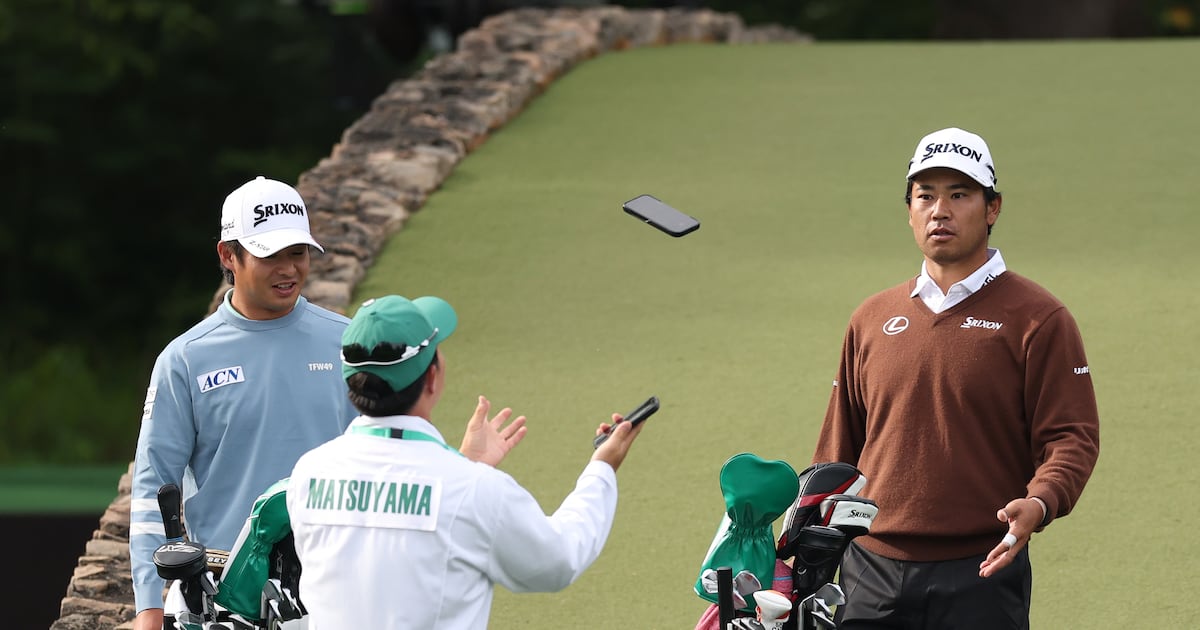
The Masters is the exception to the rule compared to the other Majors in that spectators are not allowed to bring mobile phones on to the property.
Phones are among the prohibited items, along with laptops, bleepers, radios, cameras, flags or banners, ladders and tripods, and even golf shoes with metal spikes.
But it’s the absence of phones being held high by spectators which is most appreciated by the players.
As Ludvig Aberg observed: “It’s very different. It’s very different because a normal tournament seems like there’s a lot of phones up. You want to take videos and pictures and keep up with the scores.
“That’s very different here. It feels like the fans are a little bit more engaged in the golf. They’re a little bit more attuned to what’s going on. It’s a cool environment to play. It feels like good golf shots are being appreciated in a different way. And it’s also quite nice to just leave your phone somewhere.”
Playing ball
The row-back on the golf ball will come sooner or later. Golf’s two governing bodies, the R&A and the USGA have shared data with stakeholders, including Augusta National, on driving distances.
The sight of amateur Jackson Herrington’s drive bombing past the bunkers – at 320 yards – on the first hole in practice rounds provided an adequate demonstration and reminder of the prodigious lengths players at elite level are hitting the ball.
“Regulation of the golf ball is not an attempt to turn back time or stifle progress. It is an effort to preserve the essence of what makes golf the great game that it is,” remarked Fred Ridley, chairman of Augusta National, in his annual address at the Masters.
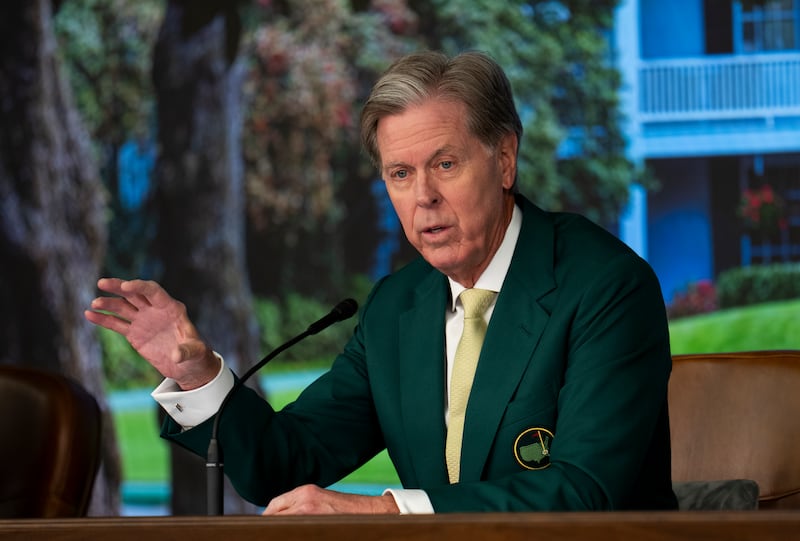 Chairman of the Masters Tournament Fred S Ridley: ‘The greats of the game are defined not merely by how far they hit the ball, but their extraordinary skill in all aspects of the game.’ Photograph: Joe Toth/Augusta National/Getty Images
“Until recent years, golf has been a game of imagination, creativity, and variety. The game has become much more one-dimensional. As players drive the ball prodigious distances and routinely hit short irons into par-4s and even some par-5s, this issue goes beyond competitive impacts. Increased course lengths result in more time, more cost, and more environmental concerns.
“As for professional golf, we hold firm in our belief that the greats of the game are defined not merely by how far they hit the ball, but their extraordinary skill in all aspects of the game. Their ability to shape shots, to take on risk, and to execute under pressure is at the heart of championship golf and is best displayed through a full spectrum of shot-making opportunities.”
Cutline defines the best
The 36-hole cutline has been something of a moveable feast at the Masters, but since 2020, it has been clear-cut with the leading 50 players and ties qualifying for the weekend.
Initially brought in at the 1957 tournament (there was no cut from 1932 to 1956), the original cut through 36 holes was for the low 40 players plus ties and lasted until 1961.
From 1962 until 2012, the cut number was increased to include the low 44 players and those within 10 strokes of the leader. And from 2013 to 2019, it was increased to include the low 50 players plus those within 10 strokes. No fewer than 65 players made the cut in 2019.
By the time the 2020 Masters came around, that 10-stroke rule was gone. So, from 2020, the low 50 players plus ties make the cut into the final two rounds.
If there is a tie after 72 holes, the sudden-death playoff will commence at hole 18 with holes 18 and 10 played alternatively until a champion is decided.
Quote
“I’m the old fat guy out here.” – a self-deprecating Brandon Holz, who earned his exemption as winner of the 2025 US Mid-Amateur Championship.
After playing practice rounds with Tommy Fleetwood and Jordan Spieth, he said: “Talk about two icons of the sport, I just learned some things from them. At points in time, I was just sitting back and watching them play.”
By the Numbers: 7
The world’s top-ranked player entering the week has won the Masters on seven occasions: Ian Woosnam (1991), Fred Couples (1992), Tiger Woods (2001 & 2002), Dustin Johnson (2020) and Scottie Scheffler (2022 & 2024). Scheffler is world number one this week.